Places, by kind letterNeighborhoodsNeighborhood area
Duomo, Signoria & SS. Annunziata
Monuments, palazzi and central browsing · Florence
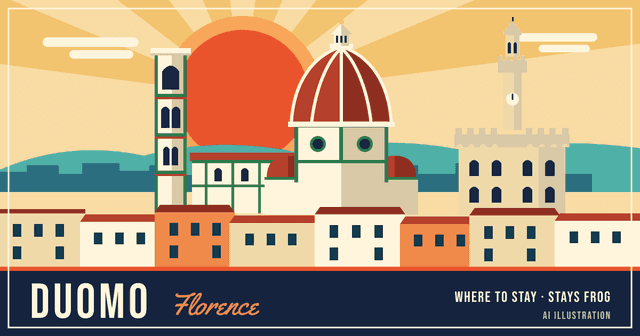
Pick the Duomo area for a first visit or a short stay with Florence's great monuments on the doorstep, if you don't mind paying for it.
The postcard heart of Florence, packed between the cathedral, Piazza della Signoria and Piazza della Santissima Annunziata, with Brunelleschi's dome, the Uffizi and the Ponte Vecchio's goldsmiths steps from the door. It is the city's priciest place to stay.
How it scores
- Food
- 8/10
Gucci Osteria's Michelin-starred table on Piazza della Signoria and the historic cafés Gilli and Paszkowski on Piazza della Repubblica
- Nightlife
- 6/10
Drinks at the historic Gilli, Paszkowski and Giubbe Rosse cafés on Piazza della Repubblica; the squares stay busy into the late evening
- Shopping
- 8/10
Jewellers' and goldsmiths' shops line the Ponte Vecchio, with central browsing on the streets between the cathedral and the river
- Walkability
- 9/10
Compact and largely pedestrianised: cathedral, Signoria, Uffizi and Ponte Vecchio are minutes apart; the ZTL limits driving
- Transit
- 7/10
Santa Maria Novella station is a short walk west; the T2 tram from the airport takes about 20 minutes and runs on to San Marco
- Coolness
- 7/10
Brunelleschi's dome, Giotto's bell tower, Cellini's Perseus in the Loggia dei Lanzi and the original David at the Accademia
- Safety
- 6/10
Busy and well lit into the evening; pickpockets work the cathedral queues, the Ponte Vecchio and crowds on Piazza della Signoria
- Loudness
- 7/10
Crowds fill the main squares from morning to late evening; rooms on the big squares hear them, so ask for a courtyard room
Each category is scored 1-10 by our editors; the Frog Score is their average. Safety is our editors' judgment of how comfortable it is to walk around, not crime statistics. Loudness runs from library quiet (1) to never sleeps (10) and doesn't count toward the Frog Score. How we score
Our take
This is the Florence of the postcards: the compact area between the cathedral, Piazza della Signoria and Piazza della Santissima Annunziata, packed with the monuments most visitors come for. Brunelleschi's dome rises over narrow medieval streets, Piazza della Repubblica opens up on the site of the Roman forum, and the streets towards the river end at the Ponte Vecchio, lined with jewellers' and goldsmiths' shops. It is grand, dense and busy from morning to late evening, and there are few corners where you will not be sharing the view.
It suits first-time visitors, short stays and anyone who wants to step out of the door straight into the sights, and it is the most expensive part of the city to sleep and eat in. Hotels range from larger, pricier addresses near the main squares to small family-run places in the side streets: Hotel Davanzati, a three-star hotel on Via Porta Rossa beside Palazzo Davanzati, has been run by the same family for generations. Rooms on the big squares hear the crowds until late, so ask for one on a courtyard if you sleep lightly, and if you would rather trade monuments on the doorstep for neighbourhood life, the Oltrarno and Sant'Ambrogio are short walks away.
The cathedral complex comes first: the cathedral itself, with the remains of Santa Reparata in its crypt; the octagonal Baptistery, whose bronze Gates of Paradise by Ghiberti are replicas, the originals being in the cathedral museum; the 463 steps to the top of Brunelleschi's dome; and the more than 400 steps to the terrace of Giotto's bell tower. On Piazza della Signoria, the Palazzo Vecchio is still the town hall and largely a museum, a copy of Michelangelo's David stands at its door, the Loggia dei Lanzi is an open-air sculpture gallery with Cellini's Perseus, and the Uffizi Gallery opens off the square. North of the cathedral, Via dei Servi leads to Piazza della Santissima Annunziata, with Brunelleschi's arcaded Ospedale degli Innocenti, now the Museo degli Innocenti, and the National Archaeological Museum, while the original David is close by in the Galleria dell'Accademia. For a drink, the historic cafés on Piazza della Repubblica, Gilli, Paszkowski and the Giubbe Rosse, were meeting places for writers and Futurist artists in the early 20th century; for a special dinner, Gucci Osteria on Piazza della Signoria is the neighbourhood's Michelin-starred table.
Everything here is walkable and much of it is pedestrianised. Most of the historic centre is a camera-controlled limited-traffic zone (ZTL), so do not drive in unless your hotel or garage registers your plate with the police. Santa Maria Novella station, with high-speed trains to Rome and Milan, is a short walk west of the cathedral, and the T2 tram runs from the airport to the station in about 20 minutes before continuing along Via Cavour to Piazza San Marco, just north of the cathedral; the small electric C-line buses cross the centre if your feet need a rest. The area is busy and well lit and feels comfortable by day and late into the evening. The main risk is pickpocketing, which UK government advice flags in city centres, at major tourist attractions and on public transport, so keep bags closed and phones out of back pockets in the queues outside the cathedral, on the Ponte Vecchio and in the crowds on Piazza della Signoria. Climbing into or bathing in public fountains is an offence in Florence.
By Stays Frog AI Desk
A short history
This is the oldest part of Florence: the Roman colony of Florentia, traditionally dated to 59 BC, had its forum where Piazza della Repubblica now opens, and the remains of a Roman theatre and baths lie beneath Piazza della Signoria. Work began on Arnolfo di Cambio's new cathedral in 1296, over the older church of Santa Reparata, and in 1299 Arnolfo began the Palazzo Vecchio beside a square first cleared when the victorious Guelphs pulled down Ghibelline houses in 1268. Giotto started the bell tower in 1334, Brunelleschi raised the dome between 1420 and 1436, and in 1565 Vasari built the corridor that runs from the Palazzo Vecchio over the Ponte Vecchio to the Pitti Palace. After Florence became capital of Italy in 1865, the old market and the Jewish ghetto at the heart of the city were demolished, and the arcaded Piazza della Repubblica rose in their place in the 1880s and 1890s. Together with Brunelleschi's foundling hospital on Piazza della Santissima Annunziata, these streets form the core of the historic centre that UNESCO listed as a World Heritage site in 1982.
Hotels in Duomo, Signoria & SS. Annunziata
Restaurants in Duomo, Signoria & SS. Annunziata
Traveller reviews
What people who've been say. One review each; you can update yours.
References(21)
Primary sources used to check this guide and its listings.
- Visit Florence: Things to do & Attractions - Italia.it · Official tourism authority
- Hotel Davanzati | 3-star Hotel in the center of Florence - Official Website · Venue operator
- Homepage ⏤ Gucci Osteria · Venue operator
- Comune di Firenze municipal rioni dataset (1995 PRG lineage) — SIGNORIA, REBUBBLICA, SS. ANNUNZIATA, S. GIOVANNI · Official municipal GIS / Istat; CC BY 4.0
- Safety and security - Italy travel advice - GOV.UK GOV.UK · UK Foreign, Commonwealth & Development Office
- Florence Cathedral · Wikipedia
- Giotto's Campanile · Wikipedia
- Florence Baptistery · Wikipedia
- Piazza della Signoria · Wikipedia
- Palazzo Vecchio · Wikipedia
- Piazza della Repubblica, Florence · Wikipedia
- Ponte Vecchio · Wikipedia
- Piazza della Santissima Annunziata · Wikipedia
- History of Florence · Wikipedia
- Bus and tram in Florence · Destination Florence (official tourism site, Comune di Firenze)
- Driving in Florence: the ZTL limited-traffic zone · Destination Florence (official tourism site, Comune di Firenze)
- Firenze Santa Maria Novella railway station · Wikipedia
- Trams in Florence · Wikipedia
- Portrait Firenze — venue details · lungarnocollection.com
- Location and address · findit.city
- Caffè dell’Oro — venue details · lungarnocollection.com