NeighborhoodsNeighborhood area
Bahnhofsviertel
Station-area hotels and international dining · Frankfurt
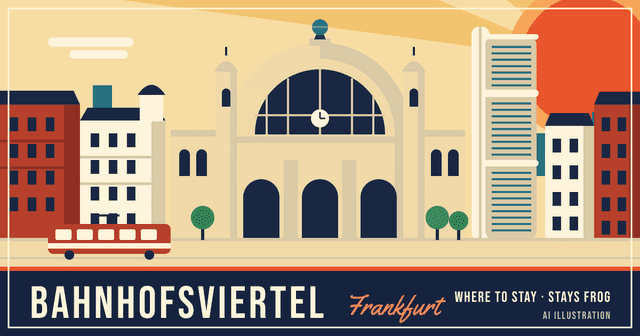
Pick the Bahnhofsviertel for the station on your doorstep, great international food and cocktail bars, if a gritty street scene after dark won't put you off.
A gritty, cosmopolitan grid between the Hauptbahnhof and the banking towers, where Kaiserstraße's Gründerzeit facades front international restaurants, cocktail bars and design hotels alongside the red-light trade and a visible drug scene.
How it scores
- Food
- 8/10
International restaurants, snack bars and grocers on Münchener Straße, plus fresh pita at BAR SHUKA in 25hours The Trip
- Nightlife
- 8/10
Sake cocktails at SHUKA BAR, cocktail bars across the grid and the bar at Roomers just over the line in the Gutleutviertel
- Shopping
- 5/10
Little shopping beyond the international grocers and snack bars along Münchener Straße and its side streets
- Walkability
- 8/10
Compact grid: Kaiserstraße leads to the centre, and the Altstadt, the Main and the Nizza garden are an easy walk
- Transit
- 9/10
Hauptbahnhof for long-distance and regional trains and every S-Bahn line but the S7, including the S8 and S9 to the airport
- Coolness
- 8/10
Kaiserstraße's Gründerzeit facades, Max Taut's 1931 Gewerkschaftshaus, galleries and the travel-themed 25hours The Trip
- Safety
- 7/10
Generally fine by day; with open drug use and red-light streets such as Taunusstraße, keep to Kaiserstraße at night
- Loudness
- 8/10
Busy day and night around the station; Taunusstraße and its side streets are noisiest, the southern part by the river calmer
Each category is scored 1-10 by our editors; the Frog Score is their average. Safety is our editors' judgment of how comfortable it is to walk around, not crime statistics. Loudness runs from library quiet (1) to never sleeps (10) and doesn't count toward the Frog Score. How we score
Our take
The Bahnhofsviertel is the compact grid of streets between the Hauptbahnhof and the high-rises of the banking district, and the most cosmopolitan and contradictory corner of Frankfurt. Its broad east-west boulevards, Kaiserstraße, Münchener Straße, Taunusstraße and Niddastraße, are lined with ornate late-19th-century facades, and half of its residents are foreign nationals, which shows in a dense mix of international restaurants, snack bars and grocers. Artists, galleries, cocktail bars and design hotels have moved in alongside the long-established red-light trade, and the result is energetic, gritty and never boring.
It suits rail travellers, trade-fair visitors and city-savvy travellers who want to be a few minutes' walk from the trains and enjoy a neighbourhood with an edge. 25hours Hotel The Trip on Niddastraße is themed on world travel, with each floor evoking a different landscape, plus BAR SHUKA for fresh pita from a show kitchen and SHUKA BAR for sake cocktails. Scandic Frankfurt Museumsufer and the big InterContinental sit on Wilhelm-Leuschner-Straße in the calmer southern part near the river, and Roomers Frankfurt Central, a dark, glamorous design hotel with an award-winning bar, is just across the line in the Gutleutviertel. If you want quiet nights, choose a room away from Taunusstraße and its side streets.
Look up as you walk: Kaiserstraße, laid out between 1874 and 1888 as a grand boulevard from the city centre to the station, still has some of Frankfurt's finest Gründerzeit facades. The Gewerkschaftshaus on Wilhelm-Leuschner-Straße, designed by Max Taut and finished in 1931, was the city's first large high-rise, and the 166-metre Silberturm at Jürgen-Ponto-Platz was the tallest building in Germany from 1978 until 1990. Eating is the main event here, from the international restaurants, snack bars and grocers of Münchener Straße and the side streets to the hotel restaurants and cocktail bars that make the quarter one of the city's liveliest places for a drink. When you need air, the Nizza on the riverbank at the southern edge is a 19th-century garden planted with Mediterranean vegetation, a pleasant place to sit by the Main.
Getting around could not be easier. The Hauptbahnhof on the western edge has long-distance and regional trains, and its underground station is used by every S-Bahn line except the S7, including the S8 and S9 to the airport's regional station under Terminal 1. Trams run along Münchener Straße, and the Willy-Brandt-Platz U-Bahn and Taunusanlage S-Bahn stations serve the eastern side, with the Altstadt and the Main within easy walking distance. Safety is the honest caveat: the district has an open drug scene that, by police accounts, worsened again from 2015 and during the pandemic, and drug use on the street is not unusual, while the red-light trade is concentrated on Taunusstraße and parts of Elbestraße and Moselstraße. By day the streets are busy and generally fine, and in 2025 the state government announced more police checks and video surveillance for the area. At night, stick to Kaiserstraße and the main lit streets, keep valuables close as you would at any big station, and take a taxi if you arrive late with luggage and are staying on a side street.
By Stays Frog AI Desk
A short history
Until the 19th century this was open land outside the city walls, close to the town gallows, and from 1839 the tracks of the Taunus Railway, later joined by the Main-Weser and Main-Neckar lines, ran across it to three western terminals on the edge of the centre. When the new Hauptbahnhof opened about 500 metres farther west in 1888, the freed rail land was divided into plots from 1889, hosted Oskar von Miller's International Electro-Technical Exhibition in 1891, and by the First World War was built up as a grid of broad boulevards such as Kaiserstraße, Taunusstraße and Münchener Straße lined with ornate Gründerzeit blocks. Less damaged by bombing than the old town, the quarter housed American troops after 1945 and grew into Frankfurt's main nightlife and red-light district, while the fur traders of Niddastraße helped make the city one of the world's centres of the fur trade. Demolitions, neglect and an open drug scene gave it a hard reputation in the 1970s and 1980s, but the listing of its historic buildings set off a long wave of restoration, and today restaurants, galleries, design hotels and offices share the streets with the old milieu.
No places in Bahnhofsviertel scored yet.
Traveller reviews
What people who've been say. One review each; you can update yours.
References(14)
Primary sources used to check this guide and its listings.
- 25hours Hotel Frankfurt The Trip | Best Rates - Book now · 25hours-hotels.com
- Roomers Frankfurt Central, Autograph Collection | Luxushotel · www.roomers-hotels.com
- Stay at Scandic Frankfurt Museumsufer | Hotel in Frankfurt · www.scandichotels.com
- Hunky Dory Bar – The name says it all: Everything is fine! That’s our motto. · hunkydorybar.com
- Bewertung von Nachtleben und Nachtökonomie in Frankfurt — PROJECT M / dwif · www.visitfrankfurt.travel
- Safety and security - Germany travel advice - GOV.UK · UK Foreign, Commonwealth & Development Office
- RMV-Schnellbahnplan und Schnellbahnpl mit Expressbussen 2026 mit Änderungen an der U2, Gültig ab 13. April 2026 · www.rmv.de
- OpenStreetMap administrative boundary — Bahnhofsviertel · OpenStreetMap contributors, ODbL 1.0; parent-supplied cache
- Bahnhofsviertel · Wikipedia
- Frankfurt-Bahnhofsviertel · Wikipedia (de)
- Kaiserstraße (Frankfurt am Main) · Wikipedia (de)
- Silberturm · Wikipedia
- Frankfurt (Main) Hauptbahnhof · Wikipedia
- Travel by train | Frankfurt Airport · Fraport AG (Frankfurt Airport)