Places, by kind letterNeighborhoodsNeighborhood area
Sluizeken–Tolhuis–Ham
Canals, dockland change and northern streets · Ghent
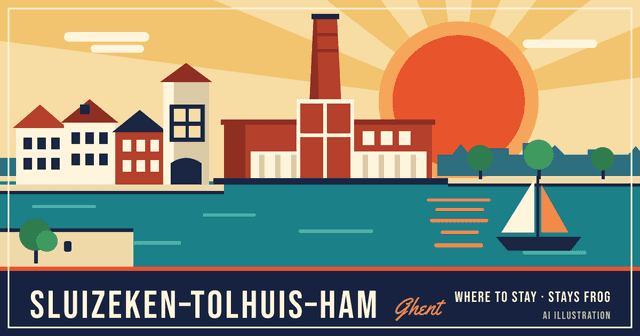
Choose Sluizeken–Tolhuis–Ham for Turkish food streets, a dockside food hall and brewery, and a Lieve-side hotel steps from the old centre.
Sluizeken–Tolhuis–Ham covers northern neighbourhood streets and the Dok Noord edge. The municipal profile describes substantial changes around the docks and transport corridors.
How it scores
- Food
- 8/10
Turkish restaurants on Sleepstraat and Tolhuislaan, RØK and Officina Raffaelli in Hal 16, and ramen at Golden Gai
- Nightlife
- 8/10
About 30 taps at Dok Brewing Company, natural wine at Hey Frankie and cocktails at Golden Gai near Gent-Dampoort
- Shopping
- 7/10
Turkish greengrocers and fabric shops around Tolhuislaan and Sleepstraat, one of Ghent's top five areas for shops
- Walkability
- 8/10
The Lieve quays are under five minutes from the main sights; cross the busy Neuseplein junction and main axes with care
- Transit
- 8/10
Tram T4 through Voormuide and Sluizeken to Gent-Sint-Pieters, and Gent-Dampoort station on the eastern edge
- Coolness
- 8/10
17th- and 18th-century gables on Sluizeken, De Centrale in a 1920s power station and the Hal 16 food hall at Dok Noord
- Safety
- 6/10
Lively and comfortable by day; quays and building sites go quiet at night, so walk the main streets after dark
- Loudness
- 7/10
Heavy traffic on Tolhuislaan and Sleepstraat and restaurant buzz at night; the quays and building sites stay quiet
Each category is scored 1-10 by our editors; the Frog Score is their average. Safety is our editors' judgment of how comfortable it is to walk around, not crime statistics. Loudness runs from library quiet (1) to never sleeps (10) and doesn't count toward the Frog Score. How we score
Our take
Sluizeken–Tolhuis–Ham is the 19th-century belt directly north of the historic centre: dense, diverse, young and changing quickly, and framed by water, with the Tolhuisdok and Blaisantvest to the north, the Handelsdok to the east and the Leie to the south. It has four distinct parts. Tolhuis, around Tolhuislaan and Sleepstraat, is the busy heart, known for Turkish restaurants, greengrocers and fabric shops; Voormuide is an old boatmen's quarter shaped by the water and the tram; Briel is an island around Fratersplein with hospitals and care homes; and the Ham, between Dampoort and the Oude Dokken, is where the old port is becoming a new waterside district. The city ranks it among Ghent's top five neighbourhoods for shops, cafés and restaurants, and cultural houses such as De Centrale and the Kopergietery are based here.
It suits food-focused travellers, repeat visitors and anyone who likes a lived-in, multicultural base within walking distance of the old town. The ward reaches down to the Lieve quays close to the medieval core, and that is the place to stay: Ghent Urbanist Hotel by Harmony on Augustijnenkaai is a family-run hotel with 38 rooms, including family rooms, in a historic building on the Lieve, with its own bar and terrace and the main sights less than five minutes' walk away. The streets further north are mainly residential, so choose the Lieve end for sightseeing and the Dampoort end if you want the station and the docks close by.
Start at Sluizeken, a triangular old square where the Oudburg, Lange Steenstraat and Sleepstraat meet; its east side keeps a row of 17th- and 18th-century gables. Walk up Sleepstraat and Tolhuislaan for Turkish restaurants and greengrocers, then on to the Oude Dokken, where new homes, quays and footbridges are going up around the Handelsdok, Houtdok and Achterdok. Hal 16 at Dok Noord is a food hall in an old port warehouse, with RØK barbecue and burgers, the Tuscan kitchen of Officina Raffaelli and the brewery café of Dok Brewing Company, which brews on site and pours about 30 beers on tap beside a large covered terrace. Near the castle end of the ward, Hey Frankie on Sint-Margrietstraat is a natural-wine bar with a long central bar, and just beyond the ward on Dampoortstraat, near Gent-Dampoort station, Golden Gai serves house-made ramen and cocktails. De Centrale, the intercultural centre in the 1920s power station, is easy to spot by its tall brick chimney.
Public transport is good. Gent-Dampoort station sits on the eastern edge, and tram T4 runs through Voormuide and Sluizeken and on via Rabot to Gent-Sint-Pieters, the main station, where direct trains leave for Brussels and Brussels Airport; De Lijn has changed several tram routes for works since 14 September 2026, so check the current network before you set out. The Lieve end of the ward is an easy walk from the centre, but traffic is heavy on the main axes, Tolhuislaan–Rodelijvekensstraat and Sleepstraat–Sint-Salvatorstraat–Voormuide, and the Neuseplein junction is busy and complicated, so cross with care. By day Tolhuis is lively and comfortable; in the evening the action gathers around the restaurants of Sleepstraat and Tolhuislaan and the bars at Dok Noord, while the quays and building sites between them are quiet, so walk the main streets after dark. Residents themselves name traffic, noise and litter as the area's main nuisances, and as anywhere busy in Belgium, keep a close eye on bags and phones.
By Stays Frog AI Desk
A short history
Sluizeken–Tolhuis–Ham grew on the marshy northern edge of medieval Ghent. The triangular Sluizeken square is named after a long-vanished sluice that let water from the Leie into the moat of the Oudburg, and its shape still recalls the gates that once guarded this corner of the city. The low-lying Meerhem to the north, inside the walls since the 14th century but used mostly as bleaching fields, was transformed after 1902, when its canal was filled in and the city laid out the broad shopping street of Tolhuislaan with side streets of workers' houses, largely built up by 1906. To the east, the Handelsdok and Achterdok were dug in 1829 after King William I decided to extend the canal to Terneuzen, and the Ham became part of the working port, joined in 1926 by the city's coal-fired power station. When port activity moved north at the end of the 20th century, the power station's turbine hall became the intercultural centre De Centrale and the Oude Dokken have been redeveloped since 2004 as a new waterside quarter, while Tolhuis, home to many who came as guest workers, grew into the Turkish-flavoured shopping street it is today.
Hotels in Sluizeken–Tolhuis–Ham
Restaurants in Sluizeken–Tolhuis–Ham
Bars in Sluizeken–Tolhuis–Ham
Traveller reviews
What people who've been say. One review each; you can update yours.
References(14)
Primary sources used to check this guide and its listings.
- Sluizeken-Tolhuis-Ham · hoeveelin.stad.gent
- Stadswijken Gent — official 25-wijk dataset · Dienst Data en Informatie Gent
- Ghent tram network and works from September 2026 · De Lijn
- Belgium: safety and security for visitors · UK Foreign, Commonwealth & Development Office
- Ghent Urbanist Hotel by Harmony · visit.gent.be
- Golden Gai · visit.gent.be
- Hal 16 · visit.gent.be
- Hey Frankie · visit.gent.be
- Sluizeken · Agentschap Onroerend Erfgoed (Inventaris)
- Meerhem · Agentschap Onroerend Erfgoed (Inventaris)
- Handelsdok · Wikipedia (nl)
- Oude Dokken · Wikipedia (nl)
- De Centrale (Gent) · Wikipedia (nl)
- Gent-Sint-Pieters railway station · Wikipedia