NeighborhoodsNeighborhood area
Porta Romana
Food-led streets south of the centre · Milan
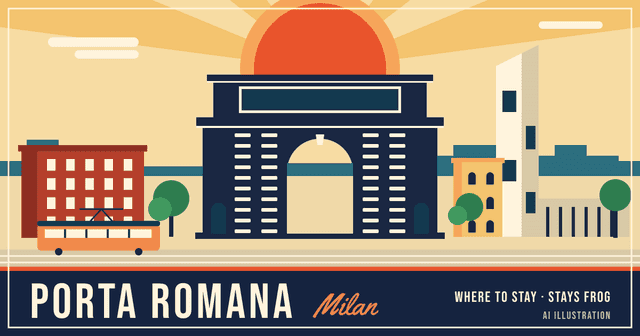
Pick Porta Romana for a calm, residential base with serious trattorias, Fondazione Prada close by and a direct M3 ride to the Duomo and Centrale.
Porta Romana is a grown-up, residential slice of south-east Milan around its lone 1596 stone arch, with Trippa's daily-changing menu on Via Vasari, the Cascina Cuccagna farmers' market and Fondazione Prada a short walk south; quiet, local and made for food lovers.
How it scores
- Food
- 8/10
Trippa on Via Vasari is worth planning a night around, with more restaurants on Via Orti, Via Montenero and Via Crema
- Nightlife
- 5/10
Evenings centre on restaurant streets that stay lively until late, plus the jazz club and events at Cascina Cuccagna
- Shopping
- 5/10
Not a shopping district; the highlight is Cascina Cuccagna's weekly farmers' market by Via Muratori
- Walkability
- 7/10
A pleasant 2 km walk up Corso di Porta Romana to the centre; cross the busy Piazza Medaglie d'Oro junction with care
- Transit
- 7/10
M3 at Porta Romana and Lodi T.I.B.B. runs direct to Duomo and Centrale for the Malpensa Express; M4 crosses the centre to Linate
- Coolness
- 7/10
Fondazione Prada's gold-leaf Haunted House and Wes Anderson's Bar Luce, plus the 1596 arch and Cascina Cuccagna's courtyards
- Safety
- 6/10
Settled and residential day and night; keep to Corso Lodi and Viale Montenero late, not the old rail yard edges, and mind metro bags
- Loudness
- 6/10
Restaurant streets stay lively until late and Piazza Medaglie d'Oro is a busy traffic junction; residential side streets are calmer
Each category is scored 1-10 by our editors; the Frog Score is their average. Safety is our editors' judgment of how comfortable it is to walk around, not crime statistics. Loudness runs from library quiet (1) to never sleeps (10) and doesn't count toward the Frog Score. How we score
Our take
Porta Romana is a grown-up, residential slice of Milan just south-east of the centre, built around the rusticated stone arch of 1596 that gives it its name. The arch stands alone in Piazza Medaglie d'Oro, where Corso di Porta Romana arrives from the Duomo and splits into Corso Lodi and Viale Montenero, and the streets around it are lined with handsome 19th- and early 20th-century apartment buildings, offices and neighbourhood restaurants rather than big sights. With the Policlinico hospital and Bocconi University nearby, the daytime crowd is young and local, and the regional tourism board picks the area out above all for its food.
It suits repeat visitors, food-focused couples and anyone who wants a calm, local base with a direct metro line to the Duomo and Centrale station. Expect smaller hotels and apartment rentals in residential streets rather than grand addresses; staying near the arch or the Porta Romana metro stop keeps the centre a few stops away, while the southern streets towards Corso Lodi are the closest base for Fondazione Prada.
Food is the reason to come. The tourism board points to Via Orti, Via Montenero and Via Crema for eating out, and Trippa on Via Vasari is a trattoria worth planning a night around: its menu changes daily with the season, it serves dinner on weekdays plus Friday lunch and it is closed at weekends, so reserve ahead. Cascina Cuccagna, a restored farmhouse by Via Muratori that now works as a community space, runs a weekly farmers' market, a jazz club and events in its courtyards. A short way south, Fondazione Prada fills an early 20th-century gin distillery remade by Rem Koolhaas's OMA, with a gold-leaf-clad Haunted House, the 60-metre white Torre, whose restaurant looks out over the city, and Bar Luce, a café designed by Wes Anderson to recall old Milan.
Getting around is easy: M3 stops at Porta Romana beside the arch and at Lodi T.I.B.B. further south, and runs through Crocetta, Missori and Duomo to Centrale, where Malpensa Express trains leave for the airport; Linate is at the end of the M4 line, which crosses the centre. The arch is about 2 km from the city centre, a pleasant walk straight up Corso di Porta Romana. By day and in the evening Porta Romana feels like what it is, a settled residential district whose restaurant streets stay lively until late. Piazza Medaglie d'Oro is a busy traffic junction, so cross with care, and late at night stick to main, well-lit streets such as Corso Lodi and Viale Montenero rather than the quiet edges by the old rail yard to the south. As everywhere in Milan, the main risk is petty theft: keep bags closed on crowded metro trains and at stations, and never leave a drink unattended.
By Stays Frog AI Desk
A short history
Porta Romana takes its name from the gate on the old road to Rome: the Roman walls had a gate on the same axis near today's Piazza Missori, the medieval walls moved it outwards, and the Via Porticata to Rome followed the line of today's Corso di Porta Romana. When the Spanish ringed the city with new bastions from 1548, the gate moved to its present site, and the rusticated Doric arch that still stands in Piazza Medaglie d'Oro went up in 1596 for the entry of Margaret of Austria, the bride of Philip III of Spain. For two centuries it was the most sumptuous gate in Milan, and on 15 May 1796 Napoleon Bonaparte entered the city through it at the head of the French troops. Beyond the bastions the area filled with handsome 19th- and early 20th-century buildings, with the Porta Romana rail yard to the south, and its streets later served as a film set for Luchino Visconti's Rocco and His Brothers (1960). Today the walls are gone and the arch stands alone in a busy square, the gateway to a largely residential district known for its restaurants.
No places in Porta Romana scored yet.
Traveller reviews
What people who've been say. One review each; you can update yours.
References(11)
Primary sources used to check this guide and its listings.
- Milano: 6 quartieri di tendenza | in-Lombardia: Sito Ufficiale del Turismo della Regione Lombardia · Official tourism authority
- Trattoria - Trippa Milano · Venue operator
- Comune di Milano — current NIL PGT 2030 — PTA ROMANA · Official municipal GIS / Istat; CC BY 4.0 — confirm municipal catalogue license before publication
- Safety and security - Italy travel advice - GOV.UK GOV.UK · UK Foreign, Commonwealth & Development Office
- Porta Romana (spagnola, Milano) — Wikipedia (it) · Wikipedia
- Porta Romana (Milan) — Wikipedia (en) · Wikipedia
- Fondazione Prada — Wikipedia (it) · Wikipedia
- Cascina Cuccagna · Venue operator
- Milan Metro Line 3 — Wikipedia (en) · Wikipedia
- Milan Metro Line 4 — Wikipedia (en) · Wikipedia
- Malpensa Express — Wikipedia (en) · Wikipedia