NeighborhoodsNeighborhood area
Schwabing-West
Residential Schwabing and shopping streets · Munich
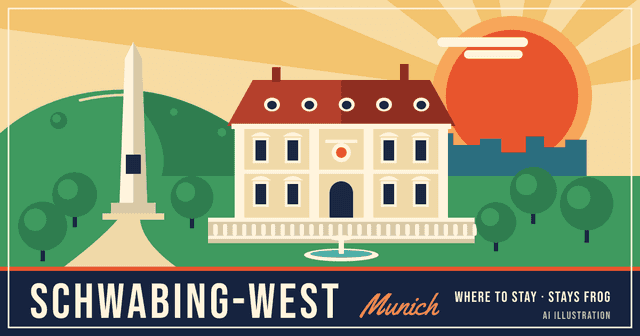
Choose Schwabing-West for a calm, leafy residential base with a daily food market, the Luitpoldpark and fast U2 and U3 links into the centre.
The western part of Schwabing offers a street-based neighborhood outing beyond the Old Town.
How it scores
- Food
- 7/10
Elisabethmarkt food market with rooftop terraces, corner cafés and the Bamberger Haus garden restaurant in Luitpoldpark
- Nightlife
- 6/10
Corner cafés, performances at the Schwere Reiter cultural centre, and Leopoldstraße's bars close by
- Shopping
- 8/10
Boutiques, shoe shops and small independents on Hohenzollernstraße, plus the renovated Elisabethmarkt
- Walkability
- 8/10
Café-lined squares from Hohenzollernplatz to Elisabethplatz and Kurfürstenplatz, with Luitpoldpark's lawns to the north
- Transit
- 8/10
U2 at Hohenzollernplatz and Scheidplatz to the Hauptbahnhof, U3 to Odeonsplatz, and trams 12 and 27 across the district
- Coolness
- 8/10
Jugendstil apartment blocks, the Luitpoldhügel lookout and Elisabethmarkt's rooftop terraces; lived-in, no headline sights
- Safety
- 7/10
Calm and safe day and night on lit main streets; keep to main Luitpoldpark paths after dark and watch bags on platforms
- Loudness
- 5/10
Quiet residential streets, greener near Luitpoldpark and Scheidplatz; the Leopoldstraße edge gets busier late at weekends
Each category is scored 1-10 by our editors; the Frog Score is their average. Safety is our editors' judgment of how comfortable it is to walk around, not crime statistics. Loudness runs from library quiet (1) to never sleeps (10) and doesn't count toward the Frog Score. How we score
Our take
Schwabing-West is the quieter, more residential half of Schwabing: long streets of turn-of-the-century apartment houses, leafy squares and corner cafés between Maxvorstadt and the Petuelring. It has no headline sights, and that is much of its appeal. Daily life revolves around the Elisabethmarkt, the shops of Hohenzollernstraße and the lawns of the Luitpoldpark, and it feels like a neighbourhood where Munich residents simply live.
It suits repeat visitors, longer stays and travellers who prefer a residential base with fast U-Bahn links to sightseeing, as well as families who will use the parks. Choose an address near Hohenzollernplatz or Elisabethplatz for the most cafés and shops, with Maxvorstadt's museums and the bars of Leopoldstraße close by; streets toward the Luitpoldpark and Scheidplatz are greener and quieter.
The Elisabethmarkt on Elisabethplatz is one of Munich's four permanent food markets; it reopened in September 2024 after a complete renovation, and since June 2025 two of its buildings have rooftop terraces where you are not obliged to buy anything. Hohenzollernstraße is the main shopping street, with boutiques, shoe shops and small independents, and Kurfürstenplatz is the neighbourhood's everyday square. In the Luitpoldpark, an obelisk honouring the Prince Regent stands among linden and oak trees, the 37-metre Luitpoldhügel, built from wartime rubble, makes a green lookout, and the neo-Baroque Bamberger Haus at the park's western entrance is a garden restaurant. The Nordbad on Schleißheimer Straße is the local indoor pool, and the Schwere Reiter cultural centre stages performances.
The U2 stops at Hohenzollernplatz and Scheidplatz and runs straight to the Hauptbahnhof, where you can pick up the S-Bahn trunk line and the airport lines S1 and S8; the U3 serves Bonner Platz, Scheidplatz and Petuelring and runs south through Odeonsplatz to Marienplatz, and trams 12 and 27 cross the district. Schwabing-West is a calm residential area that feels safe by day and at night, and its main streets stay lit and walked into the evening. Take ordinary big-city care around the busier Leopoldstraße edge late at weekends, keep to the main paths of the Luitpoldpark after dark, and watch your bag on crowded U-Bahn platforms, as the UK government advises for stations across Germany.
By Stays Frog AI Desk
A short history
Schwabing-West grew out of the western fields of the old village of Schwabing, which was first recorded in 782, became a town in 1886 and joined Munich in 1890. Around 1900 the farmland was built up with Jugendstil apartment blocks laid out around squares such as Kurfürstenplatz, Hohenzollernplatz, Elisabethplatz and Scheidplatz, and in 1909 these new streets were split off as a city district of their own. Prince Regent Luitpold's 90th birthday was marked in 1911 with the opening of the Luitpoldpark, and in 1912 the architect Franz Rank built the Bamberger Haus at its edge, decorated with Baroque sandstone sculptures from a Bamberg town house, and gave it to the city. The Second World War left heavy damage; the gaps were filled in the 1950s and 1970s and the old buildings were renovated from around 1985. The boundary reform of 1996 added northern Schwabing with the Luitpoldpark and part of the former Oberwiesenfeld, where the Ackermannbogen neighbourhood has since risen on the site of old army barracks.
No places in Schwabing-West scored yet.
Traveller reviews
What people who've been say. One review each; you can update yours.
References(11)
Primary sources used to check this guide and its listings.
- dmo-schwabing · www.munich.travel
- Safety and security - Germany travel advice - GOV.UK · UK Foreign, Commonwealth & Development Office
- MVV Netzplan S-Bahn, U-Bahn, Regionalzug · www.mvg.de
- OpenStreetMap administrative boundary — Schwabing-West · OpenStreetMap contributors, ODbL 1.0; parent-supplied cache
- Schwabing-West · Wikipedia (de)
- Schwabing · Wikipedia (de)
- Luitpoldpark (München) · Wikipedia (de)
- Bamberger Haus · Wikipedia (de)
- Elisabethmarkt · Wikipedia (de)
- Munich U-Bahn · Wikipedia
- Munich S-Bahn · Wikipedia