NeighborhoodsNeighborhood area
La Malva-rosa
Northern city beach and rice-focused seaside meals · Valencia
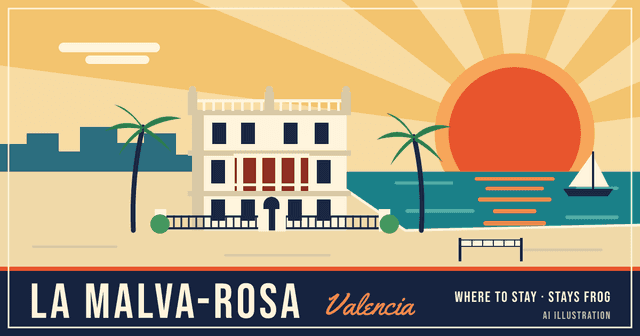
Choose La Malva-rosa for a quiet, local beach stay with paella by the sea and a long promenade, if you don't mind riding in to the old town.
Valencia's northern city beach and the quiet residential streets behind it, with wide fine sand and a promenade for runners and skaters. Book paella at Casa Carmela, cooked over orange-wood fires since 1922, and visit the Blasco Ibáñez Museum-Home.
How it scores
- Food
- 7/10
Paella over orange-wood fires at Casa Carmela since 1922, plus rice restaurants looking out to sea
- Nightlife
- 4/10
Little after dark: the promenade is busy on summer evenings, but the area is sleepy out of season
- Shopping
- 4/10
Mostly residential streets and villas behind the beach; the old town, a ride away, is better for shopping
- Walkability
- 8/10
A long seafront promenade runs on into Cabanyal beach, with walkways and ramps down to the water
- Transit
- 6/10
Trams 4 and 6 stop at Platja Malva-rosa; tram 6 to Marítim for metro line 5 to the centre and airport
- Coolness
- 7/10
Blasco Ibáñez Museum-Home in the novelist's 1902 villa, the beach Sorolla painted and 32 volleyball courts
- Safety
- 7/10
Busy and comfortable by day and on summer evenings; out of season keep to lit stretches, and watch bags on the sand
- Loudness
- 5/10
Lively promenade on summer days and evenings; the residential streets turn sleepy out of season
Each category is scored 1-10 by our editors; the Frog Score is their average. Safety is our editors' judgment of how comfortable it is to walk around, not crime statistics. Loudness runs from library quiet (1) to never sleeps (10) and doesn't count toward the Frog Score. How we score
Our take
La Malva-rosa is Valencia's northern city beach and the residential neighbourhood behind it: a wide stretch of fine sand, a seafront promenade popular with runners and skaters, and rice restaurants looking out to sea, backed by residential streets and a few early 20th-century villas. It is quieter and more local than the Cabanyal end, and in summer it is where Valencians come to swim and eat paella. The sand runs on without a break into Cabanyal beach to the south, and Patacona beach continues north beyond the city limits, in Alboraia.
It suits families, beach-first travellers and anyone happy to trade old-town atmosphere for sea air. Hotels are few: the Hotel Malvarrosa Plaza by Intelier, a new 170-room hotel on Avenida de la Malvarrosa with a rooftop pool, is a few minutes from the sea, and otherwise most visitors rent apartments or stay at the bigger beach hotels on the Cabanyal side, such as Las Arenas and Neptuno, a walk down the promenade. Out of season the neighbourhood is sleepy, which suits some travellers and not others.
Casa Carmela, on Isabel de Villena, has cooked paella over orange-wood fires since 1922 and is the beach's best-known rice house; book ahead, especially for weekend lunch. A few doors along, the Blasco Ibáñez Museum-Home occupies the villa the novelist commissioned in 1902, with its gallery of columns and caryatids, rooms that recreate where he lived and wrote, and a Mediterranean garden. Joaquín Sorolla painted this beach in several works. On the sand there are 32 beach volleyball courts and a marked channel for sailing and windsurfing, and walkways and ramps down to the water make it the city's best beach for visitors with reduced mobility.
Trams on lines 4 and 6 run along Avinguda dels Tarongers on the neighbourhood's southern edge, stopping at Platja Malva-rosa, and line 6 continues to Marítim, where metro line 5 runs to the city centre and the airport; EMT buses also run to the centre, more often in summer. The old town is a ride away rather than a walk, so allow time. The promenade is busy and comfortable by day and on summer evenings, but out of season it empties after dark, so keep to the lit, busier stretches at night. As on any city beach, don't leave bags unattended on the sand, keep children within reach, and never swim under a red flag.
By Stays Frog AI Desk
A short history
La Malva-rosa takes its name from the malva-rosa, the hollyhock flowers grown here in the 19th century, a name local history links to the French gardener Félix Robillard around 1848; until then the land behind the beach was orchards and fishermen's huts. In the early 20th century the seafront gained modernist and eclectic villas, and the novelist Vicente Blasco Ibáñez had his villa built beside the sand in 1902, a house with a gallery of columns and caryatids where he came to write. Joaquín Sorolla painted this beach in several works, and Casa Carmela, which started as a humble barraca, opened here in 1922. Behind the seafront the district grew into a working-class residential neighbourhood, and in 1997 Blasco Ibáñez's restored villa reopened as a house-museum.
No places in La Malva-rosa scored yet.
Traveller reviews
What people who've been say. One review each; you can update yours.
References(11)
Primary sources used to check this guide and its listings.
- Valencia Beach | Hotels in Valencia Beach · Visit València
- València municipal neighbourhoods — exact named polygons · Ajuntament de València — Geoportal
- Safety and security - Spain travel advice - GOV.UK · UK Foreign, Commonwealth & Development Office — current visitor-safety guidance
- La Malvarrosa beach · Visit València
- Blasco Ibáñez Museum-Home · Visit València
- Paseo Marítimo & Paseo Neptuno · Visit València
- Malvarrosa (Valencia) · Wikipedia (Spanish)
- La Malva-rosa · Wikipedia (Catalan)
- Casa Carmela — official site · Casa Carmela
- Hotel Malvarrosa Plaza by Intelier — official site · Intelier Hotels
- Metrovalencia · Wikipedia