Places, by kind letterNeighborhoodsNeighborhood area
Centrum
Historic streets, canals and central stays · Amsterdam
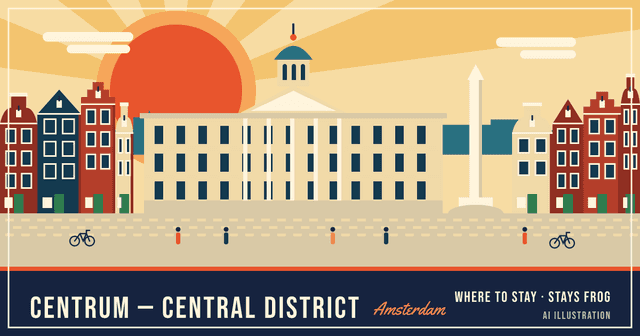
The all-in-one central base: canals, museums and nightlife on foot, with central prices and central crowds.
Centrum is Amsterdam’s full central district, joining the old core, canals and several distinct visitor areas.
How it scores
- Food
- 9/10
Brown cafés, wine bars and restaurants of every kind fill the side streets; genever tastings at Wynand Fockink
- Nightlife
- 9/10
Leidseplein and Rembrandtplein are the late-night bar and club hubs, with brown cafés and wine bars in between
- Shopping
- 9/10
The Nine Streets and Haarlemmerstraat for boutiques, plus the Noordermarkt and the Waterlooplein flea market
- Walkability
- 9/10
Royal Palace, Anne Frank House, Rembrandt House and the canal ring are all within walking distance
- Transit
- 9/10
Trains from Schiphol reach Centraal in 15 to 20 minutes; trams and metro lines fan out from the station
- Coolness
- 9/10
UNESCO canal ring, the Jordaan, the Jewish Cultural Quarter and Artis zoo in the Plantage, all in one district
- Safety
- 7/10
Safe day and night, but pickpockets work Centraal, the Dam, Damrak and the Red Light District; mind trams and canal edges
- Loudness
- 8/10
Red Light District, Leidseplein and Rembrandtplein get rowdy late on weekends; canal ring, Jordaan and Plantage are calmer
Each category is scored 1-10 by our editors; the Frog Score is their average. Safety is our editors' judgment of how comfortable it is to walk around, not crime statistics. Loudness runs from library quiet (1) to never sleeps (10) and doesn't count toward the Frog Score. How we score
Our take
Centrum is the whole of historic Amsterdam inside the Singelgracht: the medieval core around the Dam and the Red Light District, the UNESCO-listed canal ring, the Jordaan, the old Jewish quarter and the Plantage, and the eastern and western islands. It holds most of the city's landmarks, so it is busy, beautiful and expensive, with very different moods from one street to the next.
It suits first-timers and short trips, when being able to walk everywhere matters most. Hotels range from grand addresses such as De L'Europe on the Amstel to canal-house boutiques like Hotel Estheréa on the Singel; rooms in old buildings can be small and stairs steep. For calmer nights, pick the canal ring, the Jordaan or the Plantage over the streets around the Dam, Rembrandtplein and Leidseplein.
The Royal Palace on the Dam, the Anne Frank House, the Rembrandt House and the Jewish Cultural Quarter are the essential sights, with Artis zoo in the Plantage. Shop the Nine Streets and Haarlemmerstraat, browse the Noordermarkt and the Waterlooplein flea market, and taste old Dutch genever at the Wynand Fockink tasting room. Brown cafés, wine bars and restaurants of every kind fill the side streets, and Leidseplein and Rembrandtplein are the centres of late-night bars and clubs.
Trains from Schiphol reach Amsterdam Centraal in about 15 to 20 minutes, and trams and metro lines fan out from the station, but most of Centrum is best covered on foot. It is safe by big-city standards day and night, but crowds bring pickpockets around Centraal, the Dam, Damrak and the Red Light District, and the Red Light District and the nightlife squares get rowdy late on weekends. Never stand in the red cycle lanes, look both ways for trams, and take care along the unrailed canal edges after dark.
By Stays Frog AI Desk
A short history
Amsterdam began around the year 1000, when settlers at the mouth of the Amstel started reclaiming the peat bogs, and after the All Saints' Flood of 1170 a dam was built across the river, the "dam in the Amstel" that gave the city its name. The oldest document naming the settlement is a toll privilege from Count Floris V dated 27 October 1275, which helped turn it into one of the great trading cities of the Middle Ages. In the 17th-century Golden Age it became Europe's most important trading hub and the leading financial centre of the western world, and the canal ring, islands and Jordaan were built around the medieval core. Today's Amsterdam-Centrum borough, created in 2002, covers that whole historic city, from the Burgwallen and the Jodenbuurt to the Plantage and the eastern and western islands.
Clubs in Centrum
Shopping in Centrum
Traveller reviews
What people who've been say. One review each; you can update yours.
References(16)
Primary sources used to check this guide and its listings.
- City Centre — official neighbourhood guide · I amsterdam
- Exact municipal Amsterdam area geometry · Gemeente Amsterdam open data
- Amsterdam health, safety and crime guidance · I amsterdam
- Public transport in Amsterdam · I amsterdam
- Hotel Estheréa Amsterdam · www.estherea.nl
- De L’Europe Amsterdam · www.deleurope.com
- Amsterdam-Centrum — history · Wikipedia
- History of Amsterdam — history · Wikipedia
- The American Book Center — official information · The American Book Center
- Verified venue location · OpenStreetMap contributors (ODbL 1.0)
- Paradiso — official information · Paradiso
- Paradiso — official information · Paradiso
- Verified venue location · OpenStreetMap contributors (ODbL 1.0)
- Melkweg — official information · Melkweg
- Melkweg — official information · Melkweg
- Verified venue location · OpenStreetMap contributors (ODbL 1.0)