NeighborhoodsNeighborhood area
Oostelijke Eilanden and Eastern Docklands
Maritime architecture and eastern IJ waterfront · Amsterdam
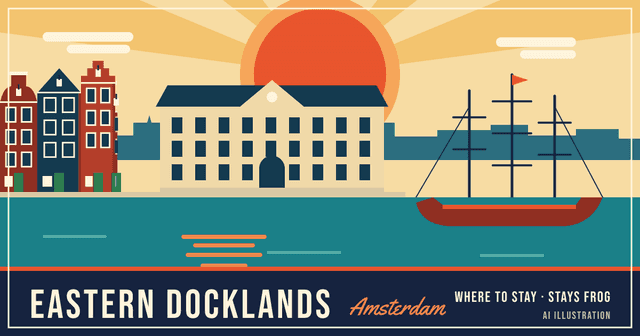
Choose the eastern docklands for modern waterfront architecture, maritime history, jazz at BIMHUIS and calm evenings by the water.
An eastern waterfront visitor area for dockland architecture, maritime history and IJ-side stays.
How it scores
- Food
- 7/10
Cafés and restaurants are spread along the quays rather than packed into one street, so book dinner ahead
- Nightlife
- 7/10
Jazz and improvised music at BIMHUIS beside the Muziekgebouw aan 't IJ on Piet Heinkade; otherwise calm evenings
- Shopping
- 5/10
Few shops on these residential piers; come for the Scheepvaartmuseum and the waterside architecture instead
- Walkability
- 7/10
Pleasant pier walks past Borneo and Sporenburg's canal houses, but the long piers make crossing the area slow
- Transit
- 7/10
Tram 26 runs from Centraal along Piet Heinkade to IJburg, buses serve the islands, and a bike does the rest
- Coolness
- 8/10
Het Scheepvaartmuseum's 1656 naval storehouse and replica East India ship, plus bold modern housing on KNSM Island
- Safety
- 7/10
Very safe by day and calm at night, though long quays and car-free paths empty after dark; quay edges have no railings
- Loudness
- 5/10
Calm, open and residential, about two-thirds water; concert crowds leaving BIMHUIS are the main late bustle
Each category is scored 1-10 by our editors; the Frog Score is their average. Safety is our editors' judgment of how comfortable it is to walk around, not crime statistics. Loudness runs from library quiet (1) to never sleeps (10) and doesn't count toward the Frog Score. How we score
Our take
The Eastern Islands and Eastern Docklands are Amsterdam's maritime east. Closest to the centre are the 17th-century islands of Kattenburg, Wittenburg and Oostenburg, built for the navy and the East India Company; beyond them the old harbour piers of KNSM Island, Java-eiland, Borneo and Sporenburg have been rebuilt as waterside housing with bold modern architecture. About two-thirds of the area is water, and the mood is open, calm and residential.
It suits architecture fans, repeat visitors, families and anyone who wants quiet evenings by the water a short ride from Centraal. Hotel Jakarta on Java-eiland is the signature stay, and other hotels sit along the IJ waterfront closer to the station. Check which island you are booking on: the piers are long, and getting from one end of the area to the other takes longer than the map suggests.
Het Scheepvaartmuseum, the National Maritime Museum in the 1656 naval storehouse, is the main sight, with a replica East India Company ship moored outside. Walk or cycle the piers to see the low-rise canal houses and footbridges of Borneo and Sporenburg and the big apartment blocks of KNSM Island. In the evening, BIMHUIS stages jazz and improvised music on Piet Heinkade next to the Muziekgebouw aan 't IJ. Cafés and restaurants are spread along the quays rather than packed into one street, so book dinner ahead.
Tram 26 runs from Centraal along Piet Heinkade towards IJburg, buses serve the islands, and a bike is the best way to get around. The area feels very safe by day and calm at night, though long quays and car-free paths can be empty after dark, so stick to lit routes on the way back from a concert. Quay edges have no railings, and the main hazards, as everywhere in Amsterdam, are fast cyclists and bike theft.
By Stays Frog AI Desk
A short history
The islands of Kattenburg, Wittenburg and Oostenburg were laid out in the 17th century as Amsterdam's maritime yard district, where the Admiralty built its naval storehouse, 's Lands Zeemagazijn, in 1656 and the Dutch East India Company ran its shipyards. The Eastern Docklands farther east date from the late 19th century, when the building of Centraal Station took away the old harbour front and city engineer Jacobus van Niftrik planned the Oostelijke Handelskade, the first of the new quays for the bigger ships trading with the Dutch East Indies. KNSM Island, Java-eiland, Borneo and Sporenburg followed as harbour piers, and lost their purpose as shipping moved elsewhere. From the 1990s the empty docks were rebuilt as the city's biggest post-war building project, and by the early 2000s some 17,000 people lived there at some of the highest densities in the Netherlands.
No places in Oostelijke Eilanden and Eastern Docklands scored yet.
Traveller reviews
What people who've been say. One review each; you can update yours.
References(8)
Primary sources used to check this guide and its listings.
- Oostelijke Eilanden · www.iamsterdam.com
- Exact municipal Amsterdam area geometry · Gemeente Amsterdam open data
- Amsterdam health, safety and crime guidance · I amsterdam
- Public transport in Amsterdam · I amsterdam
- Homepage - Hotel Jakarta Amsterdam • by WestCord • Official Website · hoteljakarta.com
- Contact - Hotel Jakarta Amsterdam • by WestCord · hoteljakarta.com
- Eastern Docklands — history · Wikipedia
- Oostelijke Eilanden — history · Wikipedia