NeighborhoodsNeighborhood area
Saint-Michel, Capucins, Sainte-Croix & Saint-Jean
Markets, churches and railway-side stays · Bordeaux
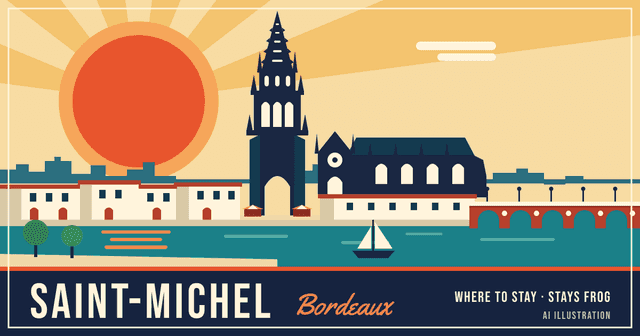
Pick Saint-Michel for the Capucins market, the Flèche and cheap, lively eating, or its station side for easy TGV and direct airport-tram connections.
A cosmopolitan old quarter of narrow streets between the Garonne and the Capucins market, running south to Gare Saint-Jean. Climb the 114-metre Flèche Saint-Michel, shop the Marché des Capucins and start evenings on the terraces of Place Meynard.
How it scores
- Food
- 9/10
The Marché des Capucins, the city's largest market, open every morning but Monday, plus Saturday's Marché Royal on the quays
- Nightlife
- 7/10
Terraces on Place Meynard, rock and rap at the 700-capacity Rock School Barbey and clubs on the quai de Paludate nearby
- Shopping
- 8/10
Sunday flea market on Place Canteloup, antique dealers and artisans' workshops, and Millesima's cellars near the station
- Walkability
- 8/10
Narrow old streets within walking distance of the old centre, but the station and Place Saint-Michel are over a kilometre apart
- Transit
- 8/10
Trams C, D and F along the quays to Gare Saint-Jean; tram F reaches the airport in about 45 minutes; Paris about 2 hours by TGV
- Coolness
- 8/10
The Flèche's 230 steps, Saintonge-style carvings at Sainte-Croix and a mix of artists, artisans and antique dealers
- Safety
- 6/10
Lively by day; after dark the basilica square, streets to the Capucins and the station area can feel edgy, so stick to lit streets
- Loudness
- 8/10
Busy, noisy streets around Gare Saint-Jean, early market mornings at the Capucins and terrace crowds on Place Meynard
Each category is scored 1-10 by our editors; the Frog Score is their average. Safety is our editors' judgment of how comfortable it is to walk around, not crime statistics. Loudness runs from library quiet (1) to never sleeps (10) and doesn't count toward the Frog Score. How we score
Our take
Saint-Michel is a cosmopolitan old quarter, a tangle of narrow streets between the Garonne quays and the Capucins market, ruled over by the Flèche, the 114-metre freestanding bell tower of the Gothic basilica of Saint-Michel. Once a port and craftsmen's district, it now mixes long-standing local shops, antique dealers, artisans' workshops and artists with café and wine-bar terraces on Place Meynard. This area runs south past the old abbey church of Sainte-Croix to Gare Saint-Jean and the streets around it, so it covers both a characterful old quarter and a busy railway district.
It suits travellers arriving by train, food lovers, budget travellers and anyone who prefers a lived-in neighbourhood to a polished one. Hotels of every category cluster around Gare Saint-Jean, which makes the station side handy for an early TGV (Paris is about two hours away), while rooms and apartments nearer the basilica and the Capucins put you in the middle of market life and within walking distance of the old centre. The trade-off is that the station streets are busy, noisy and less charming than the riverside part of the quarter, and the station and Place Saint-Michel are more than a kilometre apart, so pick your end deliberately.
Climb the Flèche Saint-Michel, finished in 1492 and crowned with Paul Abadie's openwork spire in the 1860s: its 230 steps lead to views over the ochre rooftops, the Garonne and the Pont de Pierre (it is open in season, with guided visits in winter, so check with the tourist office). The basilica is part of the UNESCO-listed Routes of Santiago de Compostela, and Sainte-Croix, a former Benedictine abbey church, has carvings in the style of the Saintonge. The Marché des Capucins, the city's largest market and its "belly", opens every morning except Monday, from 6 a.m. until early afternoon. Around the basilica the Marché Royal on Saturday and the Marché Neuf on Monday spread along the quai des Salinières, and Place Canteloup holds a flea market on Sunday mornings. Evenings start on the terraces of Place Meynard; the Rock School Barbey, a 700-capacity music venue near the station, books rock, rap, reggae and metal; and the clubs of the quai de Paludate are just beyond. Near the station, the wine merchant Millesima keeps its two-centuries-old cellars, holding more than 2.5 million bottles, and the riverside Parc des Sports Saint-Michel, opened in 2009, runs along the Garonne from the Pont de Pierre.
Trams C, D and F run along the quays with stops at Saint-Michel, Sainte-Croix, Tauzia and Gare Saint-Jean. Since December 2025 line F has carried on through the centre to Hôtel de Ville, Mériadeck and Bordeaux-Mérignac airport, a direct ride of about 45 minutes from the station, while lines C and D reach Place de la Bourse and the Quinconces. By day the quarter is lively and generally comfortable, full of shoppers, families and market traders. It is also one of the poorer parts of central Bordeaux, much of it a priority area under France's urban policy, and after dark the square around the basilica, the streets towards the Capucins and cours de la Marne, and the surroundings of the station can feel edgy. Keep to busy, lit streets and the tram late at night, and watch bags and phones in the station, on crowded trams and on market mornings, as at any big station. Trams run until about midnight, later at the end of the week, and partner bars and shops in the "Demandez Angela" scheme offer a safe place to step into if you feel harassed.
By Stays Frog AI Desk
A short history
Saint-Michel began beyond the southern edge of Roman Burdigala, where a Gallo-Roman necropolis lay along the road to Agen; by Carolingian times an outer quarter of fishermen, craftsmen and merchants had grown up around a chapel to Saint Michael above the Garonne, and in the early 14th century it was brought inside the city's third wall. Its river ports at the Salinières and La Grave handled salt, grain, fish and wine, and street names still recall the old trades, from rue des Faures (blacksmiths) to rue de la Fusterie (cask makers) and rue Carpenteyre (carpenters). The Flamboyant Gothic church was raised from the 14th century onwards, and its freestanding bell tower, the Flèche, was finished in 1492, lost its top to a hurricane in 1768 and was given its 114-metre openwork spire by Paul Abadie in the 1860s. To the south the railway arrived with the Gare du Midi in 1855, rebuilt as Saint-Jean station in 1898 under a vast metal train shed built by Gustave Eiffel, while the Capucins grew into the city's great wholesale food market before becoming the neighbourhood market it is today. The basilica joined UNESCO's World Heritage listing of the Routes of Santiago de Compostela in 1998, and the quarter, still among the city's poorer areas, now draws artisans, antique dealers, architects and artists to its cosmopolitan streets.
No places in Saint-Michel, Capucins, Sainte-Croix & Saint-Jean scored yet.
Traveller reviews
What people who've been say. One review each; you can update yours.
References(13)
Primary sources used to check this guide and its listings.
- Saint-Michel, Sainte-Croix, Saint-Jean Station | Bordeaux Tourism & Conventions Sustainable destination Search Menu · Official tourism / municipal source
- Official map: Saint-Michel, Capucins, Sainte-Croix, Gare, Sacré Cœur · Ville de Bordeaux / Bordeaux Métropole, Licence Ouverte
- Informations sécurité — visitor emergencies, night returns and Angela support · Bordeaux Tourism & Conventions — official destination visitor guidance
- Saint-Michel (Bordeaux) · Wikipédia
- Flèche Saint-Michel · Wikipédia
- Basilica of St. Michael, Bordeaux · Wikipedia
- Flèche Saint-Michel · Bordeaux Tourisme & Congrès
- Gare de Bordeaux-Saint-Jean · Wikipedia
- Les marchés de Bordeaux · Ville de Bordeaux
- Rock School Barbey · Bordeaux Tourism & Conventions
- Ligne F du tramway de Bordeaux · Wikipédia
- Bus, tramways et bateaux : du nouveau sur le réseau de transports en commun bordelais · Ville de Bordeaux
- France travel advice: safety and security · UK Foreign, Commonwealth & Development Office