NeighborhoodsNeighborhood area
Saint-Seurin, Jardin Public & Fondaudège
Residential streets, gardens and early heritage · Bordeaux
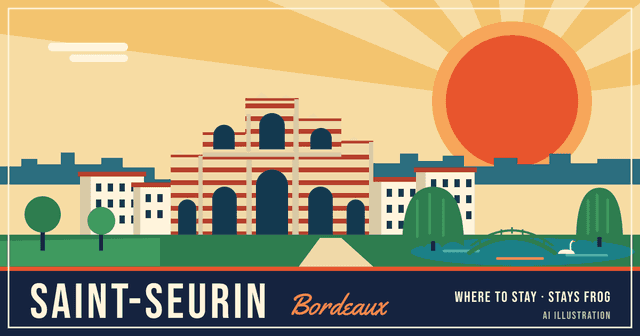
Choose Saint-Seurin for a calm residential base by the Jardin Public, with Roman and early Christian Bordeaux on the doorstep and the centre a short walk away.
A calm, village-like residential quarter just north-west of the Golden Triangle, with the 18th-century Jardin Public on the doorstep. The basilica of Saint-Seurin and its crypt, the Roman Palais Gallien and the Friday market on the basilica square are all close.
How it scores
- Food
- 8/10
The Friday Saint-Seurin market with mushrooms, heirloom tomatoes and strawberries, plus cafés around the basilica square
- Nightlife
- 5/10
Few late bars and quiet evenings around the basilica square; the Golden Triangle is within walking distance
- Shopping
- 7/10
Small shops, a butcher and a pharmacy around the Place des Martyrs-de-la-Résistance; Golden Triangle shops within walking distance
- Walkability
- 7/10
Walkable to Place Gambetta, the Golden Triangle and the Chartrons; the Jardin Public and basilica are almost 1 km apart
- Transit
- 7/10
Tram D at Fondaudège-Muséum, C and E at Jardin Public, B at Gambetta; C and D run straight to Gare Saint-Jean
- Coolness
- 8/10
The Roman Palais Gallien arches, Saint-Seurin's crypt with early bishops' sarcophagi and the Guignol Guérin puppet theatre
- Safety
- 6/10
One of the calmest areas by day and night; the Jardin Public is locked after dark, so walk around it rather than through
- Loudness
- 5/10
Little traffic and few late bars, so nights are quiet; the Friday market livens the basilica square in the morning
Each category is scored 1-10 by our editors; the Frog Score is their average. Safety is our editors' judgment of how comfortable it is to walk around, not crime statistics. Loudness runs from library quiet (1) to never sleeps (10) and doesn't count toward the Frog Score. How we score
Our take
Saint-Seurin, the Jardin Public and Fondaudège make up a calm, family-friendly residential quarter just north-west of the Golden Triangle, where the pace drops as soon as you head down rue Judaïque. Stone houses, small shops, a butcher, a pharmacy and cafés gather around the Place des Martyrs-de-la-Résistance and its basilica, in what residents call an almost village-like way of life, while to the north-east the Jardin Public puts an 18th-century park on the doorstep. It also holds some of Bordeaux's oldest heritage: the Roman amphitheatre known as the Palais Gallien stands on its edge, just off rue Fondaudège, and the basilica sits over the city's first Christian cemetery.
It suits couples, families, return visitors and anyone who wants quiet nights and a park on the doorstep while staying within walking distance of Place Gambetta, the shops of the Golden Triangle and the Chartrons. This is a residential district rather than a hotel quarter, so many visitors stay in apartments; addresses near Place Gambetta or the cours de Verdun side of the Jardin Public put you closest to the centre, while the streets around the basilica and rue Fondaudège feel the most local. The Jardin Public and the basilica are almost a kilometre apart, so check which side of the district your address is on.
The Jardin Public, laid out for the intendant Tourny and opened in 1756, was remodelled as an English-style park in the 1850s: today it has a pond with ducks and swans, a green bridge among weeping willows, an arboretum of old trees, a carousel, the Guignol Guérin puppet theatre and Va, Petit Mousse, an electric replica of an 1897 pleasure boat, and the renovated Muséum d'histoire naturelle occupies a former mansion on its edge. At the basilica of Saint-Seurin, one of the Santiago pilgrimage churches on the UNESCO list, look at the 13th-century Gothic south portal and visit the crypt and archaeological site with the sarcophagi of early bishops; the listed Hôtel Frugès mansion faces it across the square. Walk up to the Palais Gallien, whose brick-and-stone arches survive from the 2nd-century amphitheatre, and to Place de Lerme, where the 19th-century iron-and-glass Marché de Lerme hall now hosts exhibitions; Place Charles Gruet, shaded by tall trees around its fountain, is close by. Friday morning brings the Saint-Seurin market to the basilica square, with growers selling mushrooms from near Saint-Émilion, heirloom tomatoes, asparagus and strawberries in season, and cafés around the square do the rest.
Tram line D stops at Fondaudège-Muséum and Croix de Seguey for the Palais Gallien and the north of the district, lines C and E stop at Jardin Public, and line B stops at Gambetta on the southern edge. Lines C and D run straight to Gare Saint-Jean, where line F continues to the airport. This is one of the calmest parts of central Bordeaux by day and at night, with little traffic and few late bars, and it feels comfortable to walk around in the evening. The main thing to know is that the Jardin Public is locked at night (it opens at 7 a.m. and closes between 6 and 9 p.m. depending on the season), so walk around it after dark rather than looking for a shortcut. Trams run until about midnight, later at the end of the week, and the city's "Demandez Angela" network of bars and shops offers a safe place to step into if you feel harassed.
By Stays Frog AI Desk
A short history
This is one of the oldest corners of Bordeaux: on the northern edge of Roman Burdigala stood the amphitheatre now called the Palais Gallien, built in the early 2nd century for an estimated 22,000 spectators, and nearby a late-Roman cemetery became the city's first Christian burial ground, where early bishops including Saint Seurin were laid to rest. The basilica of Saint-Seurin grew over that necropolis, rebuilt in Romanesque form from the early 11th century, given a Gothic south portal in the 13th century and a new west front in 1828, and it became a major stop for pilgrims bound for Santiago de Compostela. In 1746 the royal intendant Tourny began the Jardin Public on poor vineyards and market gardens at the city's edge; it opened in 1756 to a formal French plan by Ange-Jacques Gabriel and was remodelled as an English-style park from 1856. The amphitheatre, meanwhile, was quarried for stone in the Middle Ages and its land sold in lots in 1793, so houses now wrap around its surviving arches. The faubourg grew into the calm, village-like residential quarter its residents describe today, where a local association has even replanted vines where vineyards once stood.
No places in Saint-Seurin, Jardin Public & Fondaudège scored yet.
Traveller reviews
What people who've been say. One review each; you can update yours.
References(11)
Primary sources used to check this guide and its listings.
- Saint Seurin, Public Garden, Fondaudège | Bordeaux Tourism & Conventions Sustainable destination Search Menu · Official tourism / municipal source
- Official map: Jardin public, Fondaudège, Saint-Seurin · Ville de Bordeaux / Bordeaux Métropole, Licence Ouverte
- Informations sécurité — visitor emergencies, night returns and Angela support · Bordeaux Tourism & Conventions — official destination visitor guidance
- Basilique Saint-Seurin de Bordeaux · Wikipédia
- Palais Gallien · Wikipédia
- Jardin public de Bordeaux · Wikipédia
- Le Jardin Public · Bordeaux Tourisme & Congrès
- Saint-Seurin–Fondaudège, l'esprit village au cœur de Bordeaux · Ville de Bordeaux, Le mag
- Les marchés de Bordeaux · Ville de Bordeaux
- Ligne E du tramway de Bordeaux · Wikipédia
- Ligne F du tramway de Bordeaux · Wikipédia