NeighborhoodsNeighborhood area
Binnenstad
Historic squares and canal walks · Bruges
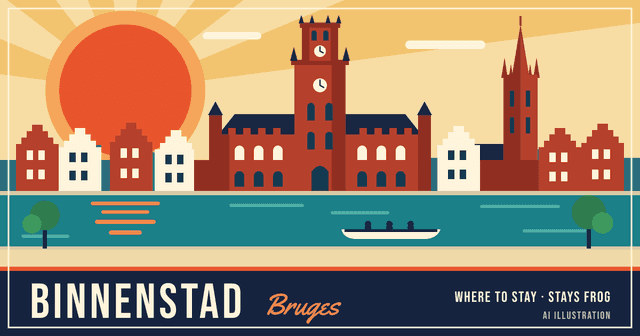
Choose the historic centre for a first visit: the Belfry, canals and best-known hotels on your doorstep, if you can live with the daytime crowds.
The whole historic centre is a broad planning area around the old street pattern, canals and central squares.
How it scores
- Food
- 9/10
Prawns at Assiette Blanche on the Burg, Belgian classics at De Mangerie on Oude Burg and some 400 beers at Cambrinus
- Nightlife
- 7/10
Some 400 beers at Cambrinus on Philipstockstraat; side streets empty after dark, with buses until 11pm, 2am on Fri and Sat
- Shopping
- 9/10
A Wednesday market fills the Markt and a Christmas market arrives in winter, steps from the busiest visitor streets
- Walkability
- 9/10
Made for walking: the Markt and Burg are a minute apart and the station about 20 minutes on foot; watch for bikes in narrow lanes
- Transit
- 8/10
Buses every five minutes from the station, lines 1 and 2 to Stadsschouwburg; direct hourly trains to Brussels Airport
- Coolness
- 8/10
The Belfry's 366 steps and 47-bell carillon, the Basilica of the Holy Blood and Michelangelo's Madonna at Our Lady's
- Safety
- 7/10
Feels safe day and night, but pickpockets work the packed Markt, Burg and quays; side streets empty quickly after dark
- Loudness
- 7/10
The Markt, Burg and canal quays are packed from late morning; a few blocks away the streets turn residential and still
Each category is scored 1-10 by our editors; the Frog Score is their average. Safety is our editors' judgment of how comfortable it is to walk around, not crime statistics. Loudness runs from library quiet (1) to never sleeps (10) and doesn't count toward the Frog Score. How we score
Our take
The Binnenstad is the whole of historic Bruges inside the oval ring of canals that follows the old city wall: about 410 hectares of brick lanes, stepped gables, bridges and quiet waterways, listed by UNESCO as a World Heritage Site. Its heart is two squares a minute apart, the Markt under the 83-metre Belfry and the Burg with the Gothic town hall, and the streets and quays between them carry the bulk of the roughly eight million visitors Bruges receives each year. Walk a few blocks in any direction, though, and the city turns residential and still, and quarters such as Langestraat and the Magdalenakwartier each keep a pace of their own.
It suits first-time visitors, short breaks and anyone who wants to step out of the door into the postcard. Hotel Central is the only hotel on the Markt itself, with 11 rooms and a sun terrace facing the Belfry. On Hoogstraat, a couple of hundred metres away, Hotel Malleberg has nine rooms in a Bruges mansion with breakfast in a 16th-century cellar, while the much larger Grand Hotel Casselbergh opposite has 118 rooms and a wellness centre in its own 16th-century cellars. Hotel Bourgoensch Hof on Wollestraat looks over the canals from one of the city's prettiest little squares, and Hotel Dukes' Palace fills a former residence of the Burgundian nobility on the Prinsenhof with 135 rooms and a garden. Many hotels occupy old houses, and several list entrances or rooms that are not easily accessible, so check before booking if steps are a problem.
Climb the Belfry's 366 steps for the view and listen for its 47-bell carillon, then cross to the Burg for the town hall and the Basilica of the Holy Blood, which keeps the relic that gives it its name. Further south, the Church of Our Lady has a 115.6-metre brick spire, one of the tallest brick towers in the world, and Michelangelo's Madonna and Child inside. A market fills the Markt on Wednesdays, and the winter brings a Christmas market. For food, Assiette Blanche faces the Burg with classic Franco-Belgian cooking such as hand-peeled prawns, De Mangerie on Oude Burg serves Belgian classics with the odd Far Eastern touch from an open kitchen, and Cambrinus on Philipstockstraat is a beer brasserie whose list runs to some 400 beers.
The centre is made for walking: the Markt is about 20 minutes on foot from Bruges railway station, and city buses run between the station and the centre every five minutes, with lines 1 and 2 serving central stops such as Stadsschouwburg. Trains from Brussels-South take about an hour, and Brussels Airport has a direct hourly train to Bruges. Cars are discouraged, and most streets are a cycle zone where vehicles may not overtake bicycles, so keep an eye out for bikes in the narrow lanes. Bruges feels safe by day and at night, but the Markt, the Burg and the canal quays are packed from late morning, and the UK government warns that theft and pickpocketing are common in crowded places in Belgium, so keep bags closed and phones out of back pockets. After dark the side streets empty quickly: buses run until about 11pm, and until about 2am on Friday and Saturday nights, and after that official taxi ranks are the way home.
By Stays Frog AI Desk
A short history
Bruges grew from a fortified settlement that Count Baldwin I of Flanders strengthened against Viking raids in the 9th century, and its name first appears as Brugis in an abbey inventory from the 850s or 860s. The town received its charter in 1128, and after a storm in 1134 opened a channel to the sea at the Zwin it became one of northern Europe's great markets, with a Hanseatic trading post, Genoese fleets from 1277 and at least 46,000 inhabitants by about 1350; the second city wall of 1297, some seven kilometres long, still traces the oval ring of canals around the centre. In the 15th century the Burgundian dukes kept court here and Jan van Eyck and Hans Memling worked in the city, but from around 1500 the silting of the Zwin drained away its trade and Antwerp took its place. Left behind for three centuries, the medieval streets survived largely intact, and in the late 19th century British and French visitors and Georges Rodenbach's 1892 novel Bruges-la-Morte made the "dead city" one of the world's first tourist destinations. Restoration of its houses, churches and monuments from 1965 onwards set off a tourism boom, and UNESCO inscribed the historic centre as a World Heritage Site in 2000.
No places in Binnenstad scored yet.
Traveller reviews
What people who've been say. One review each; you can update yours.
References(15)
Primary sources used to check this guide and its listings.
- Bruges city map · www.visitbruges.be
- Historische stadskern van Brugge — Stad Brugge GIS · Stad Brugge municipal GIS
- Travelling to and in Bruges · Visit Bruges
- Belgium visitor safety and security · UK FCDO
- Hotel Malleberg · www.visitbruges.be
- Hotel Bourgoensch Hof · www.visitbruges.be
- Hotel Central · www.visitbruges.be
- Hotel Dukes' Palace · www.visitbruges.be
- Grand Hotel Casselbergh · www.visitbruges.be
- De Mangerie · www.visitbruges.be
- Cambrinus · www.visitbruges.be
- Assiette Blanche · www.visitbruges.be
- Bruges · Wikipedia
- Belfry of Bruges · Wikipedia
- Historic Centre of Brugge · Wikipedia