NeighborhoodsNeighborhood area
Sint-Anna / Seminariekwartier
Mills, heritage streets and rampart walks · Bruges
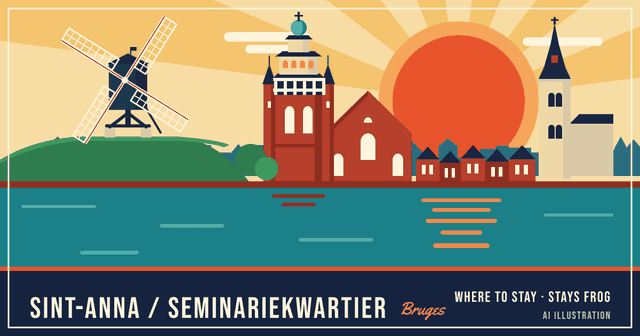
Choose Sint-Anna for quiet canal quays, windmills on the ramparts and some of Bruges' best dining, a short walk from the Markt but far from its crowds.
Sint-Anna is one of the quarters presented by the tourism office as a different view of historic Bruges.
How it scores
- Food
- 8/10
Zet'Joe (one Michelin star) and Franco Belge on Langestraat, Bistro Refter on Molenmeers, De Verloren Hoek's aged meat
- Nightlife
- 6/10
Calm evenings: Café Vlissinghe, the oldest café in Bruges with roots in 1515, has pétanque in its garden in summer
- Shopping
- 6/10
Mostly residential quays and lanes; Lilola on Langestraat sells bold, colourful womenswear
- Walkability
- 8/10
Canal quays along Sint-Annarei and Potterierei, the Kruisvest windmills, and the Markt a short stroll west
- Transit
- 6/10
Buses at Molenbrug, Kruispoort and Gouden Handstraat; line 2 from the station to Jan Van Eyckplein
- Coolness
- 8/10
Jerusalem Chapel, the working Sint-Janshuismolen of 1770, the Folk Museum and village-like workers' streets
- Safety
- 7/10
Very safe by day and calm at night; use the lit quays, not the dark ramparts, and watch for cyclists on narrow lanes
- Loudness
- 4/10
Village-like pace; residential streets empty early and evenings stay calm, far from the Markt crowds
Each category is scored 1-10 by our editors; the Frog Score is their average. Safety is our editors' judgment of how comfortable it is to walk around, not crime statistics. Loudness runs from library quiet (1) to never sleeps (10) and doesn't count toward the Frog Score. How we score
Our take
Sint-Anna, part of the Seminariekwartier, is the quiet north-east of Bruges: canal quays along the Sint-Annarei and the Potterierei, streets of low brick workers' houses, the Baroque Sint-Annakerk and, out on the Kruisvest ramparts, a line of windmills. Visit Bruges sells it as "quiet Bruges", a world of mills, workers' cottages, exclusive gentlemen's clubs and the city's oldest café, and it is still a place where people of Bruges live, a short walk from the crowds of the Markt but with a very different, village-like pace.
It suits couples, repeat visitors and walkers who want canal views and calm evenings rather than nightlife. Hotel Adornes, a friendly 20-room family hotel on the Sint-Annarei quay with free bicycle parking and bike rental, is an easy choice, and a handful of other hotels and B&Bs sit along the quays and side streets. Staying here is usually better value than around the Markt, while the dining is some of the best in the city.
Start at Kantwerkstersplein, where the Adornes estate gathers the 15th-century Jerusalem Chapel, inspired by the Church of the Holy Sepulchre, and a museum in the almshouses behind it about the merchant and diplomat Anselm Adornes. Around the corner on Balstraat, the Lace Centre in the old lace school still teaches lace-making, and the Folk Museum shows everyday Bruges life in a row of renovated workers' houses. The domed church of the English Convent on Carmersstraat dates from 1736-1739, the Gezellehuis on Rolweg is a free literary museum about the poet Guido Gezelle, and Our Lady of the Pottery on the Potterierei is a former hospital first recorded in the 13th century. On the Kruisvest, the Sint-Janshuismolen of 1770 is the only windmill in Bruges you can see in operation, grinding grain when the wind allows. Eat at Zet'Joe on Langestraat, Geert Van Hecke's one-Michelin-star successor to his three-star Karmeliet, or at his more relaxed Bistro Refter on Molenmeers; Franco Belge at Langestraat 109 gives Franco-Belgian cooking a contemporary twist, and De Verloren Hoek on Carmersstraat serves aged meat and fusion tapas on a terrace facing the mills. Café Vlissinghe on Blekersstraat, with roots going back to 1515, is the oldest café in Bruges, with pétanque in the garden in summer, and Lilola on Langestraat sells bold, colourful womenswear.
Most visitors simply walk: the Markt is a short stroll west over the canals, and city buses stop at Molenbrug, Kruispoort and Gouden Handstraat, while bus line 2 from the station runs to Jan Van Eyckplein, a few minutes' walk from the Sint-Annarei. Several routes run until about 11 p.m., and until about 2 a.m. on Friday and Saturday nights. Sint-Anna feels very safe by day and calm at night, and its residential streets empty early. After dark, walk back along the lit quays and streets rather than across the quiet ramparts by the windmills, watch for cyclists on the narrow lanes, and keep valuables close in the busier streets nearer the Markt and on buses, where UK travel advice warns that theft and pickpocketing are common in crowded places.
By Stays Frog AI Desk
A short history
Sint-Anna lies inside the second ring of city walls begun in 1297, and its parish took shape when the mansion Hof ter Vere was bought in 1496 and converted into a chapel of ease, consecrated in 1497; after the iconoclasm it was sold and partly demolished in 1580, and the present Sint-Annakerk rose on the rubble from 1611, was consecrated in 1621 and later gained the rich Baroque interior that earned it the nickname "salon church of Bruges". In the first half of the 15th century descendants of the Genoese merchant Opicius Adornes built the Jerusalem Chapel here, inspired by the Church of the Holy Sepulchre. The 17th century brought religious houses: the community of Ten Duinen abbey began a new abbey on the Potterierei in 1628, whose buildings now house the Major Seminary that gives the Seminariekwartier its name, and English canonesses settled in Carmersstraat in 1629, adding a domed church in 1736-1739. Sint-Anna was one of the poorest parts of the city, and in the 19th century Kantwerkstersplein, the Lace Makers' Square, was the hub of the Bruges lace industry; the poet Guido Gezelle was baptised in Sint-Annakerk in 1830. On the eastern ramparts the Sint-Janshuismolen of 1770 still grinds grain, joined by three mills brought from elsewhere in Flanders, and the lace school, the folk museum and the Adornes estate now draw visitors into its quiet streets.
No places in Sint-Anna / Seminariekwartier scored yet.
Traveller reviews
What people who've been say. One review each; you can update yours.
References(21)
Primary sources used to check this guide and its listings.
- Saint Anne's and Saint Giles' · press.visitbruges.be
- Seminariekwartier — Stad Brugge GIS · Stad Brugge municipal GIS
- Travelling to and in Bruges · Visit Bruges
- Belgium visitor safety and security · UK FCDO
- Bistro Refter · www.visitbruges.be
- Zet'Joe · www.visitbruges.be
- Franco Belge · www.visitbruges.be
- Café Vlissinghe · www.visitbruges.be
- Lilola by dit & dat · www.visitbruges.be
- De Verloren Hoek · www.visitbruges.be
- Sint-Annakerk (Brugge) · Wikipedia (nl)
- Adornesdomein · Wikipedia (nl)
- Engels Klooster · Wikipedia (nl)
- Grootseminarie van Brugge · Wikipedia (nl)
- Kruispoort (Brugge) · Wikipedia (nl)
- Sint-Janshuismolen · Wikipedia (nl)
- Sint-Janshuismolen (Sint-Janshuis Mill) · Visit Bruges
- Kantwerkstersplein (Lace Makers' Square) · Visit Bruges
- Musea Brugge museum locations · Visit Bruges
- The quiet Bruges · Visit Bruges press
- Hotel Adornes · Visit Bruges