Places, by kind letterNeighborhoodsNeighborhood area
Altona-Altstadt
Fish-market waterfront and independent music · Hamburg
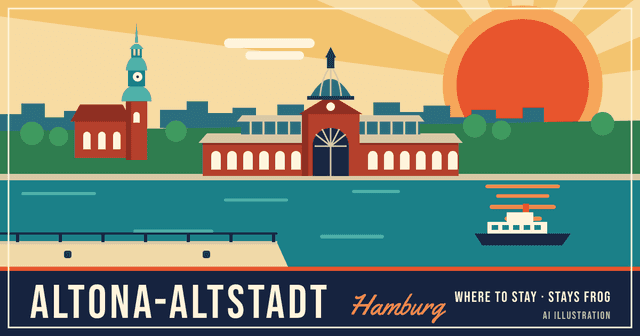
Stay in Altona-Altstadt for Elbe views, the Sunday fish market and a real, mixed neighbourhood at gentler prices, with direct S-Bahn trains to the airport.
The district links the Elbe-side fish-market landscape with streets extending inland from the harbor.
How it scores
- Food
- 8/10
Seafood at the Fischereihafen Restaurant on Große Elbstraße, fish-market stalls and brunch in the Fischauktionshalle
- Nightlife
- 7/10
Electronic music at the Golden Pudel Club by the fish market; streets near Altona station stay lively late
- Shopping
- 6/10
The Sunday Fischmarkt by the river and the Neue Große Bergstraße, a pedestrian shopping street with an IKEA
- Walkability
- 7/10
Palmaille and Große Elbstraße make good walks to the fish market, but the slope up to the Altonaer Balkon is steep
- Transit
- 7/10
S1 and S3 at Königstraße and Altona; the S1 runs direct via the Hauptbahnhof to the airport, Reeperbahn one stop east
- Coolness
- 8/10
The Sunday Fischmarkt held since 1703, the 1896 Fischauktionshalle, Golden Pudel and harbour views from the Altonaer Balkon
- Safety
- 7/10
Busy and relaxed by day; less polished late round Altona station and Neue Große Bergstraße, Große Elbstraße quiet at night
- Loudness
- 6/10
Crowded Sunday fish-market mornings and lively nights near Altona station; the riverside is quiet late at night
Each category is scored 1-10 by our editors; the Frog Score is their average. Safety is our editors' judgment of how comfortable it is to walk around, not crime statistics. Loudness runs from library quiet (1) to never sleeps (10) and doesn't count toward the Frog Score. How we score
Our take
Altona-Altstadt is the old heart of what was, until 1937, a separate city, and it still has its own town hall and main church, with Altona station just beyond its western edge. Today it is one of the most densely built parts of Hamburg, a mixed, multicultural and unpolished quarter that runs from the Neue Große Bergstraße and the streets near Altona station down the steep Elbe slope to the fish market and the river. Post-war housing blocks fill much of it, but there are traffic-calmed side streets, the stately Palmaille and a magnificent waterfront: the Altonaer Balkon park looks over the harbour and the cruise terminal from the top of the slope, about 27 metres above the river.
It suits travellers who want river views, the Sunday fish market and a lived-in neighbourhood rather than a showpiece, and it works well for anyone arriving by train at Altona or by ship at the Cruise Center Altona, which opened in 2010 and takes ships up to 300 metres long. Look for a room near Königstraße station, the Palmaille or Altona station, all within walking distance of the river, and check how far uphill an address sits, because the Elbe slope is steep. Prices for staying and eating out are generally gentler than in the centre.
Sunday morning belongs to the Fischmarkt, held since 1703 and drawing around 70,000 people to the river each week: it runs from 5:00 to 9:30 between April and October and from 7:00 to 9:30 between November and March. The Fischauktionshalle of 1895 to 1896, a brick and steel hall built as a three-aisled basilica with a dome and Altona's coat of arms on its river gable, hosts brunch and events. Walk west along Große Elbstraße past the fishing port to the Fischereihafen Restaurant, a long-established seafood address, then climb the slope to the Altonaer Balkon for the view; down by the water, the Holzhafen of 1722 to 1724 is Hamburg's oldest surviving artificial harbour basin. Inland, look for the Baroque main church of St. Trinitatis, built in 1742 to 1743, the Jewish Cemetery founded in 1611 and considered one of the most important Jewish burial grounds in the world, and the late-classical Altona Rathaus with the fountain of two fighting centaurs on the Platz der Republik. After dark, the small independent Golden Pudel Club by the river at the fish market runs an electronic-music programme, so check its listings before you go.
S-Bahn lines S1 and S3 stop at Königstraße in the middle of the quarter and at Altona station just beyond its western edge, with Reeperbahn one stop east; the S1 continues through the city tunnel via Jungfernstieg and the Hauptbahnhof to the airport, so it is a one-seat ride, about 25 minutes on from the Hauptbahnhof. The quarter feels busy and relaxed by day; around Altona station and the Neue Große Bergstraße it is lively but less polished late at night, so stick to the main streets then. The riverside along Große Elbstraße is quiet late at night, so take a taxi back from a late dinner there, and in the early-morning crowds of the Sunday fish market keep your bag close, as UK travel advice urges for any crowded place in Germany.
By Stays Frog AI Desk
A short history
Altona began in the 1530s as a fishing settlement on the Elbe just west of Hamburg's boundary, in the County of Holstein-Pinneberg, and legend has it that Hamburg's council found it 'all too near', allzu nah. It passed to the Danish crown in the 1640s, King Frederick III made it a town in 1664, and under Danish rule it grew into the second-largest city of the Danish realm after Copenhagen. Swedish troops burned it down in 1713, so little of the earlier town survives beyond the line of the Palmaille, laid out in 1638 to 1639 and later Altona's grandest street. Altona became Prussian in 1867, opened its fish auction hall on the new fishing harbour in 1896, and was merged into Hamburg under the Greater Hamburg Act of 1937. Royal Air Force raids in July 1943 destroyed much of the old town, which was rebuilt with post-war housing blocks and high-rises, while the Neue Große Bergstraße became Germany's first big-city pedestrian shopping street in the 1960s and an IKEA store opened there in 2014 after a local referendum.
Restaurants in Altona-Altstadt
Clubs in Altona-Altstadt
Traveller reviews
What people who've been say. One review each; you can update yours.
References(17)
Primary sources used to check this guide and its listings.
- Discover Hamburg's Altona & Ottensen areas! · www.hamburg-travel.com
- Fischereihafen Restaurant Hamburg: Kontakt · www.fischereihafenrestaurant.de
- Programm – Golden Pudel Club · pudel.com
- Safety and security - Germany travel advice - GOV.UK · UK Foreign, Commonwealth & Development Office
- hvv Plan: U/S/A/R-Plan · www.hvv.de
- Fischereihafen Restaurant Hamburg: Startseite · www.fischereihafenrestaurant.de
- Impressum – Golden Pudel Club · pudel.com
- OpenStreetMap administrative boundary — Altona-Altstadt · OpenStreetMap contributors, ODbL 1.0; parent-supplied cache
- Altona-Altstadt: Stadtteilporträt · Free and Hanseatic City of Hamburg (hamburg.de)
- Hamburg-Altona-Altstadt · Wikipedia (German)
- Altona-Altstadt · Wikipedia
- The Hamburg Fish Market · Hamburg Tourismus
- Fischauktionshalle · Wikipedia (German)
- Hauptkirche St. Trinitatis (Altona) · Wikipedia (German)
- Arrival and departure to the airport · Hamburg Airport
- Hamburg S-Bahn · Wikipedia
- Golden Pudel Club · pudel.com