Places, by kind letterNeighborhoodsNeighborhood area
Eimsbüttel
Residential streets and seasonal neighborhood dining · Hamburg
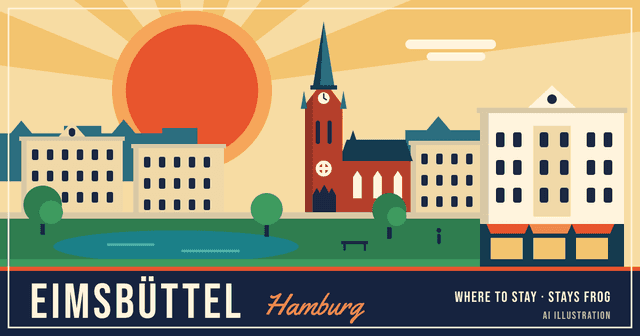
Choose Eimsbüttel to live like a local: leafy Gründerzeit streets, Osterstraße's cafés and the U2 straight to the centre, at gentler prices.
A district for neighborhood walks, smaller shops and food stops beyond the central sightseeing circuits.
How it scores
- Food
- 8/10
Seasonal tasting menus at Heimatjuwel on Stellinger Weg, Jellyfish on Weidenallee and cafés along Osterstraße
- Nightlife
- 5/10
Not a nightlife district: bars off Osterstraße and live jazz at Birdland on Gärtnerstraße at least twice a week
- Shopping
- 7/10
Owner-run shops along Osterstraße and a monthly flea market on Else-Rauch-Platz from March to October
- Walkability
- 8/10
Leafy Gründerzeit streets, the Isebek canal path and Osterstraße are easy to stroll; the centre is a long walk
- Transit
- 8/10
U2 at Osterstraße, Emilienstraße and Christuskirche to Jungfernstieg and the Hauptbahnhof; S1 on to the airport
- Coolness
- 7/10
Jugendstil façades on Fettstraße and Amandastraße, the Isebek canal and the Osterstraße spring street festival
- Safety
- 7/10
Calm and comfortable by day and night; the main hazards are traffic on the Fruchtallee and cyclists on shared paths
- Loudness
- 5/10
Lively evenings only around Osterstraße and its side-street bars; elsewhere the residential streets are quiet at night
Each category is scored 1-10 by our editors; the Frog Score is their average. Safety is our editors' judgment of how comfortable it is to walk around, not crime statistics. Loudness runs from library quiet (1) to never sleeps (10) and doesn't count toward the Frog Score. How we score
Our take
Eimsbüttel is a green, down-to-earth residential quarter north-west of the centre, with tall Gründerzeit and Jugendstil apartment houses, small parks, long-established shops and about 58,000 residents packed into just over three square kilometres. The city's own portrait calls it a mix of old buildings, green space and lived-in neighbourhood culture, popular with students, young people and families, and notes that it is no nightlife district and that tourists rarely come. That is exactly its appeal: you get everyday Hamburg life at an unhurried pace. Locals call it 'Eimsbush', a nickname made famous by Jan Delay's record label.
Choose Eimsbüttel for repeat visits, longer stays, families and anyone who would rather live like a local than sleep beside the sights. Look for an apartment or small hotel near one of the U2 stations along Osterstraße so the centre is a quick ride away; Superbude St. Pauli on Juliusstraße, in the neighbouring Schanze, is a handy hotel option with double and multi-bed rooms. Prices for staying and eating out tend to be gentler than in the centre or by the Alster.
Osterstraße is the main street, lined with restaurants, cafés, bars, ice-cream parlours and owner-run shops, and it throws a street festival every spring. The Eimsbütteler Park 'Am Weiher', the quarter's largest green space, grew from the pond dammed in 1832; Wehbers Park on Doormannsweg keeps Eimsbüttel's only surviving country house, built in 1881; and the Kaiser-Friedrich-Ufer along the Isebek canal is made for walks, runs and paddling. Fettstraße, Amandastraße, Grundstraße and Lutterothstraße show off richly decorated Gründerzeit and Jugendstil façades, and the red-brick Christuskirche, built in 1882 to 1884, stands right by its U-Bahn station. For dinner, Heimatjuwel on Stellinger Weg serves Marcel Görke's seasonal four-, five- or six-course menus with vegetables in the lead, Tuesday to Saturday evenings, and Jellyfish on Weidenallee offers both fine-dining and bistro formats; for live music, the Birdland jazz club on Gärtnerstraße has bands at least twice a week. From March to October, neighbours run a flea market on Else-Rauch-Platz on the last Sunday of each month.
The U2 runs under the neighbourhood with stops at Lutterothstraße, Osterstraße, Emilienstraße and Christuskirche, then continues via Schlump, where it meets the U3, to Gänsemarkt, Jungfernstieg and the Hauptbahnhof. For the airport, change to the S1 at Jungfernstieg or the Hauptbahnhof; from the Hauptbahnhof it is about 25 minutes, with trains every 10 minutes. City cycle routes cross the quarter, though the centre is a long walk. Eimsbüttel is a calm, comfortable residential area by day and at night; evenings are lively only around Osterstraße and the bars on its side streets, so late-night streets elsewhere are simply quiet. The main thing to watch is traffic on busy through roads such as the Fruchtallee and the cyclists on shared paths.
By Stays Frog AI Desk
A short history
Eimsbüttel was first recorded in 1275 as 'Eymersbuttele', a farming village that passed to the Herwardeshude convent in 1339 and, after the Reformation, to Hamburg's St. Johannis convent. From the 17th century wealthy Hamburg families built country houses here, Napoleon's troops burned almost the whole village in 1813, and in 1832 Ascan Lutteroth dammed the Ottersbek stream into the pond that is now the Eimsbütteler Park 'Am Weiher'. Industry and workers' housing arrived in the second half of the 19th century: the Christuskirche went up in 1882 to 1884, Beiersdorf settled here in 1892, Eimsbüttel was incorporated into the city in 1894, and its population passed 100,000 before the First World War. The U-Bahn reached its streets just before that war, and in 1936 the Kaifu-Bad became Hamburg's first heated open-air pool. The air raids of 1943 destroyed much of the old housing, so today rows of Gründerzeit and Jugendstil apartment houses alternate with post-war buildings across a densely populated quarter.
Restaurants in Eimsbüttel
Traveller reviews
What people who've been say. One review each; you can update yours.
References(13)
Primary sources used to check this guide and its listings.
- Discover Hamburg's Eimsbüttel & Eppendorf! · www.hamburg-travel.com
- Heimatjuwel · heimatjuwel.de
- Safety and security - Germany travel advice - GOV.UK · UK Foreign, Commonwealth & Development Office
- hvv Plan: U/S/A/R-Plan · www.hvv.de
- OpenStreetMap administrative boundary — Eimsbüttel · OpenStreetMap contributors, ODbL 1.0; parent-supplied cache
- Eimsbüttel: Stadtteilporträt · Free and Hanseatic City of Hamburg (hamburg.de)
- Hamburg-Eimsbüttel · Wikipedia (German)
- Eimsbüttel (quarter) · Wikipedia
- Christuskirche (Hamburg-Eimsbüttel) · Wikipedia (German)
- Arrival and departure to the airport · Hamburg Airport
- Hamburg U-Bahn · Wikipedia
- Jellyfish Hamburg – Jellyfish Restaurant · jellyfish-restaurant.de
- Kontakt – Jellyfish Hamburg · jellyfish-restaurant.de