NeighborhoodsNeighborhood area
San Giuseppe
Central streets and a food-led pause · Naples
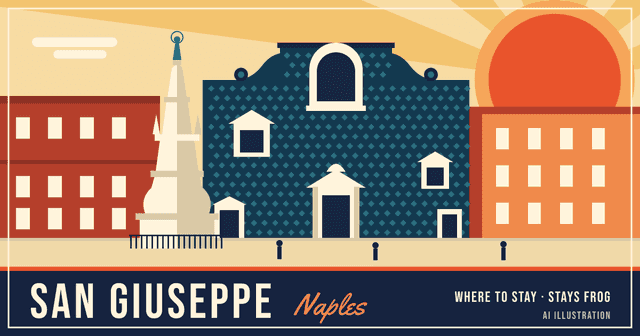
Choose San Giuseppe for a compact, walkable base between Via Toledo, the Gesù Nuovo and Spaccanapoli, with the metro and the port close by.
San Giuseppe is a compact wedge of the centre around Piazza del Gesù Nuovo and its diamond-studded church front, with Spaccanapoli heading east and Via Toledo's shops on its western edge; an easy walking base for first-timers, with the island ferries just beyond.
How it scores
- Food
- 7/10
Scaturchio's pastries on Piazza San Domenico Maggiore, with Gino Sorbillo's pizza on Via dei Tribunali a short walk north
- Nightlife
- 6/10
Bath Pipe gin bar with more than 150 gins; the squares around the Gesù and Spaccanapoli stay lively in the evening
- Shopping
- 6/10
Via Toledo's shops run along the western edge; the Rione Carità around Via Diaz is mostly banks and offices
- Walkability
- 8/10
Compact: Piazza del Gesù, Spaccanapoli and Piazza Dante a few blocks apart, with the port just beyond Piazza Municipio
- Transit
- 7/10
Line 1 at Dante and Toledo, direct to Garibaldi; Central Funicular from Augusteo to Vomero; Alibus to Molo Beverello
- Coolness
- 7/10
Diamond-studded Gesù Nuovo, Santa Chiara's cloister, Sant'Anna dei Lombardi and Vanvitelli's curved Foro Carolino
- Safety
- 6/10
Busy and comfortable by day; pickpockets work Via Toledo, Piazza Dante and the metro, so stick to lit squares late
- Loudness
- 7/10
Crowded by day and lively round the Gesù and Spaccanapoli in the evening; office streets near Via Diaz go quiet after hours
Each category is scored 1-10 by our editors; the Frog Score is their average. Safety is our editors' judgment of how comfortable it is to walk around, not crime statistics. Loudness runs from library quiet (1) to never sleeps (10) and doesn't count toward the Frog Score. How we score
Our take
San Giuseppe is the smallest of Naples' quarters, a compact wedge of the centre between Via Toledo, Piazza Dante and the Gesù Nuovo. Its northern half belongs to the historic centre: Piazza del Gesù Nuovo, with its dark, diamond-studded church front and soaring white plague spire, opens onto Via Benedetto Croce, the western stretch of the long straight street known as Spaccanapoli, with Piazza San Domenico Maggiore a few blocks east. Its southern half is the 1930s Rione Carità, a district of banks, offices and the curving Palazzo delle Poste around Via Armando Diaz. Barely 5,000 people live here, so it feels less like a residential neighbourhood than a busy crossroads of students, shoppers and office workers.
It suits first-time visitors who want to walk everywhere: the churches and pizzerias of the historic centre are on the doorstep, Via Toledo's shops run along the western edge, and the port, with ferries to the islands, lies just beyond Piazza Municipio. Artemisia Domus, a boutique residence in an 18th-century palazzo on Via dei Carrozzieri a Monteoliveto, has rooms looking over the cloister of Santa Chiara and sits between Piazza del Gesù and Spaccanapoli. If you choose a flat or guesthouse in an old palazzo instead, check for a lift and how lively the street below is before booking.
Start in Piazza del Gesù Nuovo. The church was built inside a 15th-century palace and kept its façade of projecting diamond-shaped stones; inside lies the tomb of Giuseppe Moscati, the physician canonised in 1987, and the Santa Chiara complex faces it across the square. Walk east along Spaccanapoli to the basilica of San Domenico Maggiore, then drop down Calata Trinità Maggiore, past the Renaissance Palazzo Gravina (now the university's architecture faculty), to Piazza Monteoliveto, where the church of Sant'Anna dei Lombardi faces a fountain crowned by a statue of King Charles II. To the north, Piazza Dante is framed by Luigi Vanvitelli's curved Foro Carolino, built in honour of Charles III, with Port'Alba leading through to Piazza Bellini. For pastries, Scaturchio's historic shop is on Piazza San Domenico Maggiore; for an evening drink, Bath Pipe is a gin bar with more than 150 gins on its list, and Gino Sorbillo's pizzeria on Via dei Tribunali is a short walk north.
Line 1 of the metro stops at Dante and Toledo on the quarter's western edge and runs direct to Garibaldi, beside Napoli Centrale station. Toledo station, designed to feel like a journey under the sea with a great cone of light through its levels, is worth a look in its own right. The Central Funicular climbs from Augusteo, near Via Toledo and the Galleria Umberto, to Piazza Fuga in Vomero. From the airport, the ANM Alibus runs to Piazza Garibaldi and to the port at Molo Beverello, and taxis from the airport rank charge a fixed fare to the city centre.
By day San Giuseppe is busy and comfortable, but Via Toledo, Piazza Dante and the metro are crowded, and crowds are where pickpockets and bag-snatchers work, so keep bags zipped and phones out of back pockets. In the evening the squares around the Gesù and Spaccanapoli stay lively, while the office streets around Via Diaz and the Palazzo delle Poste go quiet once offices close; late at night, stick to the main squares and well-lit streets.
By Stays Frog AI Desk
A short history
San Giuseppe grew up just west of the old Greek and Roman city and took its shape in the 15th and 16th centuries, as Naples spread beyond its walls. In 1470 a palace was built here for Roberto Sanseverino, Prince of Salerno; the Jesuits bought it in the 1580s and Giuseppe Valeriano turned it into the church of the Gesù Nuovo between 1584 and 1601, keeping the palace's façade of diamond-pointed stones. In 1536 the Spanish viceroy Pedro de Toledo laid out Via Toledo along the quarter's western side, and the square in front of the Gesù took form in the same westward expansion; its plague spire of the Immacolata was finished only in 1750. The quarter is named after the church of San Giuseppe Maggiore, built in 1500 for the city's cart-makers and demolished in 1934, when the Fascist-era clearance of the old Rione Carità replaced its lanes with wide streets and monumental offices such as Giuseppe Vaccaro and Gino Franzi's curving Palazzo delle Poste, completed in 1936. That is the mix visitors find today: Renaissance and Baroque churches around Piazza del Gesù and Monteoliveto, and a 1930s office district around Via Armando Diaz, a few minutes apart.
No places in San Giuseppe scored yet.
Traveller reviews
What people who've been say. One review each; you can update yours.
References(17)
Primary sources used to check this guide and its listings.
- Municipalità 2 - Comune di Napoli · Official tourism authority
- Visit Naples: Things to do & Attractions - Italia.it · Official tourism authority
- Boutique Hotel Napoli – Artemisia Domus – Luxury Accommodation Napoli · Venue operator
- Bath Pipe Cocktail Bar Napoli Centro: Aperitivo e Gin Tonic · Venue operator
- Istat ASC 2021 level 2 — Quartiere, Napoli — San Giuseppe · Official municipal GIS / Istat; CC BY 4.0, Istat site-wide default unless otherwise stated; no different license in release
- Safety and security - Italy travel advice - GOV.UK GOV.UK · UK Foreign, Commonwealth & Development Office
- San Giuseppe (Napoli) · Wikipedia (Italian)
- San Giuseppe, Naples · Wikipedia
- Gesù Nuovo · Wikipedia
- Rione Carità · Wikipedia (Italian)
- Chiesa di San Giuseppe Maggiore · Wikipedia (Italian)
- Via Toledo · Wikipedia
- Central Funicular · Wikipedia
- Scaturchio - shops · Venue operator
- By bus - Naples International Airport · Naples International Airport (GESAC)
- By taxi - Naples International Airport · Naples International Airport (GESAC)
- Line 1 (Naples Metro) · Wikipedia