NeighborhoodsNeighborhood area
Stella
Craft, pizza and residential streets · Naples
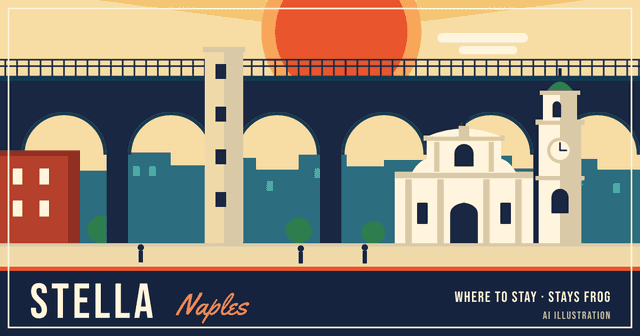
Choose Stella for the Archaeological Museum, the Sanità's catacombs and churches and old-school pizza at low prices, if you prefer everyday Naples to polish.
A dense, very Neapolitan quarter climbing north from the National Archaeological Museum into the Rione Sanità, with Baroque churches, booked catacomb tours and four generations of pizza at Concettina ai Tre Santi.
How it scores
- Food
- 8/10
Four generations of pizza at Concettina ai Tre Santi on Via Arena della Sanità, and old-school pizzerias at low prices
- Nightlife
- 5/10
Little late life: the Sanità's side lanes go very quiet after dark, so most evenings end with dinner and a taxi back
- Shopping
- 8/10
Family craft workshops, led by Omega on Via Stella, where the Squillace family has hand-made gloves for five generations
- Walkability
- 6/10
Narrow lanes, stepped alleys and steep approaches; the lift at the Ponte della Sanità links the valley to the road above
- Transit
- 6/10
Metro Line 1 at Museo and Materdei, Line 2 at Piazza Cavour, direct to Garibaldi for Napoli Centrale and the Alibus
- Coolness
- 8/10
Baroque churches, early Christian catacombs, the Borgo dei Vergini and family craft businesses in everyday Naples
- Safety
- 6/10
Lively by day but poorer, so keep phones discreet; side lanes go quiet and poorly lit at night, so take a taxi after dinner
- Loudness
- 7/10
Crowded, lively lanes in the Sanità by day; the valley's side streets turn very quiet after dark
Each category is scored 1-10 by our editors; the Frog Score is their average. Safety is our editors' judgment of how comfortable it is to walk around, not crime statistics. Loudness runs from library quiet (1) to never sleeps (10) and doesn't count toward the Frog Score. How we score
Our take
Stella climbs north from the National Archaeological Museum toward the Capodimonte hill, and its heart for visitors is the Rione Sanità: a deep valley of Baroque churches, 17th- and 18th-century palazzi and early Christian catacombs, crossed high overhead by the Napoleonic Ponte della Sanità. It is a dense, residential and very Neapolitan district rather than a polished tourist quarter, with narrow lanes and stepped alleys, the old Borgo dei Vergini, and craft businesses that have been run by the same families for generations. Much of what visitors come to see is looked after locally: La Paranza, a social cooperative that is part of a network creating work and second chances, runs the catacomb visits.
Stella suits repeat visitors, budget travellers and anyone more curious about everyday Naples than about polish. The southern edge around the Archaeological Museum and Piazza Cavour is the most practical place to stay, on two metro lines and a short walk from the historic centre; a room down in the Sanità puts you among the churches and pizzerias but further from the metro and with the valley's steep approaches to climb. Whatever you book, check how you will reach the door with luggage and what the street outside is like at night.
The National Archaeological Museum, in a building begun in 1585 as a barracks and later home to the university, holds the Farnese collection and the frescoes and mosaics of Pompeii and Herculaneum, including the Alexander Mosaic. From there, cross to the Ponte della Sanità and ride the lift down into the Rione Sanità; from the bridge you can see the majolica-tiled dome of Santa Maria della Sanità and, on a clear day, Vesuvius. The basilica is a Greek-cross church with a raised altar reached by twin Baroque staircases, and the catacombs of San Gaudioso lie beneath it; the larger catacombs of San Gennaro open off Via Capodimonte up the hill, and both are visited on guided tours that must be booked. Look out for Ferdinando Sanfelice's palace and the Palazzo dello Spagnolo on the way. For lunch, Concettina ai Tre Santi on Via Arena della Sanità has been making pizza for four generations, since 1951, and on Via Stella the Squillace family's Omega has made gloves by hand for five generations, each pair in about 25 steps, with its workshop open on weekdays.
Line 1 of the metro stops at Museo, linked to Line 2 at Piazza Cavour, and at Materdei on the western side, and runs direct to Garibaldi for Napoli Centrale and the Alibus to the airport; taxis from the airport rank charge a fixed fare to the city centre. The Sanità sits in a valley below Via Santa Teresa degli Scalzi and Corso Amedeo di Savoia, the main road up to Capodimonte, and the lift built against one of the bridge's piers, running since 1937, is the easiest link between the two levels.
By day the Sanità is lively and generally welcoming, with visitors heading for the catacombs and churches alongside residents going about their day, but it is one of the poorer parts of Naples, with high unemployment, so keep phones and cameras discreet and bags closed, as you would in any crowded city centre. After dark the valley's side lanes become very quiet and some are poorly lit: stay on the busier streets, or take a taxi back after dinner, and take the usual care around Piazza Cavour and the metro.
By Stays Frog AI Desk
A short history
Stella began as a city of the dead: the valleys outside the walls of ancient Naples held Greek and Roman burial chambers, and between the 2nd and 5th centuries AD Christians dug the great catacombs of San Gennaro and San Gaudioso into the soft tuff. Building spread out here in the 16th century, around the Porta di Costantinopoli and the church of Santa Maria della Stella, named for an icon of the Madonna with a star on her head, which gave the quarter its name, and the Sanità valley filled with churches and noble palazzi, among them the basilica of Santa Maria della Sanità (1602–1613), Ferdinando Sanfelice's palace and the Palazzo dello Spagnolo in the Borgo dei Vergini. After the plague of 1656 the nearby Fontanelle quarries became a vast burial ground, and an edict of 1718 freed building outside the walls. Between 1806 and 1809, under Joseph Bonaparte and Joachim Murat, a new road to the royal palace of Capodimonte was carried over the valley on the Ponte della Sanità, at the cost of the basilica's great cloister, and the Sanità's noble and wealthy families gradually gave way to one of the city's most working-class districts. In 1943, during the Four Days of Naples, partisans including Maddalena Cerasuolo stopped the retreating Germans from blowing up the bridge, which has borne her name since 2011.
No places in Stella scored yet.
Traveller reviews
What people who've been say. One review each; you can update yours.
References(15)
Primary sources used to check this guide and its listings.
- Municipalità 3 - Comune di Napoli · Official tourism authority
- Omega Gloves American Express Apple Pay Bancontact BLIK Google Pay Klarna Maestro Mastercard MobilePay PayPal Satispay Shop Pay Union Pay Visa · Venue operator
- Concettina ai Tre Santi · Venue operator
- Istat ASC 2021 level 2 — Quartiere, Napoli — Stella · Official municipal GIS / Istat; CC BY 4.0, Istat site-wide default unless otherwise stated; no different license in release
- Safety and security - Italy travel advice - GOV.UK GOV.UK · UK Foreign, Commonwealth & Development Office
- Stella (Napoli) · Wikipedia (Italian)
- Stella, Naples · Wikipedia
- Rione Sanità · Wikipedia (Italian)
- Ponte della Sanità · Wikipedia (Italian)
- Santa Maria della Sanità, Naples · Wikipedia
- National Archaeological Museum, Naples · Wikipedia
- Catacombs of Naples - La Paranza · La Paranza Coop. Soc. (site operator)
- By bus - Naples International Airport · Naples International Airport (GESAC)
- By taxi - Naples International Airport · Naples International Airport (GESAC)
- Line 1 (Naples Metro) · Wikipedia