NeighborhoodsNeighborhood area
Carré d'Or
Central hotels between city streets and the seafront · Nice
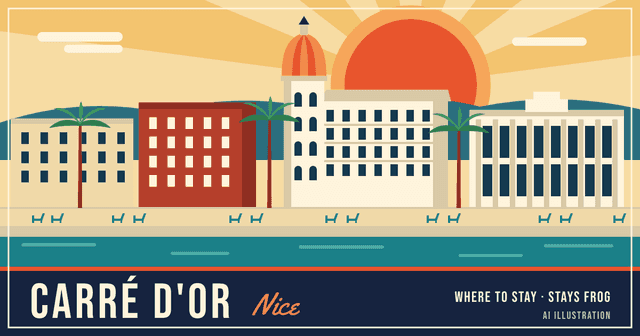
Choose the Rue de France side of the Carré d'Or for grand seafront hotels like the Negresco, the Promenade on your doorstep and an easy walk to the centre.
Nice's classic grand-hotel strip between Boulevard Gambetta and the sea, where Le Negresco, the Villa Masséna museum and the palm-lined Promenade des Anglais sit steps from the beaches of the Baie des Anges.
How it scores
- Food
- 7/10
Michelin-starred Le Chantecler at the Negresco, La Rotonde facing the Promenade and N La Plage on the beach
- Nightlife
- 6/10
Evening strolls and dinners on the Promenade; for bars and a livelier night, walk east to Place Masséna and Vieux Nice
- Shopping
- 7/10
Mostly hotels and apartments; the stores of Avenue Jean-Médecin are a few blocks north-east of the quarter
- Walkability
- 8/10
Flat and easy: the seafront leads east to Place Masséna, the Jardin Albert-Ier and the edge of Vieux Nice
- Transit
- 7/10
Tram 2 at Alsace-Lorraine runs direct to both airport terminals and east to Jean Médecin; Nice-Ville is uphill
- Coolness
- 7/10
Belle Époque grandeur: Le Negresco's pink dome, the Villa Masséna museum and Holy Trinity on Rue de la Buffa
- Safety
- 7/10
Safe and well kept by day and evening; watch bags in crowds and on the beach, and keep to the lit Promenade late
- Loudness
- 6/10
The Promenade stays busy with walkers, runners and diners into the evening; polished rather than a bar district
Each category is scored 1-10 by our editors; the Frog Score is their average. Safety is our editors' judgment of how comfortable it is to walk around, not crime statistics. Loudness runs from library quiet (1) to never sleeps (10) and doesn't count toward the Frog Score. How we score
Our take
The Rue de France quarter is the western half of what the Niçois call the Carré d'Or, the golden square of grand hotels and Belle Époque apartment buildings between Boulevard Gambetta, Boulevard Victor-Hugo, Rue Halévy and the sea. Rue de France, partly pedestrianised, runs through the middle past the listed Croix de Marbre, and the neo-Gothic Anglican church stands one street over on Rue de la Buffa. Down on the seafront, the palm-lined Promenade des Anglais, its famous blue chairs and the beaches of the Baie des Anges set the tone: this is Nice's classic grand-hotel strip, polished and elegant rather than bohemian.
It suits couples, first-timers and anyone who wants a Riviera hotel with the sea across the road. Le Negresco at 37 Promenade des Anglais, a five-star art hotel with a pink dome, a listed façade and a collection of art and furniture spanning several centuries, is the landmark stay. Its neighbours on the Promenade include the Art Deco Hôtel Palais de la Méditerranée, a five-star hotel at no. 13; the Belle Époque West End, most of whose 121 rooms look over the bay; and the sea-facing Westminster. A block inland on Rue Dalpozzo, the Hôtel Windsor, run by the same family for more than 80 years, has rooms painted with frescoes or decorated by contemporary artists and a tropical garden with a pool. Sea-view rooms on the Promenade are among the priciest in the city; the side streets cost less and are just as close to the beach.
Start at the Villa Masséna, the villa beside the Negresco that is now the city's museum of art and history, telling the story of Nice and the Riviera from the 18th to the early 20th century, with a listed garden opening onto the Promenade. Holy Trinity, built between 1859 and 1862 by the British architect Thomas Smith, recalls the English winter visitors who gave the Promenade its name. For a special dinner, the Negresco's Michelin-starred Le Chantecler serves chef Virginie Basselot's cooking in a room panelled with woodwork from 1751, while its brasserie La Rotonde looks straight onto the Promenade and N La Plage serves food on the beach. Then walk east along the seafront to Place Masséna and the old town for bars and a livelier night out.
The whole quarter is walkable: Place Masséna, the Jardin Albert-Ier and the edge of Vieux Nice lie east along the seafront, and the shops of Avenue Jean-Médecin are a few blocks north-east. Tram line 2 stops at Alsace-Lorraine, just off the quarter's north-west corner, with direct trams west to both airport terminals and east through the city-centre tunnel to Jean Médecin and the port; Nice-Ville railway station is uphill to the north. The Rue de France quarter feels safe and well kept by day and in the evening, when the Promenade is busy with walkers, runners and diners. The city describes Nice as a safe city but asks visitors to keep bags closed and watched in crowds and on public transport, and never to leave belongings unattended on the beach while swimming. Late at night, keep to the lit Promenade and main streets rather than the beach, and leave nothing visible in parked cars.
By Stays Frog AI Desk
A short history
This slice of Nice grew along the old Route de France, for centuries the only carriage road from the city to the French border on the Var and the way every coach traveller arrived until the railway reached Nice in 1864. English visitors had been wintering here since the 18th century, and in the 1820s Reverend Lewis Way and members of Holy Trinity, the Anglican church on Rue de la Buffa, paid for the seaside walkway that became the Promenade des Anglais. Hotels followed: the West End opened in 1854 as the first hotel on the Chemin des Anglais, the Dalmas of 1865 took the name Westminster in 1881, and behind them the Belle Époque apartment buildings of what was long called the Buffa quarter filled in the grid. Victor Masséna, prince of Essling, built his villa beside the sea between 1898 and 1901, Henri Negresco opened his pink-domed hotel next door just before the First World War, and the Art Deco Palais de la Méditerranée followed in 1929. Gutted behind its listed façade in 1990 and reopened as a hotel and casino in 2004, the Palais completes the run of grand seafront addresses that locals now call the Carré d'Or.
No places in Carré d'Or scored yet.
Traveller reviews
What people who've been say. One review each; you can update yours.
References(25)
Primary sources used to check this guide and its listings.
- Anantara Plaza Nice Hotel in Nice - Nice Côte d'Azur Tourist Office · Official tourism / municipal source
- Official map: Rue de France · Métropole Nice Côte d’Azur
- Nice municipal visitor safety leaflet · Ville de Nice
- En vacances, l’esprit tranquille — visitor prevention campaign · Ville de Nice
- Le Negresco (heritage notice) · Nice Côte d'Azur Tourist Office
- Hôtel Le Negresco · Nice Côte d'Azur Tourist Office
- Hotel Negresco · Wikipedia
- Villa Masséna, musée d’art et d’histoire · Nice Côte d'Azur Tourist Office
- Musée Masséna · Wikipedia (French)
- Hôtel West-End (heritage notice) · Nice Côte d'Azur Tourist Office
- Hôtel West End · Nice Côte d'Azur Tourist Office
- Hôtel Westminster (heritage notice) · Nice Côte d'Azur Tourist Office
- Hôtel Windsor · Nice Côte d'Azur Tourist Office
- Hôtel Palais de la Méditerranée · Nice Côte d'Azur Tourist Office
- Palais de la Méditerranée · Wikipedia (French)
- Holy Trinity Church – Église Anglicane de Nice · Nice Côte d'Azur Tourist Office
- Promenade des Anglais · Nice Côte d'Azur Tourist Office
- Promenade des Anglais · Wikipedia
- Rue de France (Nice) · Wikipedia (French)
- Restaurant Le Chantecler · Nice Côte d'Azur Tourist Office
- Restaurant La Rotonde · Nice Côte d'Azur Tourist Office
- Restaurant N La Plage · Nice Côte d'Azur Tourist Office
- Liste des quartiers de Nice · Wikipedia (French)
- Ligne 2 du tramway de Nice · Wikipedia (French)
- Nice tramway · Wikipedia