NeighborhoodsNeighborhood area
Cimiez
Hilltop museums, gardens and Roman remains · Nice
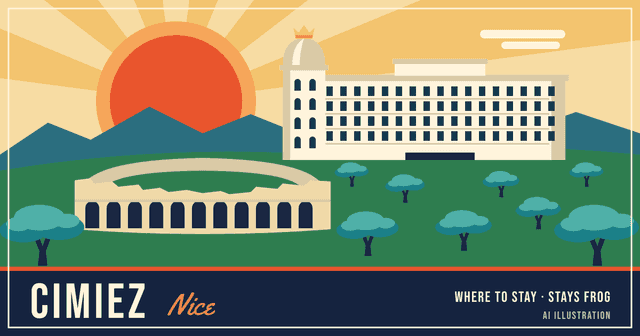
Choose Cimiez for Roman ruins, the Matisse and Chagall museums and quiet, leafy streets above the city, if you don't mind taking the bus to the beach.
A leafy, well-to-do residential hill north-east of central Nice, where an olive grove ties together the Musée Matisse, the Roman ruins of Cemenelum and the Franciscan monastery, with the Chagall museum lower down.
How it scores
- Food
- 6/10
No real dining scene: a refreshment stand and picnics under the olive trees; head down to the centre for a proper meal
- Nightlife
- 4/10
Calm and green, more for a long morning of museums than for nightlife; evenings mean heading down to the centre
- Shopping
- 4/10
Mostly residential, with Belle Époque palaces turned into apartments and little shopping on the hill itself
- Walkability
- 5/10
Steep: the climb up the Boulevard de Cimiez is long and hot in summer, but the walk down past the Chagall museum is pleasant
- Transit
- 5/10
Buses 5, 16, 18, 33 and 40 stop at Arènes / Musée Matisse; tram 1 runs below at Libération and Valrose Université
- Coolness
- 7/10
Musée Matisse in a 17th-century villa, Roman Cemenelum, Louis Bréa paintings in the monastery and the Chagall museum
- Safety
- 7/10
Calm and safe by day and night, but streets are very quiet after dark; take a bus or taxi late and watch bags on buses
- Loudness
- 4/10
One of the calmest parts of Nice: green, quiet residential streets by day and very quiet after dark
Each category is scored 1-10 by our editors; the Frog Score is their average. Safety is our editors' judgment of how comfortable it is to walk around, not crime statistics. Loudness runs from library quiet (1) to never sleeps (10) and doesn't count toward the Frog Score. How we score
Our take
Cimiez is Nice's hill of history and gardens, a leafy, well-to-do residential quarter that climbs north-east of the centre along the Boulevard de Cimiez. Belle Époque palaces, built as hotels for winter visitors and long since turned into apartments, line the boulevard, and at the top a park of century-old olive trees surrounds the Roman amphitheatre, the ruins of Cemenelum, the Franciscan monastery and the Genoese-style villa that houses the Musée Matisse. It is calm, green and quiet, more a place for a long morning of museums and a picnic than for nightlife.
It suits culture lovers, families with children who need room to run, and travellers who would rather sleep somewhere quiet and come down to the sea by bus. Most of the grand palace hotels, including the Régina that hosted Queen Victoria, are now private apartments, so Cimiez works best as a calm residential base for a longer stay; check how close your address is to a bus stop, because the hill is steep and the beach is a ride away. The lower slopes near the Chagall museum are the easiest for getting into town, while the streets around the Arènes put the gardens on your doorstep.
Make a morning of the hilltop. The Musée Matisse, in a 17th-century villa with a trompe-l'oeil façade, holds nearly 600 works given by Matisse and his heirs, from the 1890s to the paper cut-outs of his last years. Beside it, the archaeology museum, opened in 1989, is the gateway to the Roman baths, paved streets and 5th-century early Christian complex of Cemenelum, and the amphitheatre, which hosted the Nice Jazz Festival until 2010, is open as a public garden. Across the olive grove, the monastery church holds three major paintings by Louis Bréa, with a 16th-century cloister and a small Franciscan museum alongside, and its garden looks out over the whole city and the sea; Matisse and Raoul Dufy are buried in the cemetery next door. Lower down the hill, the Musée national Marc Chagall holds the 17 paintings of his Biblical Message, the largest public collection of his work. The park has a refreshment stand and allows picnics under the olive trees; for a proper meal, head back down to the centre.
Most visitors come up by bus: Lignes d'Azur lines 5, 16, 18, 33 and 40 stop at Arènes / Musée Matisse at the top, and tram line 1 runs through the valley below the hill's western flank, with stops at Libération and Valrose Université. Walking down the Boulevard de Cimiez towards the station and Avenue Jean-Médecin is a pleasant way back, past the Chagall museum and the Belle Époque palaces, but the climb up is long and hot in summer. Cimiez is one of the calmest parts of Nice and feels safe by day and at night, but its residential streets are very quiet after dark, so late in the evening take the bus or a taxi rather than walking long stretches alone. As everywhere in the city, keep an eye on bags on crowded buses, lock cars and leave nothing visible inside.
By Stays Frog AI Desk
A short history
The hill was first settled by the Vediantii, a Celto-Ligurian tribe whose oppidum crowned the summit, and the Romans then built Cemenelum below it as the capital of their province of the Maritime Alps, leaving baths and an amphitheatre that still stand. As the town declined after the 4th century, the hill went back to olive groves, vineyards and country houses such as the 17th-century Gubernatis villa, while a monastery passed from the Benedictines of Saint-Pons to the Franciscans in 1546. The railway's arrival in 1864 and the opening of the Boulevard de Cimiez at the end of the 19th century turned the hill into a winter retreat for European royalty and aristocrats, crowned by the Régina, completed in 1897, where Queen Victoria stayed in 1897, 1898 and 1899. The palace hotels became apartments from the 1930s; Henri Matisse made his home and studio in the Régina from 1938 and is buried in the monastery cemetery, and in 1963 the city opened the Musée Matisse in the old Gubernatis villa, now set in the olive grove beside the Roman ruins.
No places in Cimiez scored yet.
Traveller reviews
What people who've been say. One review each; you can update yours.
References(19)
Primary sources used to check this guide and its listings.
- Jardin des Arènes de Cimiez in Nice - Nice Côte d'Azur Tourist Office · Official tourism / municipal source
- Official map: Cimiez · Métropole Nice Côte d’Azur
- Nice municipal visitor safety leaflet · Ville de Nice
- En vacances, l’esprit tranquille — visitor prevention campaign · Ville de Nice
- Cimiez · Wikipedia (French)
- The historical neighbourhood of Cimiez · Musée Matisse Nice
- The Villa · Musée Matisse Nice
- Practical information · Musée Matisse Nice
- Musée Matisse Nice · Nice Côte d'Azur Tourist Office
- Musée d’Archéologie de Nice / Cimiez · Nice Côte d'Azur Tourist Office
- Arènes de Cimiez · Wikipedia (French)
- Musée Franciscain – Église et Monastère de Cimiez · Nice Côte d'Azur Tourist Office
- Monastère de Cimiez · Wikipedia (French)
- Jardin du Monastère de Cimiez · Nice Côte d'Azur Tourist Office
- Ancien Hôtel Régina · Nice Côte d'Azur Tourist Office
- Musée National Marc Chagall · Nice Côte d'Azur Tourist Office
- Musée Matisse (Nice) · Wikipedia
- Liste des quartiers de Nice · Wikipedia (French)
- Nice tramway · Wikipedia