NeighborhoodsNeighborhood area
Bonfim
Artistic institutions and eastern central streets · Porto
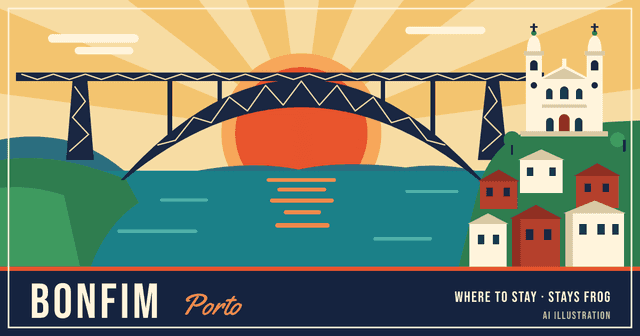
Pick Bonfim for a local, good-value base on the metro, with São Lázaro, the Fine Arts quarter and the Fontainhas views over the Douro a walk away.
A residential, once-industrial parish in eastern-central Porto, running from the São Lázaro garden and Campo 24 de Agosto's metro stations down to the Fontainhas bluffs, with Fine Arts students and Douro views.
How it scores
- Food
- 8/10
Euskalduna Studio's 16-seat tasting menu on Rua de Santo Ildefonso; everyday cafés around Campo 24 de Agosto
- Nightlife
- 6/10
Low-key evenings: two bars at the Vila Galé, Euskalduna Studio dinners and the June São João party at Fontainhas
- Shopping
- 6/10
Few shops of its own; Rua de Santa Catarina's shopping is about ten minutes on foot from Campo 24 de Agosto
- Walkability
- 8/10
Walk to the Baixa and Ribeira from the western streets, but routes up from the river and Fontainhas are steep
- Transit
- 8/10
Heroísmo and 24 de Agosto metro on lines A, B, C, E and F; line E runs direct to the airport, Campanhã one stop
- Coolness
- 9/10
Fine Arts students, the 1834 São Lázaro garden, Monte do Tadeu's street-art stairs and Eiffel's Maria Pia bridge
- Safety
- 7/10
Comfortable by day and on main streets at night; back lanes and Fontainhas stairs get quiet late. Watch bags on the metro
- Loudness
- 6/10
Everyday residential bustle on the main streets; quiet back lanes at night, busy at Fontainhas for São João in June
Each category is scored 1-10 by our editors; the Frog Score is their average. Safety is our editors' judgment of how comfortable it is to walk around, not crime statistics. Loudness runs from library quiet (1) to never sleeps (10) and doesn't count toward the Frog Score. How we score
Our take
Bonfim is eastern-central Porto, a residential, once-industrial parish that runs from the São Lázaro garden and Campo 24 de Agosto down to the Fontainhas bluffs above the Douro. It feels local rather than touristy: neoclassical church towers, 19th-century terraces, old factory buildings and the Faculty of Fine Arts, whose students give the area the creative, slightly irreverent edge the city's tourism board likes to celebrate.
It suits repeat visitors, budget-minded travellers and anyone who wants the metro on the doorstep without sleeping in the crowded historic core; the shops of Rua de Santa Catarina are about ten minutes on foot from the Campo 24 de Agosto end. Hotel Vila Galé Porto, a 1999 tower on Avenida Fernão de Magalhães about 100 metres from the 24 de Agosto metro station, is the big-hotel option, with a cinema theme, a restaurant, two bars and a top-floor spa with an indoor pool and wide views over the city. Otherwise look for guesthouses and apartments close to the Heroísmo or 24 de Agosto stations, which keep the rest of Porto within easy reach.
Start at the São Lázaro garden, opened in 1834 as Porto's first public garden, a railed romantic square of magnolias, fountains and a small bandstand facing the municipal library in the old Convent of Santo António; the library closed in 2024 for a redevelopment designed by Souto Moura, so check before planning a visit inside. The Fine Arts Faculty museum is on Avenida de Rodrigues de Freitas, and the Military Museum on Rua do Heroísmo, a late-19th-century house that held a regional office of the PIDE political police until 1974, displays around 16,000 miniature soldiers. Walk east to the twin-towered Church of Bonfim, then on to the Parque das Águas do Porto, once the Reid family's estate, and the street-art staircase of Monte do Tadeu; Prado do Repouso, the city's first public cemetery, is full of granite funerary art. On the river side, the Fontainhas promenade looks down on the Douro and every June hosts one of the oldest street parties of the São João festival, while Eiffel's wrought-iron Maria Pia bridge spans the river at the parish's southern tip. For a special dinner, Euskalduna Studio on Rua de Santo Ildefonso seats just 16 guests around chef Vasco Coelho Santos's team for a tasting menu; for everyday meals, the cafés and small restaurants on the streets around Campo 24 de Agosto serve the neighbourhood.
Heroísmo and 24 de Agosto metro stations sit on the trunk shared by lines A, B, C, E and F, so Bolhão and Trindade are one or two stops west, Campanhã railway station is one stop east of Heroísmo, and line E runs to the airport without a change. The Baixa and the Ribeira are walkable from the western streets, but the routes between the river and the upper parish are steep. Bonfim is an ordinary residential district and feels comfortable by day and on its main streets in the evening; late at night the back lanes, the Fontainhas stairways and the riverside paths get very quiet, so stick to lit main roads or take a taxi. As everywhere in Porto, keep your bag closed on crowded metros and at busy bus and tram stops, where thieves often work in teams.
By Stays Frog AI Desk
A short history
Bonfim was the youngest of Porto's parishes before the 2013 reorganisation, carved out of parts of Santo Ildefonso, Campanhã and Sé on the city's eastern side, with its present limits fixed by decree in 1956. Its first civic landmarks date from the 1830s: the São Lázaro garden opened in 1834 as Porto's first public garden, the municipal library founded by Pedro IV in 1833 moved into the 18th-century Convent of Santo António da Cidade in 1842, and Prado do Repouso opened in 1839 as the city's first public cemetery. Through the 19th century Bonfim also filled with factories and workers' housing, and its population climbed from about 10,700 in 1864 to more than 42,000 by 1950. The parish church, with its twin 42-metre bell towers, was built between 1874 and 1894 to replace a small chapel, and in 1877 the Maria Pia railway bridge, built by Gustave Eiffel's company, opened across the Douro below the Seminário hill at its southern edge. Most of the old factories have since closed, leaving a residential district of shops and services where the Faculty of Fine Arts keeps an artistic streak alive.
No places in Bonfim scored yet.
Traveller reviews
What people who've been say. One review each; you can update yours.
References(22)
Primary sources used to check this guide and its listings.
- Bonfim District - Visit Porto · Visit Porto — official visitor material
- DGT CAOP 2012.1 — historical parish polygons · Direção-Geral do Território — official historical cartography
- Hotel Vila Galé Porto - Visit Porto · Visit Porto
- Euskalduna Studio - Visit Porto · Visit Porto
- Euskalduna · Euskalduna Studio operator
- Safety and security - Portugal travel advice - GOV.UK · UK Foreign, Commonwealth & Development Office — current visitor-safety guidance
- Metro do Porto / Mapas e horários · Metro do Porto — current operator maps and timetables
- Linhas STCP · STCP — current operator route information
- Bonfim (Porto) · Wikipédia (pt)
- Igreja Matriz do Bonfim · Wikipédia (pt)
- Church of Bonfim - Visit Porto · Visit Porto — official visitor material
- São Lázaro Garden - Visit Porto · Visit Porto — official visitor material
- Porto Municipal Public Library - Visit Porto · Visit Porto — official visitor material
- Biblioteca Pública Municipal do Porto · Wikipédia (pt)
- Porto Military Museum - Visit Porto · Visit Porto — official visitor material
- Museu Militar do Porto · Wikipédia (pt)
- Prado do Repouso Cemetery - Visit Porto · Visit Porto — official visitor material
- Águas do Porto Park - Visit Porto · Visit Porto — official visitor material
- Belas Artes Museum - Visit Porto · Visit Porto — official visitor material
- Escadaria do Monte do Tadeu - Visit Porto · Visit Porto — official visitor material
- Alameda das Fontainhas · Wikipédia (pt)
- Maria Pia Bridge · Wikipedia