NeighborhoodsNeighborhood area
Campanhã
Rail arrivals, parks and eastern heritage · Porto
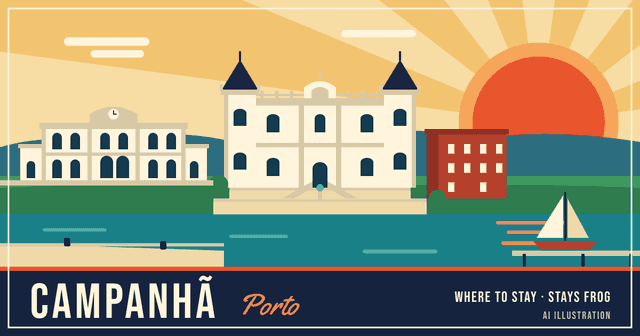
Choose Campanhã for early trains, Dragão match days or a palace stay on the Douro; the centre is a few metro stops away, but evenings out are elsewhere.
Porto's big eastern parish around Campanhã railway station and FC Porto's Estádio do Dragão, mixing rail links and housing estates with Nasoni's Palácio do Freixo on the Douro and the green Parque Oriental.
How it scores
- Food
- 6/10
Mostly neighbourhood cafés and local restaurants; plan bigger dinners in the centre, a few metro stops west
- Nightlife
- 4/10
Evenings out are elsewhere; FC Porto match nights at the Estádio do Dragão bring the crowds
- Shopping
- 4/10
Little to browse: a big, spread-out parish of housing estates, former factories and parks; shop in the centre
- Walkability
- 6/10
Large and spread out: use the metro, a bus or taxi between the station, the Dragão and Palácio do Freixo
- Transit
- 9/10
Campanhã station for Alfa Pendular to Lisbon, metro lines A, B, C, E and F, line E to the airport, and the TIC bus terminal
- Coolness
- 7/10
Nasoni's baroque Palácio do Freixo, the box-hedge labyrinth at Parque de São Roque and the Casa São Roque art centre
- Safety
- 7/10
Busy and fine by day; the station empties late, so take lit main roads or a taxi, and mind bags on match-night platforms
- Loudness
- 5/10
Crowds and packed trains around the Dragão on match nights; the station area empties late, and the parks are calm
Each category is scored 1-10 by our editors; the Frog Score is their average. Safety is our editors' judgment of how comfortable it is to walk around, not crime statistics. Loudness runs from library quiet (1) to never sleeps (10) and doesn't count toward the Frog Score. How we score
Our take
Campanhã is Porto's eastern edge, a big, uneven parish that most visitors first see from a train window. The main railway station, the intermodal bus terminal and FC Porto's Estádio do Dragão are all here, but so are baroque country houses, old farm lanes in the river valley and the largest continuous green space in the city. The tourism board sums it up as rural and modern Porto at once, and it is still being renewed, so expect housing estates, former factories and new parks within a short distance of one another.
Stay here for the trains or a match: it suits travellers with an early Alfa Pendular to Lisbon, football fans and anyone happy to ride the metro into the centre each day. The standout stay is the Pestana Palácio do Freixo, the largest of the Pousadas de Portugal, set in Nicolau Nasoni's 18th-century palace on the Douro with terraced gardens above the river. Elsewhere, choose an address close to Campanhã or Estádio do Dragão metro stations, because the parish is large and its sights are spread out.
Palácio do Freixo is the architectural highlight: a mid-18th-century baroque palace with four pyramid-roofed corner towers, balustrades topped with pinnacles and Italian-style terraces, restored by Fernando Távora, with the Freixo Marina beside it. Inland, Parque de São Roque is a romantic garden of more than four hectares with a box-hedge labyrinth, opened to the public in 1979 after the Calém family sold it to the city, and Casa São Roque, a villa and garden on the same road, is an art centre with a contemporary programme. Parque Oriental, opened in 2010, covers about ten hectares of the valley, and Quinta de Bonjóia keeps an 18th-century manor attributed to Nasoni among woods and gardens. At the Estádio do Dragão, FC Porto's home since 2003 and designed by Manuel Salgado, the FC Porto Museum is the draw on non-match days. Eating out is mostly neighbourhood cafés and local restaurants, so plan your bigger dinners in the centre.
Campanhã station handles Alfa Pendular trains to Lisbon and urban trains that continue to São Bento in the centre, and the metro station beside it is on every line except D: lines A, B, C, E and F all run through Heroísmo, Bolhão and Trindade, and line E goes straight to the airport. The TIC intermodal terminal on Rua de Bonjóia links buses with the metro and trains, and STCP buses 205 and 207 run from Campanhã to Castelo do Queijo and Mercado da Foz on the coast. Distances inside the parish are long, so use the metro, a bus or a taxi between the station, the Dragão and the riverside palace. By day the station area is busy and feels fine; late at night it empties, so take lit main roads or a taxi between the station, the bus terminal and quieter residential streets, and leave the parks and riverside for daylight. On match nights expect crowds and packed trains around the Dragão, and keep your bags close on busy platforms and at stops, where pickpockets often work in teams.
By Stays Frog AI Desk
A short history
Campanhã is older than the city that absorbed it: a document of 994 names its river, and by the 11th century the 'villa campaniana', a rural estate of Roman tradition, covered much of the valley. In 1120 Teresa, mother of Afonso Henriques, granted Porto to Bishop Hugo, splitting the valley between the bishop's land in the west and royal land in the east, and for centuries it fed the city as farmland worked by farmers, Douro fishermen and millers, while in the 18th century wealthy families built country houses such as Nasoni's Freixo palace and Quinta de Bonjóia. Campanhã was a town with its own council until 1836. The railway transformed it: trains ran from Campanhã to Braga by 1875, and in 1877 the Maria Pia bridge and Campanhã station were inaugurated together, drawing workers from the interior into new factories and into the 'ilhas' and courtyard housing around the station. From the 1950s the city built large housing estates in the valley as services replaced industry, and today Campanhã mixes rural pockets and the city's largest continuous green space with the rail hub, the Dragão stadium and new parks.
No places in Campanhã scored yet.
Traveller reviews
What people who've been say. One review each; you can update yours.
References(17)
Primary sources used to check this guide and its listings.
- Campanhã District - Visit Porto · Visit Porto — official visitor material
- DGT CAOP 2012.1 — historical parish polygons · Direção-Geral do Território — official historical cartography
- Safety and security - Portugal travel advice - GOV.UK · UK Foreign, Commonwealth & Development Office — current visitor-safety guidance
- Metro do Porto / Mapas e horários · Metro do Porto — current operator maps and timetables
- Linhas STCP · STCP — current operator route information
- Campanhã · Wikipédia (pt)
- Porto-Campanhã railway station · Wikipedia
- TIC - Terminal Intermodal de Campanhã - Visit Porto · Visit Porto — official visitor material
- Palácio do Freixo - Visit Porto · Visit Porto — official visitor material
- Palácio do Freixo · Wikipédia (pt)
- Freixo Marina - Visit Porto · Visit Porto — official visitor material
- São Roque Park - Visit Porto · Visit Porto — official visitor material
- Casa São Roque - Visit Porto · Visit Porto — official visitor material
- Parque Oriental - Visit Porto · Visit Porto — official visitor material
- Bonjóia Manor - Visit Porto · Visit Porto — official visitor material
- Quinta de Bonjóia · Wikipédia (pt)
- Estádio do Dragão & FC Porto Museum - Visit Porto · Visit Porto — official visitor material