NeighborhoodsNeighborhood area
Centro
Royal squares and arcaded streets · Turin
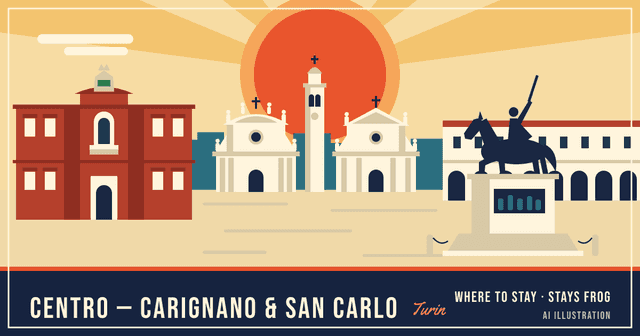
First-timers who want Turin's grand squares, the Museo Egizio and historic cafés on the doorstep, between Via Roma and Porta Nuova station.
Turin's postcard centre runs down porticoed Via Roma to Piazza San Carlo, the city's drawing room, with the Museo Egizio a block away and Del Cambio, open since 1757, on Piazza Carignano; grand, walkable and right by Porta Nuova for a first visit.
How it scores
- Food
- 9/10
Historic Del Cambio on Piazza Carignano, the Sitea's Carignano restaurant and Stratta pastries since 1836
- Nightlife
- 8/10
Aperitivo in the portico cafés, cocktails at Bar Cavour and Farmacia Del Cambio, and the Sitea's American Bar
- Shopping
- 9/10
Porticoed Via Roma, the Galleria Subalpina and Galleria San Federico, and Stratta's pralines and gianduiotti
- Walkability
- 9/10
Via Roma runs about 600 m under porticoes from Piazza Castello to Piazza Carlo Felice; the Mole and the Po are close
- Transit
- 8/10
Porta Nuova station with Metro line 1 beneath; airport buses from Piazza Carlo Felice take 45 to 50 minutes
- Coolness
- 8/10
Piazza San Carlo's porticoes and twin churches, Guarini's Palazzo Carignano and the Museo Egizio, founded in 1824
- Safety
- 6/10
Comfortable by day and evening under lit arcades; pickpockets work Via Roma, Piazza San Carlo and Porta Nuova
- Loudness
- 7/10
Via Roma and the big squares are busy and host concerts and screenings; Borgo Nuovo's garden squares are calmer
Each category is scored 1-10 by our editors; the Frog Score is their average. Safety is our editors' judgment of how comfortable it is to walk around, not crime statistics. Loudness runs from library quiet (1) to never sleeps (10) and doesn't count toward the Frog Score. How we score
Our take
This is the Turin of the postcards: long arcaded streets running south from the royal palaces, broken up by formal squares. Piazza San Carlo, nicknamed the city's drawing room, is framed by Carlo di Castellamonte's 17th-century porticoes and closed at its southern end by the twin churches of San Carlo and Santa Cristina, with Carlo Marochetti's 1838 bronze of Duke Emanuele Filiberto on horseback in the middle. A block east, Guarini's Palazzo Carignano curves its red-brick Baroque façade around Piazza Carignano, and beyond it lie the calmer 19th-century streets and garden squares of Borgo Nuovo, such as Piazza Cavour and Via Mazzini. Via Roma, the porticoed shopping street rebuilt in the 1930s, ties it all together from Piazza Castello down to Piazza Carlo Felice and Porta Nuova station; its northern stretch, from Piazza Castello to Piazza San Carlo, has been pedestrian since 2025.
Centro is the obvious base for a first visit: the Museo Egizio, the Royal Museums and most of a short Turin itinerary are a walk away, and the porticoes keep you dry when it rains. It suits couples, culture-focused travellers and anyone arriving by train, since Porta Nuova sits at its southern end. The Grand Hotel Sitea on Via Carlo Alberto, a five-star hotel that celebrated its centenary in 2025, is the classic grand-hotel choice, with its Carignano restaurant and American Bar. This is the city's grandest address and room prices tend to reflect it; for quieter nights, ask for a room away from Via Roma and the big squares, which host concerts and screenings.
The Museo Egizio on Via Accademia delle Scienze, founded in 1824 and the world's oldest museum devoted entirely to ancient Egypt, is the headline sight. Palazzo Carignano houses the National Museum of the Italian Risorgimento, and the Galleria Subalpina and Galleria San Federico are elegant covered arcades for a rainy-day stroll; Piazza Castello and the Royal Palace are just to the north. Del Cambio on Piazza Carignano, which opened as a café in 1757, is Turin's grand historic dining room, with the Bar Cavour cocktail bar and the Farmacia Del Cambio, set in a pharmacy dating from 1833, alongside. Stratta, on Piazza San Carlo since 1836, sells pastries, pralines and gianduiotti, and the cafés under the porticoes are made for the aperitivo, a custom the tourism board says began in Turin about two centuries ago.
Centro is best explored on foot: Via Roma runs about 600 metres from Piazza Castello to Piazza Carlo Felice, and the Mole Antonelliana and the Po are a short walk east. Porta Nuova, Turin's main station, faces Piazza Carlo Felice with Metro line 1 underneath; buses to Turin Airport leave from Piazza Carlo Felice and take 45 to 50 minutes, and the airport train from Porta Susa, three metro stops away, takes about half an hour. The centre feels comfortable by day and into the evening, with the arcades lit and plenty of people about. The main risk is petty theft: watch for pickpockets in the crowds on Via Roma and Piazza San Carlo, around Porta Nuova station and on the metro, and when a big event fills Piazza San Carlo, stay near the edges and the exits.
By Stays Frog AI Desk
A short history
Centro's grid of arcaded streets began in 1620, when Duke Carlo Emanuele I of Savoy launched the "Città Nova", Turin's first planned expansion south of the old town, with a new street (today's Via Roma) laid out by Ascanio Vittozzi and a royal square, today's Piazza San Carlo, whose porticoes Carlo di Castellamonte designed around 1638. In 1679 Guarino Guarini began Palazzo Carignano for Emanuele Filiberto, Prince of Carignano, and its undulating brick palace later housed the Chamber of Deputies of the Kingdom of Sardinia from 1848 and the first parliament of united Italy in 1861. After the old south-eastern walls came down in the early 19th century, Via Roma was extended to what became Piazza Carlo Felice in 1822, King Charles Felix founded the Museo Egizio in 1824, and Borgo Nuovo was laid out for the nobility east of Via Roma, with Via Mazzini dating from 1832 and Piazza Cavour from 1835. Porta Nuova station rose at the southern end between 1861 and 1868, and between 1931 and 1938 Via Roma was rebuilt with the tall porticoes visitors walk under today, its southern stretch to a rationalist design coordinated by Marcello Piacentini.
No places in Centro scored yet.
Traveller reviews
What people who've been say. One review each; you can update yours.
References(16)
Primary sources used to check this guide and its listings.
- Torino centro: scopri i quartieri di Torino | Turismo Torino e Provincia · Official tourism authority
- Comune di Torino Azzonamenti Statistici — Zone statistiche — Palazzo Carignano - Vecchio Ospedate (Borgo Nuovo), Piazza San Carlo - Piazza Carlo Felice · Official municipal GIS / Istat; CC BY 4.0
- Safety and security - Italy travel advice - GOV.UK GOV.UK · UK Foreign, Commonwealth & Development Office
- Piazza San Carlo · Wikipedia
- Palazzo Carignano · Wikipedia
- Via Roma (Torino) · Wikipedia (Italian)
- Borgo Nuovo (Torino) · Wikipedia (Italian)
- Museo Egizio · Wikipedia
- Museo Egizio – official site · Museo Egizio
- About us – Del Cambio · Venue operator
- Stratta 1836 · Venue operator
- Grand Hotel Sitea · Hotel operator
- Torino Porta Nuova railway station · Wikipedia
- Turin Metro · Wikipedia
- By bus | Torino Airport · Torino Airport (airport operator)
- By train | Torino Airport · Torino Airport (airport operator)