NeighborhoodsNeighborhood area
Quadrilatero Romano
Roman traces and old-city cafés · Turin
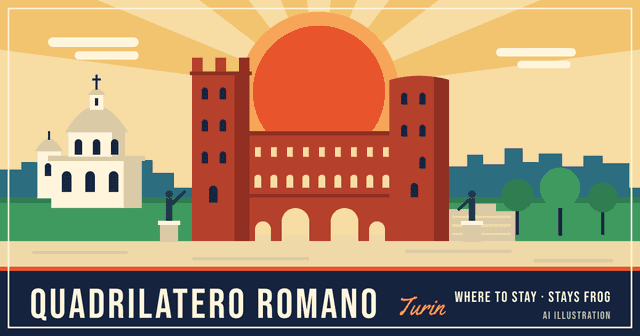
Pick the Quadrilatero for Roman Turin on your doorstep, aperitivo squares at night, and the royal centre and Porta Palazzo market a short walk away.
The Quadrilatero Romano is Turin's oldest corner, a Roman street grid running west from the Porta Palatina towers to the Consolata, where Caffè Al Bicerin still serves its namesake drink; lively at aperitivo hour and steps from the royal palaces.
How it scores
- Food
- 8/10
Bicerin at Caffè Al Bicerin, aperitivo bars on Piazza Emanuele Filiberto and the Mercato Centrale at Porta Palazzo
- Nightlife
- 7/10
Aperitivo crowds fill the bars around Piazza Emanuele Filiberto from early evening, and weekends run late
- Shopping
- 6/10
Small artisan shops around Piazza Emanuele Filiberto, Porta Palazzo's daily market and the Balôn flea market nearby
- Walkability
- 8/10
Compact Roman grid along Via Garibaldi; Piazza Castello, the Duomo and Porta Palazzo are all a short walk
- Transit
- 7/10
Metro line 1 at XVIII Dicembre and Porta Susa; trains from Porta Susa reach the airport in about 30 minutes
- Coolness
- 8/10
The Roman Porta Palatina, Guarini and Juvarra's Consolata, the MAO in Palazzo Mazzonis and the Shroud museum
- Safety
- 6/10
Busy and safe-feeling by day and evening; mind bags at Porta Palazzo market and stations, and never leave a drink unattended
- Loudness
- 7/10
Bar streets around Piazza Emanuele Filiberto stay loud late on weekends; Via Garibaldi and the Consolata are quieter
Each category is scored 1-10 by our editors; the Frog Score is their average. Safety is our editors' judgment of how comfortable it is to walk around, not crime statistics. Loudness runs from library quiet (1) to never sleeps (10) and doesn't count toward the Frog Score. How we score
Our take
The Quadrilatero Romano is Turin's oldest corner: a tight grid of streets laid out by the Romans just west of the Porta Palatina, where a plan more than two thousand years old still shapes the walk. The name now belongs mainly to the part west of Via XX Settembre and Porta Palazzo, with Via Garibaldi, the old Roman decumanus, running through it and Piazza Palazzo di Città, the town hall square, at its centre. It is a compact quarter of small squares, churches and old palazzi that has been renewed in recent decades and comes alive in the early evening, when the aperitivo crowd fills the bars around Piazza Emanuele Filiberto.
It suits couples, culture-minded first-timers and anyone who wants to step out of the door into old Turin, with Piazza Castello, the royal palaces and the Duomo just to the east and the Porta Palazzo market just to the north. For quieter nights, look for an address on or just off Via Garibaldi or near Piazza Savoia and the Consolata; the streets closest to Piazza Emanuele Filiberto are the liveliest after dark. Expect to pay a little more than in Turin's residential districts, in exchange for being able to walk almost everywhere.
Start at the Porta Palatina, the Roman city's northern gate, whose two 16-sided brick towers stand in the Archaeological Park beside the remains of the Roman theatre, with bronze copies of statues of Augustus and Julius Caesar beside it. Then wander west to the Santuario della Consolata, a Baroque shrine by Guarini and Juvarra with a Romanesque bell tower and a gallery of ex-votos, and order a bicerin, the layered glass of espresso, chocolate and milk, at Caffè Al Bicerin across the square, which has served it since the 18th century. The MAO Museo d'Arte Orientale in Palazzo Mazzonis and the Museo della Sindone, the Holy Shroud museum in the church of the Santo Sudario, are both inside the quarter. Turin claims the aperitivo, a ritual the tourist board traces back about two centuries, and Piazza Emanuele Filiberto is the place to join it. For food shopping, Porta Palazzo next door runs what is billed as Europe's largest open-air market every day, with the Mercato Centrale in the Fuksas-designed pavilion, and the Balôn, Turin's historic flea market, lies just beyond in Borgo Dora.
Everything central is walkable, and Porta Susa, which is becoming the city's main rail hub for regional and high-speed trains, is a short walk west, with metro Line 1 stopping at XVIII Dicembre and Porta Susa. Trains from Porta Susa reach the airport in about 30 minutes, and airport buses also call at Porta Susa and Porta Nuova. The quarter feels safe and busy by day and into the evening, when the squares are full of people. Take the usual big-city care with bags and phones in crowds, especially in the crush of the Porta Palazzo market, at the stations and on public transport. On weekend nights the bar streets around Piazza Emanuele Filiberto stay loud until late; never leave a drink unattended, and steer clear of any demonstrations, which can start in Italian cities with little warning.
By Stays Frog AI Desk
A short history
The Quadrilatero takes its name from the square walled camp of Julia Augusta Taurinorum, the Roman colony founded in the 1st century BC, and its grid of right-angled streets still follows that plan: Via Garibaldi, long called Via Dora Grossa, traces the decumanus, and Piazza Palazzo di Città is thought to stand on the old forum. The Porta Palatina, the colony's northern gate from the 1st century AD, became a fortified castle in the Middle Ages, had its western tower rebuilt in 1404, and survived the early 18th century only because the architect Antonio Bertola persuaded Duke Vittorio Amedeo II not to demolish it. Beside the old walls, a church with a venerated Marian icon grew into the Baroque Consolata, rebuilt by Guarino Guarini from 1678 and extended by Filippo Juvarra between 1729 and 1740, while medieval building slowly blurred the Roman side streets. In 2006 the city opened the Archaeological Park around the gate and the Roman theatre, and the old district, renewed in recent decades, is now known for the aperitivo bars and small artisan shops around Piazza Emanuele Filiberto.
No places in Quadrilatero Romano scored yet.
Traveller reviews
What people who've been say. One review each; you can update yours.
References(12)
Primary sources used to check this guide and its listings.
- Quadrilatero, Porta Palazzo, Borgo Dora e Barriera: scopri i quartieri di Torino | Turismo Torino e Provincia · Official tourism authority
- Comune di Torino Azzonamenti Statistici — Zone statistiche — Municipio · Official municipal GIS / Istat; CC BY 4.0
- Safety and security - Italy travel advice - GOV.UK GOV.UK · UK Foreign, Commonwealth & Development Office
- Quadrilatero romano · Wikipedia (Italian)
- Porta Palatina · Wikipedia
- Santuario della Consolata · Wikipedia
- Bicerin · Wikipedia
- Piazza della Repubblica (Torino) · Wikipedia (Italian)
- Turin · Wikipedia
- Turin Metro · Wikipedia
- By train | Torino Airport · Torino Airport (airport operator)
- By bus | Torino Airport · Torino Airport (airport operator)