NeighborhoodsNeighborhood area
Erzsébetváros (District VII)
Courtyard meals and ruin-bar culture · Budapest
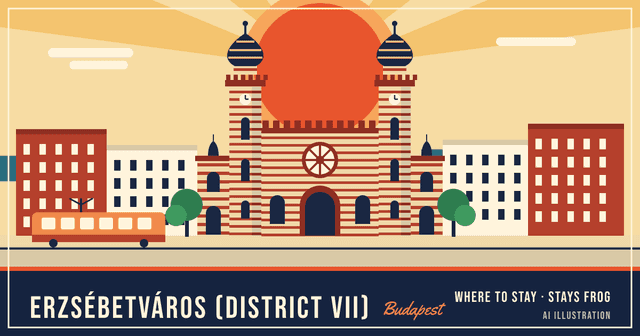
Pick Erzsébetváros for ruin bars, the Jewish Quarter's synagogues and good-value eating, and book on a quieter side street if you want to sleep.
Erzsébetváros holds Budapest's old Jewish Quarter, where the Dohány Street Synagogue, the original ruin bar Szimpla Kert and the courtyards of Gozsdu Court share a few crumbling, curving streets; the city's liveliest district after dark, it suits young travellers and night owls.
How it scores
- Food
- 9/10
Middle Eastern plates in Mazel Tov's courtyard, Kádár Étkezde's lunch counter on Klauzál tér and the 1894 New York Café
- Nightlife
- 9/10
Szimpla Kert, the original ruin bar, the multi-room Instant-Fogas and the bars of Gozsdu Court's six courtyards
- Shopping
- 8/10
Local design at Printa, vintage and fashion at Szputnyik on Dohány utca, kosher shops and Szimpla's weekend market
- Walkability
- 8/10
The Jewish Quarter is compact, with three synagogues minutes apart; beyond the Grand Boulevard it runs on to Keleti
- Transit
- 9/10
M2 at Astoria and Blaha Lujza tér, M1 under Andrássy út, trams 4 and 6 on the Grand Boulevard, Keleti nearby
- Coolness
- 9/10
Dohány Street Synagogue, Europe's largest, ruin bars in old tenement courtyards and the Art Nouveau Kazinczy synagogue
- Safety
- 6/10
Relaxed and safe by day; at night watch for spiked drinks and inflated bills in bar streets, and pickpockets on trams
- Loudness
- 9/10
Kazinczy utca, Akácfa utca and Gozsdu Court stay loud into the small hours at weekends; beyond the boulevard is calmer
Each category is scored 1-10 by our editors; the Frog Score is their average. Safety is our editors' judgment of how comfortable it is to walk around, not crime statistics. Loudness runs from library quiet (1) to never sleeps (10) and doesn't count toward the Frog Score. How we score
Our take
Erzsébetváros is Budapest's most densely populated district and its liveliest after dark. Its inner half, between Károly körút and the Grand Boulevard, is the old Jewish Quarter: narrow, curving streets such as Kazinczy utca, three great synagogues a few minutes' walk apart, kosher shops and a matzah bakery, and the crumbling courtyards of old tenement houses, many now filled with ruin bars, restaurants and design shops. Király utca forms its northern edge with Terézváros, and beyond the Grand Boulevard the district turns more residential as it runs out towards Keleti station and the City Park.
It suits young travellers, groups and night owls who want bars on the doorstep, and food lovers who want to eat well for less than in District V. Continental Hotel Budapest, a four-star-superior hotel on Dohány utca on the site of the old Hungária Bath, is the stand-out base inside the Jewish Quarter, and Bo33 Hotel, a family-and-suites hotel on Szövetség utca, sits on a quieter street a few steps from the action. Many visitors rent apartments in the old tenements, so check exactly where yours is: a flat above Kazinczy utca, Akácfa utca or Gozsdu Court can be loud into the small hours at weekends, while the blocks beyond the Grand Boulevard are calmer.
Begin at the Dohány Street Synagogue, with its twin onion-domed towers, the Hungarian Jewish Museum, the Heroes' Temple and the Holocaust Memorial Park with its weeping-willow memorial; the synagogue is open on weekdays and closed on Saturdays and Jewish holidays. The Rumbach Street Synagogue, refurbished in 2021 with a kosher café, and the Art Nouveau Kazinczy Street Synagogue complete the triangle. Szimpla Kert, the original ruin bar, is a warren of mismatched furniture, old bicycles and a bathtub, with concerts and a weekend market; Instant-Fogas on Akácfa utca is a huge multi-room party complex, and Mazel Tov a few doors away serves Middle Eastern food in a cosy courtyard. Gozsdu Court, seven linked buildings with six courtyards between Király utca and Dob utca, is lined with bars and restaurants. For something grander, the New York Café on Erzsébet körút has been pouring coffee since 1894, while Kádár Étkezde on Klauzál tér keeps the old lunch-counter tradition alive. Shop for local design at Printa and for vintage and contemporary fashion at Szputnyik's Dohány utca store.
Everything in the Jewish Quarter is walkable. Metro M2 stops at Astoria and Blaha Lujza tér on the district's southern edge, M1 runs under Andrássy út just north of Király utca, trams 4 and 6 run along the Grand Boulevard, and Keleti station is at the district's eastern corner; the 100E airport bus leaves from Deák Ferenc tér, a short walk west. By day the district is relaxed and safe. At night the bar streets are crowded, noisy and mostly good-natured, but this is exactly where Britain's Foreign Office says drinks have been spiked in Budapest's bars, so buy your own and keep them in sight, check prices and the bill, and be wary of anyone, taxi drivers included, who steers you to a particular bar or club. Pickpockets work the crowds and the busy trams, and the streets around Kazinczy utca and Gozsdu Court stay loud until very late on Friday and Saturday nights.
By Stays Frog AI Desk
A short history
Erzsébetváros grew out of Pest's 18th-century Upper Suburb, where gardens outside the city walls filled with houses as the crowded town overflowed, and it belonged to Terézváros until 1882, when the southern half was split off and named after Queen Elisabeth, consort of Franz Joseph. Jewish families concentrated here from around 1800, joined in the later 19th century by immigrants from Eastern Europe, and the Dohány Street Synagogue, built in 1854–1859 to designs by Ludwig Förster, remains the largest synagogue in Europe; the Rumbach and Kazinczy Street synagogues and the six courtyards of Gozsdu Court (1900–1904) followed. In November 1944 the Arrow Cross regime forced some 70,000 Jews into a fenced ghetto in these blocks, between Károly körút and Dohány, Kertész and Király streets, until Soviet troops liberated it in January 1945. The district lost much of its population under socialism, and from the early 2000s its empty, decaying tenements were reborn as ruin bars, led by Szimpla Kert, which moved into a condemned former stove factory on Kazinczy utca in 2004.
No places in Erzsébetváros (District VII) scored yet.
Traveller reviews
What people who've been say. One review each; you can update yours.
References(25)
Primary sources used to check this guide and its listings.
- 6+1 must-see ruin bars in Budapest · Official destination or municipal source
- VII. kerület — exact relation outline · OpenStreetMap contributors, ODbL 1.0; cached public geographic result
- Home - Bo33 Hotel****Family & Suites · Venue operator
- Continental Hotel Budapest | 4-Star Superior City Centre Hotel · Venue operator
- MAZEL TOV - Budapest · Venue operator
- New York Kávéház Budapest | A világ legszebb kávéháza · Venue operator
- Szimpla · Venue operator
- Instant-Fogas: party complex in the heart of Budapest · Venue operator
- Vintage & kortárs divat | Szputnyik shop · Venue operator
- Retro Adventures: 5+1 Vintage Shops You Will Love · Official city tourism directory
- Printa · Venue operator
- KAPCSOLAT – Printa · Venue operator
- Safety and security - Hungary travel advice - GOV.UK · FCDO official government travel guidance
- BKK metro, suburban railway and tram network · Official transport operator or destination source
- Maps - BKK.hu · Official transport operator or destination source
- Erzsébetváros · Wikipedia
- Dohány Street Synagogue · Wikipedia
- Budapest Ghetto · Wikipedia
- Szimpla Kert · Wikipedia
- Ruin bar · Wikipedia
- Terézváros and Erzsébetváros · Budapest Info (official city tourism)
- Synagogues in Budapest · Budapest Info (official city tourism)
- Dohány utca Synagogue · Budapest Info (official city tourism)
- 100E Airport Express – BKK · BKK Centre for Budapest Transport
- List of Budapest Metro stations · Wikipedia