NeighborhoodsNeighborhood area
Óbuda-Békásmegyer (District III)
Older Buda history and a wider district outing · Budapest
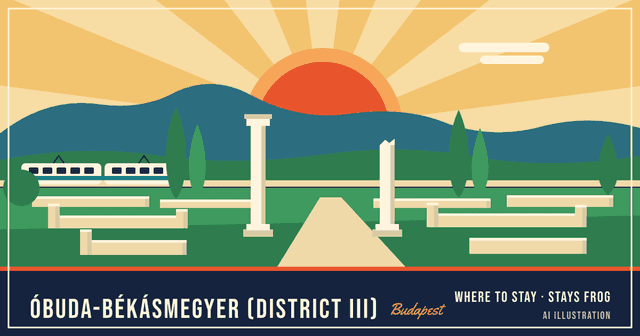
Choose Óbuda for Roman ruins, small museums and green riverside space at lower prices, if you don't mind taking the HÉV into the centre.
District III offers an alternative historic focus beyond the Castle District, with Óbuda at its core.
How it scores
- Food
- 6/10
Cosy taverns of the Krúdy quarter around Fő tér, and the tiny Gázlámpa Kioszk café in the middle of the square
- Nightlife
- 5/10
Pubs of the Krúdy quarter and festivals on Fő tér; Sziget takes over Óbuda Island every August
- Shopping
- 5/10
Mostly residential with big housing estates; shopping is not a draw, though Fő tér hosts festivals and Advent events
- Walkability
- 5/10
Old Óbuda around Fő tér and Szentlélek tér is walkable; Aquincum and Békásmegyer are HÉV rides north
- Transit
- 7/10
No metro; the H5 HÉV runs from Batthyány tér (M2) via Szentlélek tér and Aquincum, with buses and trams
- Coolness
- 7/10
Roman Aquincum and its amphitheatres, the Vasarely Museum in the Zichy Palace and the 1821 Óbuda Synagogue
- Safety
- 7/10
Calm and family-oriented; watch bags on crowded trains and at Sziget, and avoid the quiet riverside paths late
- Loudness
- 4/10
Residential and calm most of the year; Fő tér festivals and Sziget in August are the loud exceptions
Each category is scored 1-10 by our editors; the Frog Score is their average. Safety is our editors' judgment of how comfortable it is to walk around, not crime statistics. Loudness runs from library quiet (1) to never sleeps (10) and doesn't count toward the Frog Score. How we score
Our take
Óbuda-Békásmegyer is a large, mostly residential district on the Buda bank north of the centre, and it pairs Budapest's deepest history with some of its biggest housing estates. Its heart is old Óbuda around the cobbled Fő tér and Szentlélek tér, where low historic houses, small museums and cosy taverns survive beside the concrete blocks. Heading north along the Danube come the Roman ruins of Aquincum, the riverside Római-part and, at the far end, the Békásmegyer estate and its old village at the foot of the Pilis hills. Óbuda Island, in the river alongside, is home to the Sziget Festival every August.
It suits repeat visitors, families, cyclists and runners, Sziget-goers and anyone who would rather sleep somewhere calm and spend less, in exchange for a train or bus ride into the centre. The best base is near Szentlélek tér, Fő tér and Flórián tér, the district's centre, with restaurants on the doorstep and the HÉV into town; the riverside around Rómaifürdő suits those who want the river and the cycle path, while the big estates further out are purely residential.
Start in Óbuda's museum quarter around Szentlélek tér: the Vasarely Museum of op art in the Zichy Palace, the Óbuda Museum, the Goldberger Textile Collection, the Budapest Gallery and the Hungarian Museum of Trade and Tourism sit close together, and the Kassák Museum, the Kiscelli Museum and the Imre Varga Collection are also in the district. Fő tér hosts events all year, from Óbuda Day and craft-beer and wine festivals to Óbuda Summer and Advent, and the little Gázlámpa Kioszk in the middle of the square is the city's smallest café. The writer Gyula Krúdy spent his last years here, and the surrounding "Krúdy quarter" keeps its cosy restaurants and pubs. A few stops north, the Aquincum Museum and its ruin garden show the streets, baths and houses of a Roman provincial town, and the civil and military amphitheatres and the Thermae Maiores baths museum are dotted through the district. The Óbuda Synagogue of 1821, reopened in 2010, is once again a centre of Jewish community life. In summer, the Római-part riverbank, the Római lido and the cycle paths along the Danube pull Budapesters north, and the trails of Hármashatár-hegy offer hiking without leaving the city.
The metro does not reach Óbuda, so the H5 suburban railway (HÉV) is the quickest link: it starts at Batthyány tér, where it meets metro M2, and runs north through Szentlélek tér, Aquincum, Rómaifürdő and Békásmegyer on its way to Szentendre. Buses and trams fill in the rest; for the airport, ride the HÉV and M2 to Deák Ferenc tér and pick up the 100E Airport Express there. Óbuda is one of the calmer parts of the city, residential and family-oriented, with little of the bar-district hassle of central Pest. Keep the usual eye on your bags on crowded trains and buses and in the Sziget Festival crowds, and after dark stick to the busier streets around Fő tér and the HÉV stations rather than the quiet riverside paths and parks, which empty out late at night.
By Stays Frog AI Desk
A short history
Óbuda is the oldest part of Budapest: the Romans built the legionary fortress and town of Aquincum here, which from AD 103 was the capital of the province of Pannonia Inferior and by the end of the 2nd century had at least 30,000 inhabitants. Hungarians arrived after 900 and Óbuda became a seat of tribal leaders and then kings, until Béla IV built a new capital in Buda, a little to the south, after the Mongol invasion of 1241–42. After the plague of 1738–39 the market town was largely resettled by Danube Swabians, and it stayed a separate town, with Pál Harrer as its first and only mayor, until it merged with Buda and Pest to form Budapest in 1873. Socialist planning transformed the district with two huge prefabricated housing estates, built in central Óbuda in 1969–1984 and in Békásmegyer, a former German-speaking village that joined the city in 1950, in 1971–1983. Since 1993 the Sziget Festival has taken over Óbuda Island every August, while the cobbled Fő tér, the Roman ruins and a cluster of small museums keep the old town's story alive.
No places in Óbuda-Békásmegyer (District III) scored yet.
Traveller reviews
What people who've been say. One review each; you can update yours.
References(14)
Primary sources used to check this guide and its listings.
- Óbuda: Budapest’s hidden treasures · Official destination or municipal source
- III. kerület — exact relation outline · OpenStreetMap contributors, ODbL 1.0; cached public geographic result
- Safety and security - Hungary travel advice - GOV.UK · FCDO official government travel guidance
- BKK metro, suburban railway and tram network · Official transport operator or destination source
- Maps - BKK.hu · Official transport operator or destination source
- Óbuda · Wikipedia
- Óbuda-Békásmegyer · Wikipedia
- Budapest III. kerülete · Wikipedia (Hungarian)
- Aquincum · Wikipedia
- Békásmegyer · Wikipedia
- Sziget Festival · Wikipedia
- BHÉV (Budapest suburban railway) · Wikipedia
- Óbuda · Budapest Info (official city tourism)
- Synagogues in Budapest · Budapest Info (official city tourism)