NeighborhoodsNeighborhood area
Újbuda (District XI)
Bartók Béla culture and Buda-side music · Budapest
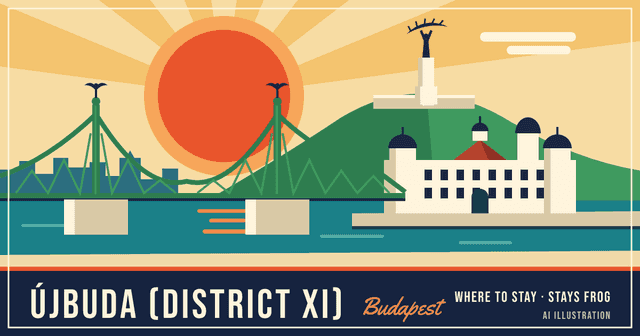
Choose Újbuda for local Buda life on Bartók Béla út, gigs on the river and quick M4 rides to the centre, at lower prices than central Pest.
Újbuda rises from the Danube to the Liberty Statue on Gellért Hill, with Art Nouveau mansions, galleries and wine bars along its main boulevard and a racing car hanging from the ceiling at Szatyor Bar; a lived-in student-and-family district for repeat visitors who would rather live like locals than sightsee.
How it scores
- Food
- 8/10
Tapas at La Nube, pizza at MOTO, brunch at Bartók reggel.délben.este and pastries at Császármorzsa on Bartók Béla út
- Nightlife
- 8/10
Gigs on the A38 concert ship by Petőfi Bridge and at Dürer Kert, plus Szatyor Bar and wine bars on Bartók Béla út
- Shopping
- 7/10
Galleries, antique shops and design boutiques along Bartók Béla út, and the Figaro Magic Shop, trading since 1969
- Walkability
- 7/10
Bartók Béla út from Szent Gellért tér to Kosztolányi Dezső tér walks well; Gellért Hill is a climb and the estates sprawl
- Transit
- 8/10
Five M4 stations from Kelenföld to Szent Gellért tér; two stops to Kálvin tér for the 100E airport bus; trains at Kelenföld
- Coolness
- 8/10
Szatyor Bar's hanging racing car, the B32 Gallery on Gárdonyi tér, the old Hadik Coffee House and the A38 concert ship
- Safety
- 7/10
Calm and safe by day and on the busy main streets at night; Gellért Hill paths and the Bottomless Lake get quiet after dark
- Loudness
- 6/10
Bartók Béla út and Móricz Zsigmond körtér stay busy in the evening, A38 and Dürer Kert have gig nights; side streets are calm
Each category is scored 1-10 by our editors; the Frog Score is their average. Safety is our editors' judgment of how comfortable it is to walk around, not crime statistics. Loudness runs from library quiet (1) to never sleeps (10) and doesn't count toward the Frog Score. How we score
Our take
Újbuda, District XI, is the most populous district in Budapest and one of its most varied, climbing from the Danube embankment up the slopes of Gellért Hill and stretching back through the Technical University quarter, the café streets around Bartók Béla út and the big housing estates of Kelenföld. For visitors the heart of it is Bartók Béla út between Szent Gellért tér and Kosztolányi Dezső tér, which the city's tourism board calls one of the locals' favourite neighbourhoods: a long boulevard of Art Nouveau mansions, galleries, antique shops, design boutiques, cafés and wine bars. It is a lived-in, student-and-family part of the city rather than a sightseeing zone, and that is its appeal.
It suits repeat visitors, budget-minded travellers and anyone who wants Buda's everyday life and good live music with a fast metro ride to the centre. The district's grand hotel, the 1918 Gellért at the foot of the hill, has been closed for renovation since December 2021 and is scheduled to reopen in 2027 as the Mandarin Oriental Gellért, so for now the choice is smaller hotels and apartments. Aim for the streets around Bartók Béla út, Móricz Zsigmond körtér and Szent Gellért tér, all on the M4, rather than the outer estates.
Walk Bartók Béla út slowly and look up at the facades. The B32 Gallery and Cultural Space on Gárdonyi tér hosts exhibitions, theatre and concerts, the Godot and Faur Zsófi galleries show contemporary art, and the Figaro Magic Shop has served magicians since 1969. The historic Hadik Coffee House was a second home to Hungarian writers in the 20th century, Szatyor Bar at Bartók Béla út 36, with a racing car hanging from the ceiling and a Lada bursting out of the wall, is the tourism board's pick if you try only one ruin bar in Buda, and the boulevard's kitchens run from tapas at La Nube and Neapolitan pizza at MOTO to brunch at Bartók reggel.délben.este and pastries at Császármorzsa. Feneketlen-tó, the Bottomless Lake, is a small park with a jogging track, with the Budai Parkszínpad open-air stage nearby. For the view, climb Gellért Hill to the Liberty Statue, the 14-metre bronze figure holding a palm leaf aloft beside the Citadella since 1947. The Gellért Thermal Bath closed for refurbishment on 1 October 2025 and expects to reopen in 2028. For live music, A38, a concert ship moored at the Buda end of Petőfi Bridge, has a concert hall, bistro and roof terrace, and Dürer Kert on Öböl utca hosts concerts, markets and other events in its halls and garden.
The M4 has five of its ten stations in the district, from Kelenföld railway station through Bikás park, Újbuda-központ and Móricz Zsigmond körtér to Szent Gellért tér, whose award-winning station is worth a look in itself. From there it is two stops under the river to Kálvin tér, where you can board the 100E Airport Express towards the airport; arriving, ride the 100E to Kálvin tér and change to the M4. Kelenföld station handles most trains to western Hungary and western Europe, and Liberty Bridge leads on foot from Szent Gellért tér to the Great Market Hall on Fővám tér. Újbuda is a calm, residential district that feels safe by day and on its main streets in the evening, when Bartók Béla út and Móricz Zsigmond körtér stay busy. After dark the paths on Gellért Hill and around the Bottomless Lake are much quieter, so stick to lit streets; keep an eye on your bags at Kelenföld station and on crowded trams and metro trains; and on gig nights at A38 or Dürer Kert, buy your own drinks and keep them in sight.
By Stays Frog AI Desk
A short history
Újbuda's story starts on Gellért Hill, where the Celtic Eravisci had a hilltop centre in the late Iron Age and where Saint Gellért was martyred at the foot of the hill in 1046; the hot springs below were documented by the 15th century and served as a bath under Ottoman rule. Until the 1890s most of the land south of Buda was fields and the Lágymányos inlet of the Danube, which was closed off by the Kopaszi dam in the 1870s and then filled in. The Ferenc József Bridge, today's Liberty Bridge, opened the area up in 1896, the Technical University campus was completed on reclaimed land by 1909, and the Gellért Hotel and Baths opened in 1918. District XI was created by a 1930 law and began work in 1934, was known as Szentimreváros until 1950, and from the mid-1960s large prefabricated housing estates rose in Kelenföld, Őrmező and Gazdagrét. The name Újbuda, meaning New Buda, became official in 2005, and the M4 metro reached the district in 2014.
No places in Újbuda (District XI) scored yet.
Traveller reviews
What people who've been say. One review each; you can update yours.
References(20)
Primary sources used to check this guide and its listings.
- Discover Bartók Béla Boulevard, the locals' favourite! · Official destination or municipal source
- XI. kerület — exact relation outline · OpenStreetMap contributors, ODbL 1.0; cached public geographic result
- Szatyor Bár és Galéria · Venue operator
- 6+1 must-see ruin bars in Budapest · Official city tourism directory
- Concert hall, cultural center, bar and bistro - A38 Ship · Venue operator
- Contact - A38 Ship · Venue operator
- Dürer Kert · Venue operator
- Dürer Kert | Kapcsolat · Venue operator
- Safety and security - Hungary travel advice - GOV.UK · FCDO official government travel guidance
- BKK metro, suburban railway and tram network · Official transport operator or destination source
- Maps - BKK.hu · Official transport operator or destination source
- Újbuda · Wikipedia
- Budapest XI. kerülete (history) · Wikipedia (Hungarian)
- Hotel Gellért · Wikipedia
- Gellért Gyógyfürdő — closure notice · Gellért Thermal Bath official site
- Liberty Bridge (Budapest) · Wikipedia
- Liberty Statue (Budapest) · Wikipedia
- Line 4 (Budapest Metro) · Wikipedia
- Airport Express 100E · BKK (Budapest transport operator)
- Budapest bus route 100E · Wikipedia