NeighborhoodsNeighborhood area
Gruž
Harbour-side urban setting · Dubrovnik
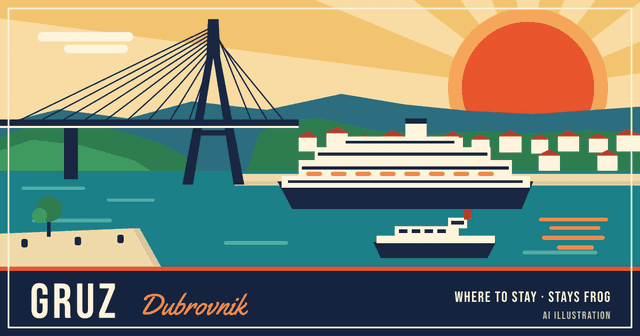
Choose Gruž for early ferries, the bus station and the city's biggest market: a practical, lived-in harbour base away from the old-town crowds.
Dubrovnik's working harbour, about 2 km northwest of the old town, where cruise ships dock and ferries leave for the Elaphiti islands. It has the main bus station and the city's largest market, making it a practical base for island-hoppers.
How it scores
- Food
- 6/10
Morning fruit, vegetables and fish at the Gruž market, and local Mediterranean cooking on the terrace at Bistro B49
- Nightlife
- 4/10
Little nightlife; the waterfront goes quiet once the last ferries and buses have left in the evening
- Shopping
- 5/10
The Gruž market, the city's biggest, plus the Srđ department store for everyday shopping
- Walkability
- 6/10
Harbour errands are easy on foot, but the old town is a 30 to 40 minute walk and some streets above climb steps
- Transit
- 7/10
Libertas buses 1A, 1B and 3 to Pile every 10 to 20 minutes; the airport shuttle ends at the Gruž bus station
- Coolness
- 6/10
Nobles' summer houses on the shore, the Dominican Church of the Holy Cross and the Franjo Tuđman Bridge
- Safety
- 7/10
Safe by day and at night; watch bags at the bus station, market and cruise quay, and cross the harbour road with care
- Loudness
- 6/10
Busy by day with harbour-road traffic, ferries and cruise crowds; the waterfront goes quiet late in the evening
Each category is scored 1-10 by our editors; the Frog Score is their average. Safety is our editors' judgment of how comfortable it is to walk around, not crime statistics. Loudness runs from library quiet (1) to never sleeps (10) and doesn't count toward the Frog Score. How we score
Our take
Gruž is Dubrovnik's working harbour and practical hub, a busy waterfront district about 2 km northwest of the old town, spread over the lower slopes of Srđ above a deep, sheltered bay. This is where the cruise ships tie up, where ferries leave for the Elaphiti islands and Mljet, and where you find the main bus station, the city's largest market and the Srđ department store, along with the offices of many of Dubrovnik's businesses. It makes no effort to be a resort and is less pretty than the walled city, but it is everyday Dubrovnik: former summer residences of the nobility along the shore, yachts and fishing boats on the quay, and locals doing their shopping at the market.
Gruž suits travellers arriving or leaving by ferry, bus or cruise ship, island-hoppers who want to be close to the early boats, and anyone who prefers a practical, lived-in base to the crowds of the old town. Accommodation is mostly apartments and rooms in the streets above the harbour, so check exactly how far your address is from the quay and the bus station, and how many steps lie in between. For a hotel, look across the bay to Lapadska obala on the Lapad side of the same harbour, where the four-star Hotel Lapad overlooks Gruž harbour and the five-star Hotel Kazbek occupies a restored 16th-century Renaissance palace.
Start at the Gruž market, the biggest in the city, which locals call the Pjaca, with its fruit and vegetable stalls and a fish market alongside; go in the morning. Bistro B49, a family-run restaurant at Obala Pape Ivana Pavla II 49 on the harbour road, serves local Mediterranean cooking with terrace seating. The Dominican monastery and Church of the Holy Cross is the neighbourhood's historic church, with a monument to Pope John Paul II nearby, and just beyond the port the Franjo Tuđman Bridge, a cable-stayed span hung from a single A-shaped pylon and opened in 2002, crosses the mouth of Rijeka Dubrovačka. Gruž is also where island days begin: Koločep, the closest of the Elaphiti islands, is about 25 minutes away by ferry.
Gruž is the easiest part of Dubrovnik to arrive in. The airport is 22.5 km from the city, usually a 30 to 35 minute drive that can stretch to an hour in summer, and the airport's shuttle bus, run by Platanus, stops at the old town's Ploče gate and ends at the main bus station in Gruž, about 35 minutes after leaving the airport; the bus station is about 500 metres from the ferry port. Libertas city buses run from the port to Pile, the old town's western gate, every 10 to 20 minutes and take 10 to 15 minutes depending on traffic, with lines 1A, 1B and 3 running along the harbour towards Pile and line 8 linking Gruž with Viktorija. On foot the old town is a 30 to 40 minute walk, and taxis wait in front of the port for the 7 to 10 minute ride.
Gruž feels safe by day and at night. Crime in Croatia is low and violent crime rare, but pickpockets work wherever tourists gather, so watch your bags at the bus station, in the market crowds and on the cruise quay when several ships are in. The harbour road carries heavy traffic, so cross at the pedestrian crossings, and late in the evening the waterfront goes quiet once the last ferries and buses have left. If you take a taxi alone at night, the UK government suggests sending a friend a photo of the taxi number or sharing your ride in the taxi app.
By Stays Frog AI Desk
A short history
Gruž grew up from the early 13th century on the southern slopes of Srđ above a deep, sheltered bay, the first sizeable settlement outside Dubrovnik's walls, and under the Republic of Ragusa the nobility lined its shore with houses and summer residences, the finest of them built in the 16th century. Shipbuilding flourished in the bay, and in the early 19th century, under French rule, the roomier Gruž bay became the city's new harbour; a maritime lazaret followed in 1832, the railway arrived in 1901, and from 1910 until 1970 the Dubrovnik tram ran out to Gruž. The district became Dubrovnik's industrial and business quarter, with its factories, port cold store and the city's largest market, and its first hotel, the Petka, opened in 1886. During the siege of 1991–92 the port was the city's only link with the outside world, receiving humanitarian aid and foreign delegations, and in 2003 Pope John Paul II beatified Marija Petković at an altar set up on the quay. Cruise traffic, which began in the 1980s and grew quickly from 1998, has made Gruž Dubrovnik's front door by sea, while its closed factories have given way to one of the city's main residential areas.
No places in Gruž scored yet.
Traveller reviews
What people who've been say. One review each; you can update yours.
References(17)
Primary sources used to check this guide and its listings.
- Municipal ward profile — Gruž · Grad Dubrovnik
- Dubrovnik local self-government and ward profiles · Grad Dubrovnik
- GUP city-ward GIS polygons — code 3 · Grad Dubrovnik municipal GIS
- GUP explanatory document — numbered ward tables, PDF pages 142–143 · Dubrovnik-Neretva County spatial-planning institute
- Libertas current city timetable · Libertas Dubrovnik
- Croatia current visitor safety guidance · UK Foreign, Commonwealth & Development Office
- Bistro B49 – Restaurants · experiencedubrovnik.com
- Gruž · Wikipedia
- Gruž · Wikipedia (Croatian)
- Historical development of the port · Dubrovnik Port Authority
- How to get to the Old City from the port · Dubrovnik Port Authority
- Franjo Tuđman Bridge (Dubrovnik) · Wikipedia
- Natural sites: Rijeka Dubrovačka, the Ombla and the Sorkočević summer residence · Dubrovnik Tourist Board
- Kako do nas: getting to and from Dubrovnik Airport · Zračna luka Dubrovnik (Dubrovnik Airport)
- Dubrovnik Airport shuttle bus: stops at Ploče gate and Gruž bus station · Platanus (Dubrovnik Airport shuttle operator)
- Hotel Lapad – Accommodation · Dubrovnik Tourist Board
- Hotel Kazbek – Accommodation · Dubrovnik Tourist Board