NeighborhoodsNeighborhood area
Pile–Kono
Western gateway and broader ward streets · Dubrovnik
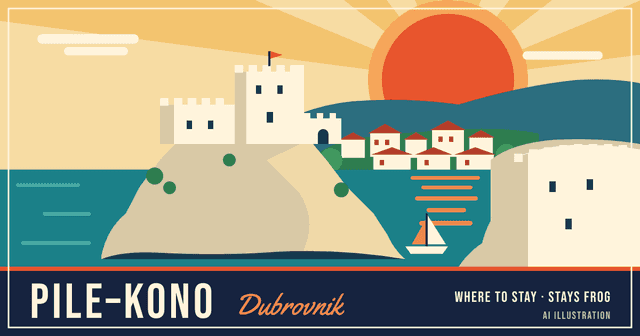
Pick Pile to sleep a minute from Stradun without the Old Town's crowds and stairs, with Lovrijenac, Gradac park and the city's main bus stop on your doorstep.
The Old Town's western gateway, where buses and taxis drop nearly everyone at the Pile Gate, with Fort Lovrijenac on its sea rock, the Brsalje terrace restaurants and Gradac park, plus hotels like the Hilton Imperial just outside the walls.
How it scores
- Food
- 8/10
Nautika at the sea's edge and Dubravka 1836's terrace on Brsalje; Stradun and Prijeko restaurants are just through the gate
- Nightlife
- 6/10
Evenings centre on dinner at Nautika or Dubravka 1836 and summer festival performances of Hamlet at Fort Lovrijenac
- Shopping
- 5/10
Little dedicated shopping; Pile is about arrivals, the Brsalje terrace and the gate, with the Old Town just inside
- Walkability
- 7/10
The Old Town is minutes away through the Pile Gate, but streets climb up the slopes of Srđ, so the walk home is uphill
- Transit
- 8/10
Main Libertas hub: lines 1A, 1B, 2A, 3, 4, 6, 9 and 17 start here; the Platanus airport shuttle stops at Ploče and Gruž
- Coolness
- 8/10
Fort Lovrijenac on its 37-metre sea rock, the 1471 stone bridge and drawbridge, Gradac park and the Amerling fountain
- Safety
- 7/10
Feels safe day and night; pickpockets work the crowds at the gate, bridge and bus stops, so keep bags closed in summer
- Loudness
- 7/10
Busy all day with buses, taxis and tour groups at the gate and bridge; residential streets higher up are quieter
Each category is scored 1-10 by our editors; the Frog Score is their average. Safety is our editors' judgment of how comfortable it is to walk around, not crime statistics. Loudness runs from library quiet (1) to never sleeps (10) and doesn't count toward the Frog Score. How we score
Our take
Pile is the Old Town's front door. Nearly everyone arrives here, off the buses and out of the taxis, and crosses the stone bridge and drawbridge into the Pile Gate under a statue of St Blaise. Around the gate it is a handsome jumble of fortress, promenade and park, with Fort Lovrijenac on its sea rock to one side and the Brsalje terrace, with its view over the walls, to the other. Behind that busy front, the wider Pile–Kono ward is a historic garden suburb of old summer residences, churches, monasteries, homes, schools and the university campus, climbing from the Boninovo cliffs toward the wooded slopes of Srđ.
It suits first-timers and short stays who want to be in the Old Town within minutes but sleep outside its crowds and stairs, and anyone arriving with luggage, since the buses and taxis stop right here. The five-star Hilton Imperial on Marijana Blažića, which opened in the 1890s as Dubrovnik's first hotel, stands a few steps from the gate, and Heritage Hotel Lucia on Branitelja Dubrovnika sits right next to the Old City. Streets higher up the ward are quieter and more residential, but the walk home from the gate is uphill.
Fort Lovrijenac, first recorded in 1301, carries the motto Non Bene Pro Toto Libertas Venditur Auro over its gate, and its performances of Hamlet have become the symbol of the Dubrovnik Summer Festival. Gradac, the city's largest park, spreads 1.7 hectares of pines above the Danče bathing area with views of Lovrijenac, Pile and the walls; Danče and Kolorina are traditional swimming spots, a little harbour sits at the foot of Lovrijenac, and Pile is the birthplace of the Jug water polo club. Ivan Rendić's Amerling fountain outside the gate is the usual meeting point for Old Town tours. On Brsalje, Nautika sits at the very edge of the sea and Dubravka 1836 has a terrace by the west entrance with views of the fortresses; for more choice, the Large Onofrio Fountain, Stradun and the restaurants of Prijeko are just through the gate, and the main entrance to the city walls is just inside it.
Pile is Dubrovnik's main bus and taxi stop. Libertas lines 1A and 1B to Mokošica, 4 to Hotel Palace in Lapad, 6 to Babin Kuk, and 2A, 3, 9 and 17 all start here, from early morning until around midnight, and there is a Libertas ticket point by the stop. The official Platanus airport shuttle stops at the Ploče Gate on the far side of the Old Town and at the main bus station in Gruž; the airport is 22.5 km away, 30 to 35 minutes by road and up to an hour in summer traffic. Pile feels safe by day and at night, and violent crime in Croatia is rare, but the gate, the bridge and the bus stops are where crowds and pickpockets concentrate, so keep bags closed in the summer crush. On-the-spot fines for drinking in public or walking around town in swimwear apply here too, and if you take a taxi late, UK travel advice suggests sharing the plate number with someone.
By Stays Frog AI Desk
A short history
Pile takes its name from a Greek word for gate, and it grew up as the suburb in front of the city's western land entrance, where Paskoje Miličević built a three-arched stone bridge in 1471 ending in a wooden drawbridge that was raised every night under the Republic. Beside it, Fort Lovrijenac stands on a 37-metre sea rock outside the walls; first recorded in 1301 and strengthened in the 15th and 16th centuries, it is the only Dubrovnik fortress set apart from the city walls. In the 19th century the area became the city's front porch: Brsalje was laid out as the first seaward promenade outside the walls, Gradac park opened above the Danče bathing area in 1898, the Imperial opened in the 1890s as Dubrovnik's first hotel, and in 1900 sculptor Ivan Rendić made the Amerling fountain that now greets visitors outside the gate. Today Pile is the Old Town's main bus and taxi stop, while the wider Pile–Kono ward, a historic garden suburb, climbs from the Boninovo cliffs past Ilijina glavica and the Konal streets to the wooded slopes of Srđ.
No places in Pile–Kono scored yet.
Traveller reviews
What people who've been say. One review each; you can update yours.
References(23)
Primary sources used to check this guide and its listings.
- Municipal ward profile — Pile–Kono · Grad Dubrovnik
- Dubrovnik local self-government and ward profiles · Grad Dubrovnik
- GUP city-ward GIS polygons — code 4 · Grad Dubrovnik municipal GIS
- GUP explanatory document — numbered ward tables, PDF pages 142–143 · Dubrovnik-Neretva County spatial-planning institute
- Libertas current city timetable · Libertas Dubrovnik
- Croatia current visitor safety guidance · UK Foreign, Commonwealth & Development Office
- Heritage Hotel Lucia – Accommodation · experiencedubrovnik.com
- Hilton Imperial Dubrovnik – Accommodation · experiencedubrovnik.com
- Dubravka 1836 – Restaurants · experiencedubrovnik.com
- Nautika – Restaurants · experiencedubrovnik.com
- Panorama – Restaurants · experiencedubrovnik.com
- Vrata od Pila · Wikipedia (hr)
- Gradac (Dubrovnik) · Wikipedia (hr)
- Amerlingova fontana na Pilama · Wikipedia (hr)
- Turizam u Hrvatskoj (first Dubrovnik hotel, the Imperial) · Wikipedia (hr)
- Fort Lovrijenac · Wikipedia
- Lovrjenac Fortress · Dubrovnik Tourist Board
- Walls of Dubrovnik · Wikipedia
- Pile and the western entrance (Monuments, archived 2023) · Dubrovnik Tourist Board
- Libertas city bus lines map · Libertas Dubrovnik
- Libertas city timetable, valid from 9 November 2026 (PDF) · Libertas Dubrovnik
- Getting to Dubrovnik Airport (Kako do nas) · Zračna luka Dubrovnik
- Dubrovnik Airport shuttle bus · Platanus, official airport shuttle operator