NeighborhoodsNeighborhood area
Albaicín and lower Plaza Nueva
Courtyard houses and hillside heritage · Granada
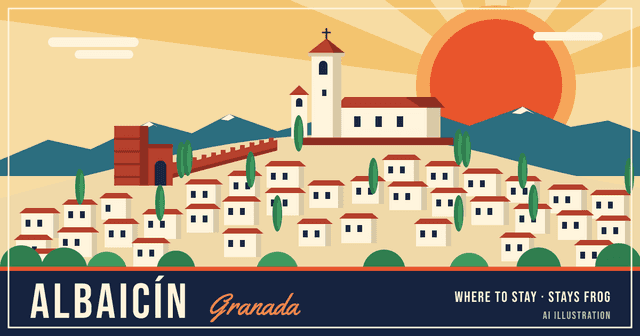
Choose the Albaicín for historic carmen hotels, Alhambra views from San Nicolás and Granada's most atmospheric lanes, if you don't mind climbing.
The Albaicín climbs the hill opposite the Alhambra in a maze of steep cobbled lanes, whitewashed houses and walled carmen gardens, from Plaza Nueva and the Carrera del Darro up to the sunset view at the Mirador de San Nicolás; a romantic old-Granada base for couples and photographers.
How it scores
- Food
- 8/10
Tapas bars round Plaza Larga such as La Porrona, plus Mirador de Morayma and Aben Humeya in the upper lanes
- Nightlife
- 7/10
Terraces on the Paseo de los Tristes facing the Alhambra and bars on Plaza Larga; upper lanes go quiet late
- Shopping
- 7/10
Traditional Granada pottery from the Fajalauza ceramics workshop on Carretera de Murcia
- Walkability
- 6/10
Medieval cobbled lanes up to San Nicolás are lovely but steep; the C31 and C32 minibuses save the climbs
- Transit
- 6/10
C31 minibus loops from Plaza Nueva past San Nicolás, C32 runs to the Alhambra; airport bus on the Gran Vía de Colón
- Coolness
- 9/10
Sunset Alhambra views from the Mirador de San Nicolás, the Bañuelo bathhouse, Dar al-Horra and walled carmens
- Safety
- 7/10
Busy and fine by day, but watch for pickpockets at San Nicolás; upper lanes are quiet and confusing after dark
- Loudness
- 6/10
Crowds at Plaza Nueva, the Carrera del Darro and San Nicolás into the evening; upper lanes turn quiet after dark
Each category is scored 1-10 by our editors; the Frog Score is their average. Safety is our editors' judgment of how comfortable it is to walk around, not crime statistics. Loudness runs from library quiet (1) to never sleeps (10) and doesn't count toward the Frog Score. How we score
Our take
The Albaicín climbs the hill on the north bank of the Darro, directly opposite the Alhambra, and still follows its medieval street plan: a maze of narrow, steep cobbled lanes, whitewashed houses and walled carmens whose gardens spill greenery and the scent of jasmine over the walls. At the bottom, Plaza Nueva and the Carrera del Darro are busy with visitors walking along the river to the Paseo de los Tristes; higher up, around Plaza Larga and San Nicolás, it feels like a village with its own squares and bars. It is part of the Alhambra's World Heritage Site and the most atmospheric place to stay in Granada.
It suits couples, photographers and first-time visitors who want to wake up in old Granada and don't mind climbing. The best stays are small hotels in historic houses in the lower Albaicín: Casa 1800 on Calle Benalúa and Casa del Capitel Nazarí on Cuesta Aceituneros are a few steps from the start of the Carrera del Darro, and Casa Morisca is on Cuesta de la Victoria. For the easiest arrival with luggage, Macià Plaza stands right on Plaza Nueva, where the lanes begin. Higher up the hill you trade convenience for quiet and views; check how close a taxi can get to your door before you book, because many lanes are narrow and steep.
Start at the Mirador de San Nicolás, the city's most famous viewpoint, for the Alhambra across the valley, best at sunset. Along the Carrera del Darro, the 11th- or 12th-century Bañuelo bathhouse and the Archaeological Museum in the 16th-century Castril Palace are worth a stop, and wandering uphill rewards you with the Nasrid houses of Dar al-Horra and Casa de Zafra, the Casa del Chapiz, the old mosque courtyard inside the Church of El Salvador, the Zirid walls and Puerta Monaita gate, and the Aljibe del Rey, the largest medieval cistern, now a water interpretation centre. The bars around Plaza Larga, such as La Porrona, are the place for tapas, and as everywhere in Granada a drink usually comes with a free one; the terraces of the Paseo de los Tristes look up at the Alhambra, Mirador de Morayma and Aben Humeya are restaurants tucked into the upper lanes, and El Huerto de Juan Ranas has views over the Alhambra. Fajalauza's ceramics workshop on Carretera de Murcia sells traditional Granada pottery.
Walking is the way to get around, but the climbs are real. Two city minibuses help: the C31 (Albaicín–Centro) runs a loop from Plaza Nueva up past Plaza San Nicolás and back down by Cuesta del Chapiz and the Carrera del Darro, and the C32 (Alhambra–Albaicín) links Plaza Isabel la Católica, the Albaicín and the Alhambra. The airport bus stops on the Gran Vía de Colón, a short walk from Plaza Nueva; from the railway station a taxi is simplest with luggage. By day the lower streets and the Mirador de San Nicolás are crowded, so keep bags zipped and phones out of reach, since thieves in Spain often work in teams using distraction tricks. Plaza Nueva and the Carrera del Darro stay busy into the evening, but after dark the upper lanes turn quiet and are easy to get lost in; stick to the main routes such as the Carrera del Darro, Cuesta del Chapiz and the streets up to San Nicolás, or take a taxi back late at night.
By Stays Frog AI Desk
A short history
The Albaicín hill is where Granada began: digs have uncovered a sizeable Roman town here, and in the early 11th century the Zirid rulers of the new Taifa of Granada built their citadel and palace on the hilltop, ringed by walls whose northern stretch and Puerta Monaita gate still stand. When the Nasrids moved the court across the Darro to the Alhambra in the 13th century, the Albaicín grew into a crowded Muslim quarter with its own great mosque, a market street beside today's Plaza Larga and a web of underground cisterns, at least twenty of which survive. After the conquest of 1492 it became the home of Granada's Moriscos and the starting point of the 1499 rebellion against forced conversion; mosques gave way to Mudéjar and Renaissance churches, and the Royal Chancellery rose over Plaza Nueva. The expulsions after the Morisco revolt of 1568 left many houses empty, and their plots became the walled garden-houses known as carmens, until the creation of the Gran Vía de Colón between 1895 and 1908 pushed many residents of the centre back up the hill. Better-off families began returning in the 1970s, and in 1994 UNESCO added the Albaicín to the Alhambra's World Heritage Site.
No places in Albaicín and lower Plaza Nueva scored yet.
Traveller reviews
What people who've been say. One review each; you can update yours.
References(9)
Primary sources used to check this guide and its listings.
- A trip through Granada's three most historical neighbourhoods · Primary official area / operator source
- HOTEL BOUTIQUE CASA MORISCA ® Granada · Web Oficial · Primary official area / operator source
- Fábrica de Cerámica Fajalauza® | Cerámica Granadina | Cerámica de Granada | Diseños Mosaicos de la Alhambra · Primary official area / operator source
- OpenStreetMap administrative neighbourhood — Albaicín · OpenStreetMap contributors, ODbL 1.0; boundary source tag Ayuntamiento de Granada
- Safety and security - Spain travel advice - GOV.UK · UK Foreign, Commonwealth & Development Office — current visitor-safety guidance
- Albaicín · Wikipedia
- Granada · Wikipedia
- Itinerarios — líneas C31 Albaicín–Centro y C32 Alhambra–Albaicín · Transportes Rober, Granada city bus operator
- How to get here by bus — F.G.L. Granada-Jaén Airport · Aena, airport operator