NeighborhoodsNeighborhood area
San Matías–Realejo and the Alhambra hill
Historic streets and palace-hill visits · Granada
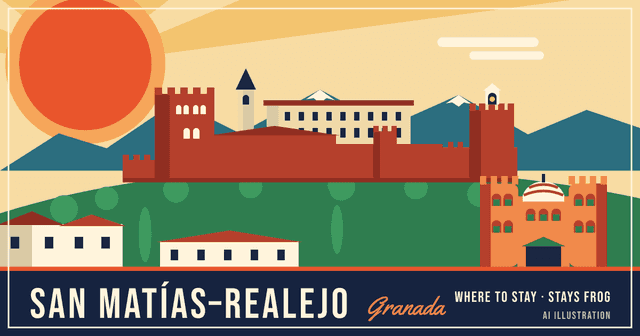
Choose it to sleep beside the Alhambra or among the Realejo's squares and carmen gardens, as long as you don't mind hills.
Historic San Matías and Realejo combine dining streets with the Alhambra hill within one formal neighbourhood.
How it scores
- Food
- 9/10
Chef Lola Marín's tasting menu at Damasqueros and New Andalusian dishes on the Carmen de San Miguel terrace
- Nightlife
- 8/10
Lower squares such as the Campo del Príncipe stay sociable in the evening; the upper lanes go very quiet
- Shopping
- 7/10
Mostly residential lanes with little shopping; the busy streets round the cathedral are a few minutes' walk
- Walkability
- 7/10
Lower Realejo is an easy walk from the cathedral; Cuesta Gomérez and Cuesta del Realejo climb steeply to the Alhambra
- Transit
- 7/10
C30 minibus from Plaza Isabel la Católica to the Alhambra, C32 to the Albaicín, C35 loop; the metro is across town
- Coolness
- 9/10
The Alhambra and Generalife, the Casa de los Tiros, Manuel de Falla's house-museum and the Campo del Príncipe
- Safety
- 7/10
Relaxed and safe by day; Antequeruela and Mauror lanes are steep and very quiet at night; watch bags in Alhambra queues
- Loudness
- 7/10
Sociable lower squares in the evening; the upper Realejo and Antequeruela lanes are very quiet after dark
Each category is scored 1-10 by our editors; the Frog Score is their average. Safety is our editors' judgment of how comfortable it is to walk around, not crime statistics. Loudness runs from library quiet (1) to never sleeps (10) and doesn't count toward the Frog Score. How we score
Our take
San Matías–Realejo is the old town's southern flank. It runs from the side streets of San Matías near the cathedral, through the old Jewish quarter of the Realejo, and up the wooded Sabika and Mauror hills to the Alhambra and the Generalife. The lower half is a close weave of lanes and small squares around Santo Domingo, Plaza del Padre Suárez and the Campo del Príncipe; the upper half, the Realejo Alto and the Antequeruela, is a tangle of steep, stepped lanes and walled carmen gardens with long views over the city to the Sierra Nevada. It is residential and unhurried, a few minutes but a world away from the crowds around the cathedral.
It suits couples, food lovers and anyone whose trip revolves around the Alhambra. On the hill itself, the Parador de Granada fills a convent the Catholic Monarchs ordered built in 1494 inside the Alhambra's walls, and the neo-Moorish Hotel Alhambra Palace, inaugurated in 1910, looks out over the city and the Sierra Nevada from the edge of the Alhambra woods; both put the monument on your doorstep but leave you a stiff climb back from dinner below. Down in San Matías, Gar Anat is a 15-room boutique hotel on Placeta de los Peregrinos, a couple of minutes from the cathedral, a good pick if you would rather have level streets and restaurants close by than a view.
The Alhambra and the Generalife come first: tickets are sold in your name, ID is checked, and the Nasrid Palaces admit visitors by half-hour slot, so book on the official site well ahead and be on time. Below the hill, the Casa de los Tiros on Calle Pavaneras is a 16th-century mansion whose stone tower carries life-size figures of classical heroes and now houses a museum of the city's history; the Cuarto Real de Santo Domingo is an Almohad-era palace; the Corrala de Santiago is a 16th-century tenement house that the University of Granada uses as a guest residence; and Manuel de Falla's house-museum sits in the Antequeruela beside the auditorium named after him. The Campo del Príncipe is the neighbourhood's real heart, and on Good Friday at three in the afternoon crowds gather there in silence before the Cristo de los Favores. For dinner, Damasqueros on Calle Damasqueros serves chef Lola Marín's seasonal tasting menu of Granada cooking, and the Carmen de San Miguel on Plaza Torres Bermejas cooks New Andalusian dishes with a summer terrace looking over the city; for a free view, look for the little-known La Churra lookout facing the Albaicín.
The lower Realejo is an easy walk from the cathedral, Plaza Nueva and Plaza Isabel la Católica, but the hill is real: the Cuesta Gomérez from Plaza Nueva and the Cuesta del Realejo are the classic walking routes up to the Alhambra, and the Cuesta del Rey Chico climbs from the Paseo de los Tristes. The city's minibuses spare your legs: the C30 runs from Plaza Isabel la Católica to the Alhambra, the C32 links the Alhambra with the Albaicín, and the C35 loops through the Barranco del Abogado and the cemetery to the centre. Private cars cannot drive up to the Alhambra from the centre, so drivers use the southern ring road to the monument's car park, and the railway station and Metro Line 1 are across town to the west, a taxi or bus ride away. By day the neighbourhood feels relaxed and safe, and in the evening the lower squares stay sociable; the upper lanes of the Antequeruela and Mauror are steep and very quiet after dark, so walk them in company or take a taxi up to a hilltop hotel late at night. Thieves in Spain work crowds with distraction tricks, so keep bags closed in the Alhambra queues and around the cathedral.
By Stays Frog AI Desk
A short history
Before 1492 the riverside slopes below the Alhambra held Granada's Jewish quarter, which medieval sources call Garnata al-Yahud, "Granada of the Jews", and from the 12th century potters' workshops, country estates and irrigation channels spread across the lower ground. On the Sabika hill above, Muhammad I, first ruler of the Nasrid dynasty, began building the Alhambra in 1238, and his successors added the palaces that the Catholic Monarchs entered on 2 January 1492. After the conquest the lower quarter took the name Realejo from the royal camp pitched there, the monarchs founded the Dominican convent of Santa Cruz la Real, and in 1497 the city levelled a former Muslim cemetery to create the Campo del Príncipe for the wedding celebrations of Prince Juan. The upper slope of the Mauror hill, settled in 1410 by people from Antequera and still called the Antequeruela, grew into a maze of stepped lanes and walled carmen gardens, where Manuel de Falla later lived and where the Hotel Alhambra Palace was inaugurated in 1910. Today San Matías–Realejo is a formal neighbourhood of the city's Centro district that runs from the Alhambra and the Generalife down to the promenades beside the Genil.
No places in San Matías–Realejo and the Alhambra hill scored yet.
Traveller reviews
What people who've been say. One review each; you can update yours.
References(14)
Primary sources used to check this guide and its listings.
- A trip through Granada's three most historical neighbourhoods · Primary official area / operator source
- Damasqueros – Restaurante · Primary official area / operator source
- Carmen San Miguel · Primary official area / operator source
- Preguntas Frecuentes - Patronato de la Alhambra y Generalife · Primary official area / operator source
- Hotel Alhambra Palace Granada | Hotel cerca de la Alhambra · Primary official area / operator source
- OpenStreetMap administrative neighbourhood — San Matías - Realejo · OpenStreetMap contributors, ODbL 1.0; boundary source tag Ayuntamiento de Granada
- Safety and security - Spain travel advice - GOV.UK · UK Foreign, Commonwealth & Development Office — current visitor-safety guidance
- Realejo-San Matías · Wikipedia (es)
- Alhambra · Wikipedia (en)
- Hotel Alhambra Palace · Wikipedia (es)
- Parador de Granada · Wikipedia (es)
- Casa de los Tiros · Wikipedia (es)
- Gar Anat Boutique Hotel, Granada — official website · Gar Anat Boutique Hotel
- Transportes Rober (Granada urban buses, Alhambra and Albaicín minibus lines) · Wikipedia (es)