NeighborhoodsNeighborhood area
Murano
Glassmaking and island exploration · Venice
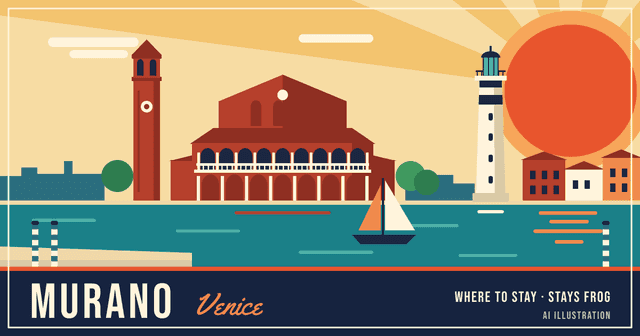
Choose Murano for glass furnaces, the Glass Museum and quiet lagoon evenings, with direct boats to the airport and Piazzale Roma.
A small island town 1.5 km north of Venice, home to glassmaking since 1291, with glassworks and showrooms along its canals. Visit the Glass Museum in Palazzo Giustinian and the mosaics of Santi Maria e Donato; evenings are very quiet once the day visitors leave.
How it scores
- Food
- 6/10
Plan a long lunch on the island; the choice of restaurants is much smaller than on the main island
- Nightlife
- 3/10
Very quiet once day visitors leave, with few bars; evenings are better spent back in Venice
- Shopping
- 9/10
Glassworks, showrooms and glass shops line the fondamente; look for the Vetro Artistico Murano trademark
- Walkability
- 7/10
Seven islands linked by bridges, all walkable, from the Rio dei Vetrai to the lighthouse on the lagoon edge
- Transit
- 6/10
Line 3 from Piazzale Roma, boats and a night line from Fondamente Nove; Alilaguna Blue from the airport to Colonna
- Coolness
- 8/10
Glass Museum in Palazzo Giustinian, the 12th-century mosaics of Santi Maria e Donato and Bellini at San Pietro Martire
- Safety
- 6/10
Safe and calm day and night; pickpockets on packed boats and in busy showrooms, and dark, empty fondamente late
- Loudness
- 5/10
Busy with day visitors in the showrooms; very quiet in the evening, with dark, empty fondamente late
Each category is scored 1-10 by our editors; the Frog Score is their average. Safety is our editors' judgment of how comfortable it is to walk around, not crime statistics. Loudness runs from library quiet (1) to never sleeps (10) and doesn't count toward the Frog Score. How we score
Our take
Murano is a small island town in the lagoon about 1.5 km north of Venice, made up of seven islands linked by bridges and divided by canals, including its own Grand Canal, and it has been the home of Venetian glassmaking since 1291. Glassworks, showrooms and glass shops line its canal-side fondamente, and with just over 5,000 residents in 2004 it still feels like a small working town rather than an open-air museum.
Murano is easy to see on a day trip, but staying here suits couples, repeat visitors and glass lovers who want quiet evenings, time to visit makers without the rush, and an easy base for Burano and Torcello, which are served by boats from the island. The trade-off is the boat ride to the historic centre and a much smaller choice of hotels, restaurants and bars than on the main island; evenings are very quiet once the day visitors leave, so first-timers who want to be in the thick of things are better off in Venice itself.
Start at the Glass Museum in Palazzo Giustinian, which holds the largest historical collection of Murano glass in the world, from the 15th to the 20th century, with Roman glass on the ground floor and a 19th-century section in the former Conterie complex, open since 2025. Nearby, the brick church of Santi Maria e Donato has a 12th-century apse mosaic, a mosaic floor from around 1140 with a peacock, an eagle and griffins, and, so it is said, the bones of a dragon slain by Saint Donatus; San Pietro Martire on the Rio dei Vetrai holds paintings by Giovanni Bellini and Paolo Veronese's St Jerome in the Desert. Palazzo da Mula, a 12th-century Venetian-Byzantine palace on the Grand Canal of Murano, now houses the town hall and hosts exhibitions, and the 35-metre Istrian-stone lighthouse, last rebuilt in 1934, stands at the island's lagoon edge. Many glassworks are open to visitors; a shop display is not evidence of where an object was made, so look for the regulated Vetro Artistico Murano trademark and ask the seller what matters to your purchase. Plan a long lunch on the island and evenings back in Venice, where the choice of bars and restaurants is far wider.
Murano is reached only by water. Line 3 water buses run between Piazzale Roma and Murano, several lines cross from Fondamente Nove on Venice's northern shore, and a night line serves the island from Fondamente Nove; Alilaguna's Blue line from Marco Polo airport stops at Murano Colonna, which makes the island an easy first or last night. Once there, everything is walkable over the bridges. Murano feels safe and calm by day and at night; the things to watch are pickpockets on packed boats and in busy showrooms, and timetables that change in fog or when high water passes 95 cm. Late in the evening the fondamente are dark and empty, so check the time of the last boat before lingering in Venice.
By Stays Frog AI Desk
A short history
Murano's origins are usually traced to refugees from Altino fleeing the barbarian invasions, and the island, first documented in 840 as Amorianas, lived at first from fishing and salt. It kept a measure of self-government within the Venetian state, with its own podestà from 1275, a council of Muranese nobles and its own coin, the osella. In 1291 the Republic ordered the city's glass furnaces moved to Murano to contain the risk of fire, and its glassmakers, privileged but forbidden to leave the Republic, made the island famous for beads, mirrors, aventurine glass and later chandeliers; from 1602 only those listed in the island's Libro d'Oro could work in the glassworks. Before Napoleon the island had 18 parishes, monasteries and convents, but many were closed and only three churches remain in use today. The Glass Museum was founded in 1861 in Palazzo Giustinian, once the residence of the bishops of Torcello, and in 1923 Murano lost its status as a separate comune and became part of Venice.
No places in Murano scored yet.
Traveller reviews
What people who've been say. One review each; you can update yours.
References(12)
Primary sources used to check this guide and its listings.
- The Island of Murano, Venice: what to see - Italia.it · Official tourism authority
- Venice and the lagoon: from Giudecca to the islands - Italia.it · Official tourism authority
- OpenStreetMap named island outline — Murano · OpenStreetMap contributors, ODbL 1.0
- Safety and security - Italy travel advice - GOV.UK GOV.UK · UK Foreign, Commonwealth & Development Office
- Murano · Wikipedia
- Murano · Wikipedia (Italian)
- Museo del Vetro: layout and collections · Fondazione Musei Civici di Venezia
- Museo del Vetro: building and history · Fondazione Musei Civici di Venezia
- Santa Maria e San Donato · Wikipedia
- Faro di Murano · Wikipedia (Italian)
- AVM/Actv water bus service: winter timetable 2026-2027 · AVM/Actv (Venice public transport operator)
- Alilaguna airport water bus lines · Alilaguna (airport water bus operator)