NeighborhoodsNeighborhood area
San Marco
Monuments, cafés and canal-front hotels · Venice
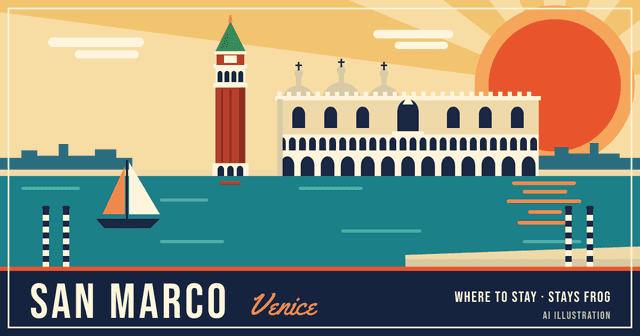
Choose San Marco for a first visit with the Basilica, the Doge's Palace and La Fenice on your doorstep, and budget for Venice's highest prices.
Venice's ceremonial heart in the last bend of the Grand Canal, with the Basilica, the Doge's Palace and Caffè Florian on Piazza San Marco and La Fenice a short walk west. Crowded by day, best early and late, and the priciest place to stay.
How it scores
- Food
- 8/10
Gran Caffè Quadri with the Quadri restaurant upstairs, Caffè Florian since 1720 and carpaccio at Harry's Bar
- Nightlife
- 6/10
Bellinis at Harry's Bar, opera at La Fenice and late evenings on the square after the day visitors leave
- Shopping
- 8/10
Smart boutiques on Calle Larga XXII Marzo and lanes packed with expensive shops around Piazza San Marco
- Walkability
- 8/10
Rialto Bridge into San Polo, Accademia Bridge into Dorsoduro and Castello just past the Bridge of Sighs, all on foot
- Transit
- 7/10
Line 2 water buses at Rialto and San Marco Giardinetti; Alilaguna Blue and Orange lines from Marco Polo airport
- Coolness
- 7/10
The Basilica, Doge's Palace and campanile views, Palazzo Grassi exhibitions and San Giorgio Maggiore across the basin
- Safety
- 6/10
Pickpockets work the square, Rialto Bridge and packed water buses by day; lanes behind the square feel calm at night
- Loudness
- 7/10
Crowded through the middle of the day around the square and the Rialto; lanes behind the square go quiet at night
Each category is scored 1-10 by our editors; the Frog Score is their average. Safety is our editors' judgment of how comfortable it is to walk around, not crime statistics. Loudness runs from library quiet (1) to never sleeps (10) and doesn't count toward the Frog Score. How we score
Our take
San Marco is the ceremonial heart of Venice, the sestiere tucked into the last bend of the Grand Canal between the Rialto Bridge and the Bacino di San Marco. At its centre is Piazza San Marco, with the five-domed, gold-mosaic Basilica, the Doge's Palace, the campanile and the long arcades of the Procuratie, and around it runs a dense web of lanes packed with hotels, banks and expensive shops, theatres, churches and palazzi. It is one of the most visited corners of the city, crowded through the middle of the day, and at its best early in the morning and late in the evening, before and after the day visitors.
It suits first-time visitors, short stays and anyone who wants the great sights, the opera and the historic cafés on the doorstep, and who is ready to pay Venice's top prices for it. Hotels range from palazzi on the water to small houses in the lanes. Hotel Saturnia & International, a four-star in a building dating back to the 14th century on Calle Larga XXII Marzo, a street of smart boutiques, has been run by the Serandrei family since 1908 and is about 100 metres from La Fenice. A San Marco address does not guarantee a canal view, so check what a room actually looks onto; families and budget travellers usually get more space for their money in Cannaregio or Santa Croce.
Start with the Basilica, consecrated in 1094 and modelled on the Church of the Holy Apostles in Constantinople; the four bronze horses on its balcony are copies, with the originals kept inside. Next door are the Doge's Palace, the Museo Correr in the Napoleonic wing and the Biblioteca Marciana, and the campanile gives the best view over the rooftops. Walk west past San Moisè and Santo Stefano to La Fenice on Campo San Fantin, where Verdi's Rigoletto and La traviata had their premieres, and look in on the exhibitions at Palazzo Grassi. Across the basin, the island of San Giorgio Maggiore, also part of the sestiere, has its basilica and the Fondazione Giorgio Cini. Coffee on the square is part of the show: Caffè Florian has served since 1720, and Gran Caffè Quadri, run by the Alajmo family since 2011, pairs its historic café with the Quadri restaurant upstairs. Harry's Bar, opened by Giuseppe Cipriani in 1931 on Calle Vallaresso, is the home of the Bellini and of carpaccio; for cheaper cicchetti, cross the Rialto Bridge into San Polo.
San Marco is best explored on foot: the Rialto Bridge leads into San Polo and the Accademia Bridge into Dorsoduro, and Castello begins just past the Bridge of Sighs. Line 2 water buses stop at Rialto and San Marco Giardinetti on their way along the Grand Canal from Piazzale Roma, and from Marco Polo airport, about 7.5 km away across the lagoon, Alilaguna's Blue line stops at San Marco Giardinetti and its Orange line at Rialto and Santa Maria del Giglio. By day the main risk is pickpockets and bag-snatchers, who work the crowds in the square, on the Rialto Bridge and on packed water buses, so keep bags closed and valuables out of reach. At night the lanes behind the square go quiet and can be disorienting but feel calm; keep a map on your phone. High water can flood parts of the city and water-bus routes change when the tide passes 95 cm, so check the tide forecast, and check whether the city's access fee applies on your dates.
By Stays Frog AI Desk
A short history
San Marco grew up around the relics of Saint Mark, brought to Venice from Alexandria in 828 or 829; the first church built for them was ready by 836, and the present basilica, rebuilt from 1063, was consecrated in 1094, while the square beside it served as the political and judicial centre of the Republic for almost a thousand years. Doge Sebastiano Ziani (1172–78) gave Piazza San Marco much of its present shape by filling in the Rio Baratario, and over the following centuries it was framed by the clock tower (1496–99), the Procuratie Vecchie (rebuilt from 1517), Sansovino's Libreria and the Procuratie Nuove, finished by Longhena in 1640; Caffè Florian opened under the arcades in 1720. After the fall of the Republic in 1797, the church of San Geminiano was demolished for the Ala Napoleonica, built from 1810 to 1813, and in 1807 the basilica, until then the Doge's chapel, became the seat of the Patriarch of Venice. Gran Teatro La Fenice opened nearby in 1792 and has twice risen again after fire, in 1837 and, after the arson of 1996, in 2003. Even the campanile is a rebuild: it collapsed on 14 July 1902 and was reconstructed by 1912, as it was and where it was.
No places in San Marco scored yet.
Traveller reviews
What people who've been say. One review each; you can update yours.
References(14)
Primary sources used to check this guide and its listings.
- Venice and the lagoon: from Giudecca to the islands - Italia.it · Official tourism authority
- Gran Caffè Quadri | Alajmo · Venue operator
- Hotel Saturnia & International, 4-star, St. Mark's, Venice · Venue operator
- OpenStreetMap named neighbourhood/sestiere outline — San Marco · OpenStreetMap contributors, ODbL 1.0
- Safety and security - Italy travel advice - GOV.UK GOV.UK · UK Foreign, Commonwealth & Development Office
- San Marco (sestiere) · Wikipedia
- Sestiere di San Marco · Wikipedia (Italian)
- Piazza San Marco · Wikipedia
- St Mark's Basilica · Wikipedia
- La Fenice · Wikipedia
- Harry's Bar (Venice) · Wikipedia
- AVM/Actv water bus service: winter timetable 2026-2027 · AVM/Actv (Venice public transport operator)
- Alilaguna airport water bus lines · Alilaguna (airport water bus operator)
- Venice Marco Polo Airport · Wikipedia