NeighborhoodsNeighborhood area
Bielany district
Forest edges and residential streets · Warsaw
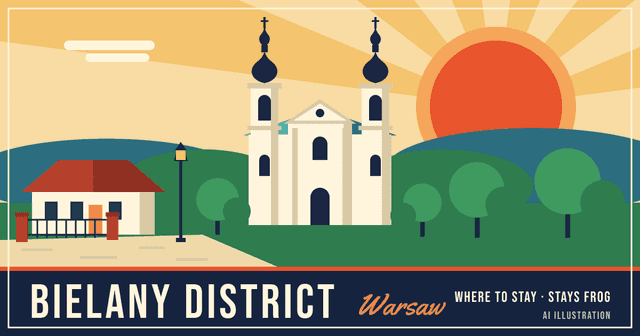
Choose Bielany for forest walks, quiet interwar streets and a calm, inexpensive base with the M1 metro straight into the centre.
Bielany offers forest-oriented outings alongside distinctive older residential streets in northern left-bank Warsaw.
How it scores
- Food
- 6/10
Low-key, local eating; plan big dinners in Żoliborz or the centre, with Galeria Młociny for anything forgotten
- Nightlife
- 4/10
Very little nightlife; residential streets are quiet after dark, so ride the M1 into the centre for a night out
- Shopping
- 5/10
Galeria Młociny shopping centre at the end of the M1 line covers anything you forgot to pack
- Walkability
- 6/10
Płatnicza Street's interwar houses and marked Bielański Forest trails; apartments sit within a walk of M1 stations
- Transit
- 8/10
M1 metro at Słodowiec, Stare Bielany, Wawrzyszew and Młociny straight to Centrum; airport trips take longer
- Coolness
- 7/10
Camaldolese church and hermitages in the Bielański Forest, gas-lit Płatnicza Street and Kora's neon at no. 59
- Safety
- 8/10
Among the calmest parts of the city by day; streets near metro stations feel comfortable at night, but forests are unlit
- Loudness
- 3/10
Quiet residential streets and forest by day and after dark, among the calmest parts of the city
Each category is scored 1-10 by our editors; the Frog Score is their average. Safety is our editors' judgment of how comfortable it is to walk around, not crime statistics. Loudness runs from library quiet (1) to never sleeps (10) and doesn't count toward the Frog Score. How we score
Our take
Bielany is Warsaw's green north-western corner, a district of forest, river escarpment and quiet residential streets where the city starts to loosen its grip. Its heart is Stare Bielany, the interwar suburb around Płatnicza Street, where the low manor-style houses of the 1920s Zdobycz Robotnicza estate still stand beneath old gas lanterns, while further north and west come the big postwar estates of Wrzeciono, Wawrzyszew and Chomiczówka. Three woods frame it all: the Bielański Forest on the Vistula escarpment, the Lindego forest and the Młociny forest.
Bielany suits repeat visitors, walkers, runners and anyone who wants a calm, leafy and inexpensive base and doesn't mind a metro ride into town. It is a residential district rather than a hotel quarter, so most stays are apartments within walking distance of the M1 stations. If you would rather sleep in the centre and come out for the day, Hotel MDM on Plac Konstytucji is about 200 metres from Politechnika station on the same M1 line that runs north to Bielany.
The Bielański Forest is the main sight. It is a nature reserve, so walking and cycling are allowed only on the marked trails, which lead to the former Camaldolese monastery: a white late-baroque church with two towers, built between 1669 and 1710, with thirteen of the monks' 17th-century hermitages still standing and the grave of Stanisław Staszic beside the church. Back in Stare Bielany, stroll Płatnicza Street for its interwar houses and gas lamps, and look for the neon unveiled in 2018 on house no. 59, where the singer Kora of Maanam lived for over a decade. Eating out here is low-key and local, so plan a big dinner in Żoliborz or the centre, and use the Galeria Młociny shopping centre at the end of the line for anything you forgot to pack.
The M1 metro is Bielany's lifeline: Słodowiec, Stare Bielany, Wawrzyszew and the terminus at Młociny opened in 2008, and trains run south through Żoliborz to Centrum and Świętokrzyska, where you change for line M2. For Chopin Airport, ride into the centre and pick up the airport's SKM trains at Warszawa Śródmieście or bus 175, which runs between the airport and Plac Piłsudskiego; allow more time than from the southern districts. By day Bielany is one of the calmest parts of the city. After dark the residential streets around the metro stations stay quiet and comfortable, but the forests are unlit and empty, so keep woodland walks for daylight, follow the UK government's general advice for Poland to avoid walking alone in isolated areas at night, and use official taxis that show the company name and phone number on the door and roof.
Choose Bielany for green space, peace and an easy metro line into town; if nightlife or sightseeing on your doorstep matters more, stay in the centre and visit for a forest morning.
By Stays Frog AI Desk
A short history
Bielany takes its name from the Camaldolese monks, brought here from Kraków in the second half of the 17th century, whose white habits gave the wooded Vistula escarpment its name; their late-baroque church went up between 1669 and 1710, and thirteen of their hermitages still stand beside it. For centuries the area was a scatter of villages such as Wawrzyszew, Słodowiec and Młociny, where an 18th-century royal estate gained a palace for minister Brühl, and Varsovians came out to the riverside woods on Pentecost outings. In 1916 Stare Bielany, Marymont and Słodowiec were brought inside the city limits, and the interwar years added the low manor-style houses of the Zdobycz Robotnicza estate on Płatnicza Street, a tram link to the centre and, in 1929, the Central Institute of Physical Education, today the Józef Piłsudski University of Physical Education. After the war the Huta Warszawa steelworks rose from the early 1950s, big housing estates followed at Wrzeciono, Wawrzyszew and Chomiczówka in the 1970s, and the Bielany Forest became a nature reserve in 1973. Bielany split from Żoliborz as a district of its own in 1994, and the M1 metro reached Słodowiec and Młociny in 2008.
No places in Bielany district scored yet.
Traveller reviews
What people who've been say. One review each; you can update yours.
References(15)
Primary sources used to check this guide and its listings.
- Walk around Bielany district – Go To Warsaw (https://go2warsaw.pl/en/walk-around-bielany-district/) · Official destination or municipal source
- Obszary MSI - ZDM Warszawa · Official destination or municipal source
- Warsaw district outlines — Bielany · Public GIS by the same ZDM Warszawa author as the dashboard linked from zdm.waw.pl
- ZDM Warszawa — official interactive map and publisher attribution · Zarząd Dróg Miejskich w Warszawie
- Safety and security - Poland travel advice - GOV.UK · FCDO official government travel guidance
- Hotel MDM Warsaw | Business Hotels in Central Warsaw, Poland · Venue operator
- Hotel in the Heart of Warsaw | Polonia Palace Hotel · Venue operator
- Bielany (Warsaw district) · Wikipedia
- Bielany (Warszawa) · Wikipedia (Polish)
- Zespół klasztorny kamedułów na Bielanach · Wikipedia (Polish)
- Rezerwat przyrody Las Bielański · Wikipedia (Polish)
- Ulica Płatnicza w Warszawie · Wikipedia (Polish)
- Stare Bielany metro station · Wikipedia
- Warsaw Metro · Wikipedia
- Public transport – Warsaw Chopin Airport · Warsaw Chopin Airport (airport operator)