NeighborhoodsNeighborhood area
Wola district
Industrial history and contemporary city development · Warsaw
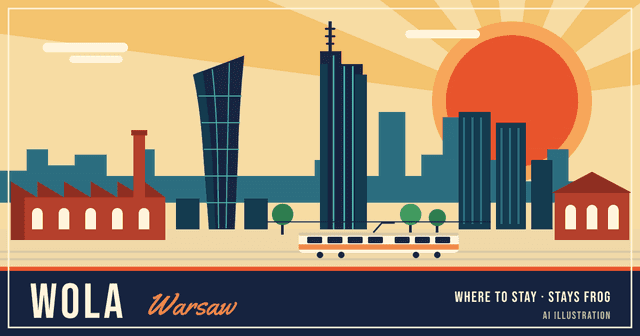
Pick Wola for glass towers, the Warsaw Rising Museum and the Norblin Factory, with metro line M2 a couple of stops from the centre: a modern business base.
Wola combines industrial and wartime history with large areas of contemporary business development.
How it scores
- Food
- 8/10
The Food Town hall, restaurants and cafés in the restored Norblin Factory, plus an eco-bazaar on the same site
- Nightlife
- 7/10
Evenings centre on the Norblin Factory's restaurants, cafés and boutique cinema; the tower blocks go quiet
- Shopping
- 7/10
Shops and an eco-bazaar in the Norblin Factory's ten listed halls; elsewhere it is offices and housing estates
- Walkability
- 6/10
The Rising Museum, Norblin Factory and towers are walkable, but wide main roads and scattered sites break up walks
- Transit
- 8/10
M2 at Rondo Daszyńskiego, Płocka, Młynów and Księcia Janusza; Varso links to Warszawa Centralna and airport trains
- Coolness
- 8/10
The Warsaw Rising Museum in an old tram power station, Varso's 53rd-floor Highline, Keret House and Powązki Cemetery
- Safety
- 7/10
Busy and safe-feeling by day; blocks between towers and the cemeteries feel deserted at night, so stick to lit streets
- Loudness
- 7/10
Office crowds around the towers on weekdays; calmer at night apart from the Norblin Factory and the wide main roads
Each category is scored 1-10 by our editors; the Frog Score is their average. Safety is our editors' judgment of how comfortable it is to walk around, not crime statistics. Loudness runs from library quiet (1) to never sleeps (10) and doesn't count toward the Frog Score. How we score
Our take
Wola is Warsaw's west side and its fastest-changing district: a 19th-century factory and workers' quarter that has become a major financial district, with glass towers rising along Towarowa and Prosta streets. Varso Tower, Warsaw Spire with its hyperboloid glass façade, Warsaw Unit and The Warsaw Hub stand over brick factory halls, old churches and postwar housing estates, and between them sit some of the city's most important memorials, because Wola was the scene of the largest single massacre in Poland during the 1944 Uprising. It is a place of contrasts rather than a picturesque quarter, full of office workers on weekdays and calmer at night, with restored industrial complexes such as the Norblin Factory giving it a social life of its own.
Wola suits business travellers with meetings in the towers, repeat visitors who want a modern base a stop or two from the centre on line M2, and anyone drawn to Warsaw's 20th-century history. If you want a classic city-centre hotel instead, neighbouring Śródmieście is minutes away: Polonia Palace, a hotel since 1913, is close to Warszawa Centralna and the Palace of Culture, and Hotel MDM on Plac Konstytucji is about 200 metres from Politechnika metro.
The Warsaw Rising Museum is the essential visit. It opened on 31 July 2004, the 60th anniversary of the Uprising, in a tram power station built in 1905 to 1909; give it time, see the memorial wall with thousands of names of the fallen, and climb to the top of the building for a panorama of Warsaw. The Norblin Factory, a metalworks founded in 1820 whose ten listed halls were restored and reopened in 2021, now holds offices, shops, restaurants and cafés, the Food Town food hall, an eco-bazaar, a boutique cinema and an open-air museum of the old works, with the early 20th-century rails and hydraulic press kept in place. Plac Europejski is the green square beside Warsaw Spire, and the Highline deck on the 53rd floor of Varso, 230 metres up, opened in 2025 with a 360-degree view of the city. For a quieter walk, visit Powązki Cemetery and the Warsaw Insurgents Cemetery, St. Lawrence's Church of 1695 to 1755, the Orthodox Church of St. John Climacus, the Wola Museum in Sikorski Palace and Keret House, an art installation billed as the narrowest house in the world.
Metro line M2 runs through the district, with stations at Rondo Daszyńskiego, the closest to the Rising Museum and The Warsaw Hub, Płocka, Młynów and Księcia Janusza, plus Rondo ONZ on the Śródmieście border; change to line M1 at Świętokrzyska, two stops east of Rondo Daszyńskiego. Varso connects at ground level with Warszawa Centralna, one of the stations where the airport trains (SKM S2 and S3 and Koleje Mazowieckie) let you change, and Chopin Airport, about 10 km from the centre, is also linked to the city by buses 175 and 188. Wola feels safe by day, busy with office workers around the towers and visitors at the museum. In the evening some blocks between the towers, the cemeteries and the wide main roads can feel deserted, so keep to lit, busy streets, avoid walking alone through isolated areas late at night as the UK government advises, watch for pickpockets around the central station and on crowded transport, and use only official taxis showing the company name on the door and roof.
By Stays Frog AI Desk
A short history
Wola began as the village of Wielka Wola, first recorded in the 14th century, and from 1573 to 1764 its fields were where the nobility of the Polish–Lithuanian Commonwealth gathered to elect their kings. In the 17th century the privately owned settlements (jurydyki) of Wielopole, Leszno, Nowolipie and Grzybów grew up on land that is now wholly or partly in Wola and were joined to Warsaw in 1791, and Wola was a battleground in the defence of the city in 1794 and again in 1831, when Józef Sowiński and Józef Bem defended it against Tsarist forces. Through the 19th century it became Warsaw's factory and workers' district, home to works such as the Norblin metal factory, and the village itself was absorbed into the city in 1916. In August 1944, during the Warsaw Uprising, German forces murdered 40,000 to 50,000 civilians here in the largest single massacre in Poland, a history now told at the Warsaw Rising Museum, which opened in 2004 in a former tram power station. Since the 1990s the old industrial land along Towarowa and Prosta streets has filled with office towers of up to 53 storeys, among them Varso Tower, at 310 metres the tallest building in Poland.
No places in Wola district scored yet.
Traveller reviews
What people who've been say. One review each; you can update yours.
References(18)
Primary sources used to check this guide and its listings.
- Walk around Wola district – Go To Warsaw (https://go2warsaw.pl/en/walk-around-wola-district/) · Official destination or municipal source
- Obszary MSI - ZDM Warszawa · Official destination or municipal source
- Wola — exact relation outline · OpenStreetMap contributors, ODbL 1.0; cached public geographic result
- Safety and security - Poland travel advice - GOV.UK · FCDO official government travel guidance
- Hotel MDM Warsaw | Business Hotels in Central Warsaw, Poland · Official transport operator or destination source
- Hotel in the Heart of Warsaw | Polonia Palace Hotel · Official transport operator or destination source
- Wola · Wikipedia
- Warsaw Rising Museum · Wikipedia
- Norblin Factory · Norblin Factory (official site)
- Fabryka Norblina · Wikipedia (Polish)
- Varso · Wikipedia
- Warsaw Spire · Wikipedia
- The Warsaw Hub · Wikipedia
- List of Warsaw Metro stations · Wikipedia
- To and from the Airport – Warsaw Chopin Airport · Warsaw Chopin Airport (airport operator)
- Warsaw Chopin Airport · Wikipedia
- Warszawa Lotnisko Chopina railway station · Wikipedia
- Palace of Culture and Science · Wikipedia