NeighborhoodsNeighborhood area
Praga-Północ district
Historic buildings and industrial reuse · Warsaw
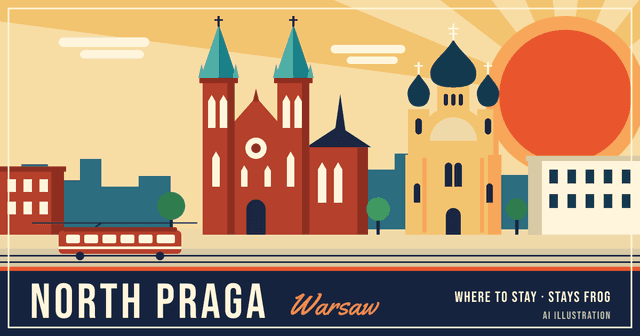
Choose Praga-Północ for old tenements, the Koneser complex and live music, if you want Warsaw's grittiest, most characterful nights out.
North Praga joins older right-bank streets with reused industrial complexes and programmed music venues.
How it scores
- Food
- 8/10
Koneser Grill and other restaurants in the old Koneser vodka distillery at the end of Ząbkowska Street
- Nightlife
- 9/10
Hydrozagadka and Chmury at 11 Listopada 22 for concerts and parties; nearby streets fill up on gig nights
- Shopping
- 8/10
The Różycki Bazaar on Targowa Street, plus galleries and studios in restored tenements and old factories
- Walkability
- 7/10
Targowa, Ząbkowska and the Koneser square are easy on foot; the zoo in Park Praski and the river beach are close by
- Transit
- 8/10
M2 at Dworzec Wileński and Szwedzka, trams at Plac Wileński; SKM S2 and S3 to Chopin Airport from Warszawa Wschodnia
- Coolness
- 9/10
Pre-war tenements on Ząbkowska, St Florian's Cathedral, the onion-domed Orthodox cathedral and the Polish Vodka Museum
- Safety
- 6/10
Targowa, Ząbkowska and Koneser are busy and fine by day; dark side streets and courtyards empty out late, so take a taxi
- Loudness
- 8/10
Streets around Hydrozagadka and Chmury fill up on concert nights; Targowa and Plac Wileński are busy by day
Each category is scored 1-10 by our editors; the Frog Score is their average. Safety is our editors' judgment of how comfortable it is to walk around, not crime statistics. Loudness runs from library quiet (1) to never sleeps (10) and doesn't count toward the Frog Score. How we score
Our take
Praga-Północ is old Praga, the right-bank town that faced Warsaw for centuries and came through the Second World War largely intact, so its streets of 19th- and early 20th-century tenements, markets and old factories are among the most authentic in the city. For decades it was neglected and known as a rough district; now restored tenements on Ząbkowska Street, galleries and studios in former factories and the Koneser complex, a former vodka distillery, have made it one of Warsaw's most fashionable neighbourhoods, though it still mixes polish with grit.
It suits curious travellers, couples and night owls who want character, galleries and live music and don't mind a few rough edges. The Moxy hotel inside the Koneser complex, opened in 2019, puts you in the middle of things; otherwise stays are mostly apartments in renovated tenements. If you would rather sleep on the left bank, Hotel MDM and the Polonia Palace in the centre are a metro or tram ride away, and Praga is easy to reach for an evening.
Begin at St Florian's Cathedral, the red-brick neo-Gothic church with two tall towers built in 1888–1904, blown up in 1944 and rebuilt by 1972, then cross to the onion domes of the Orthodox Cathedral of St Mary Magdalene, built in 1867–1869 opposite Wileńska station. On Targowa Street, the Museum of Warsaw Praga occupies the oldest surviving brick house in Praga, next to the Różycki Bazaar, and preserves wall paintings from a pre-war Jewish prayer house. Ząbkowska leads to the Koneser complex, home to the Polish Vodka Museum since 2018 and to restaurants including Koneser Grill, while the Warsaw Zoo, opened in 1928 in Park Praski, and a summer-only beach on the Vistula lie by the river. At night, Hydrozagadka and Chmury at 11 Listopada 22 are the names to know for concerts and parties.
The M2 metro stops at Dworzec Wileński under Plac Wileński, beside Warszawa Wileńska rail station and a busy tram stop, and at Szwedzka further north; westbound trains run under the river into the centre. Warszawa Wschodnia, on the district's eastern edge, is a stop for the SKM S2 and S3 trains to Chopin Airport. By day the main streets, Targowa, Ząbkowska and the Koneser square, are busy and comfortable, and the streets around the music venues fill up on concert nights. It is still the part of central Warsaw where you should keep your wits about you after dark: some side streets and courtyards are poorly lit and empty, so stick to main streets, watch your drink and check your bill in bars, as the UK government advises for Poland, and take an official taxi rather than walking long distances late.
Choose Praga-Północ for atmosphere, history and nights out with an edge; if you want polish and quiet, Saska Kępa or the left bank will suit you better.
By Stays Frog AI Desk
A short history
Praga grew up as a separate town on the Vistula's right bank, facing Warsaw: King Władysław IV Vasa granted it town rights on 10 February 1648, and it was joined to Warsaw in 1791, three years before the Russian assault on Praga in 1794. In the 19th century the railways made it the city's gateway to the east, and with them came the Orthodox Cathedral of St Mary Magdalene, built in 1867–1869 opposite the station now called Warszawa Wileńska, the Różycki Bazaar in 1882, the Koneser spirits plant in 1897 and St Florian's Cathedral, raised in 1888–1904, while Catholic, Orthodox and Jewish communities lived side by side and about half the residents of Ząbkowska Street were Jewish before the Second World War. Praga came through the war largely intact, although retreating Germans blew up St Florian's in September 1944, and in 1945 the area was divided into Praga-Północ and Praga-Południe. In the postwar decades Stara Praga was neglected and earned a reputation as a rough district, but restored tenements on Ząbkowska, galleries and studios in old factories and the Koneser complex, home to the Polish Vodka Museum since 2018, have since made it one of Warsaw's most fashionable neighbourhoods.
No places in Praga-Północ district scored yet.
Traveller reviews
What people who've been say. One review each; you can update yours.
References(20)
Primary sources used to check this guide and its listings.
- Walk around North Praga district – Go To Warsaw · Official destination or municipal source
- Obszary MSI - ZDM Warszawa · Official destination or municipal source
- Praga-Północ — exact relation outline · OpenStreetMap contributors, ODbL 1.0; cached public geographic result
- Koneser Grill – Grillujemy na prawdziwym ogniu! · Venue operator
- Bars – Go To Warsaw · Primary source
- HYDROZAGADKA – wyjaśniamy zagadki · Venue operator
- Where to dance? – Go To Warsaw · Primary source
- Live music – Go To Warsaw · Primary source
- Safety and security - Poland travel advice - GOV.UK · FCDO official government travel guidance
- Hotel MDM Warsaw | Business Hotels in Central Warsaw, Poland · Venue operator
- Hotel in the Heart of Warsaw | Polonia Palace Hotel · Venue operator
- Praga-Północ · Wikipedia
- Praga-Północ · Wikipedia (Polish)
- Bazylika katedralna św. Michała Archanioła i św. Floriana Męczennika w Warszawie · Wikipedia (Polish)
- Sobór metropolitalny Świętej Równej Apostołom Marii Magdaleny w Warszawie · Wikipedia (Polish)
- Centrum Praskie Koneser · Wikipedia (Polish)
- Muzeum Warszawskiej Pragi · Wikipedia (Polish)
- Ulica Ząbkowska w Warszawie · Wikipedia (Polish)
- Dworzec Wileński metro station · Wikipedia
- Public transport – Warsaw Chopin Airport · Warsaw Chopin Airport (airport operator)