NeighborhoodsNeighborhood area
Georgian Dublin
South-city squares and Georgian streets · Dublin
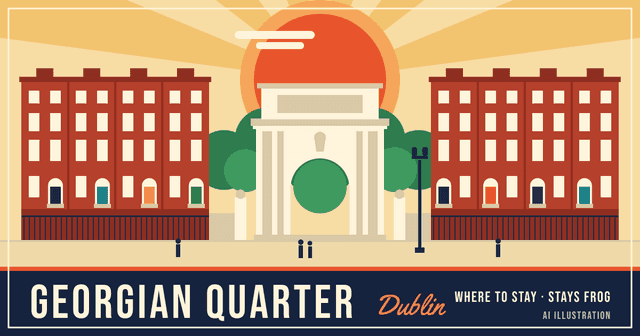
Choose it for grand Georgian squares, free national museums and Dublin's classic hotels, with Grafton Street close by and calm streets at night.
Dublin's grand Georgian south side, with redbrick terraces around St Stephen's Green, Merrion Square and Fitzwilliam Square. The free National Gallery and the classic Shelbourne and Merrion hotels are here, with Grafton Street close by.
How it scores
- Food
- 9/10
Fine dining at Michelin-starred Restaurant Patrick Guilbaud in The Merrion, opposite Government Buildings
- Nightlife
- 7/10
Calmer once the offices empty; the pubs of Grafton Street and Temple Bar are a short walk away
- Shopping
- 8/10
Grafton Street's shops sit on the doorstep, and artists sell their work on the Merrion Square railings
- Walkability
- 8/10
Walk the Merrion Square railings to St Stephen's Green via the Fusiliers' Arch; Temple Bar is a short stroll
- Transit
- 8/10
Luas Green Line at St Stephen's Green and Dawson, DART at Pearse and Dublin Express coaches at Trinity College
- Coolness
- 8/10
The free National Gallery, the Little Museum of Dublin, the Museum of Literature Ireland and Oscar Wilde's house
- Safety
- 7/10
Among Dublin's safer areas day and night; office streets by Merrion and Fitzwilliam Squares go very quiet late
- Loudness
- 6/10
Busy and polished by day, calmer once the offices empty; Merrion and Fitzwilliam Squares are very quiet late
Each category is scored 1-10 by our editors; the Frog Score is their average. Safety is our editors' judgment of how comfortable it is to walk around, not crime statistics. Loudness runs from library quiet (1) to never sleeps (10) and doesn't count toward the Frog Score. How we score
Our take
This is Dublin at its most stately: the 18th-century squares and streets east of Grafton Street, where long terraces of tall, narrow redbrick houses look onto St Stephen's Green, Merrion Square and Fitzwilliam Square. Leinster House, the seat of the Irish parliament, sits in the middle, with the National Gallery, the National Library, the National Museum and the Natural History Museum gathered around it, and Trinity College's campus fills the northern edge. Most of the townhouses are now offices, embassies and institutions, so the streets are busy and polished by day and calmer once the offices empty.
It suits culture-minded travellers, couples and anyone who wants a grand, central and quiet base with the shops of Grafton Street on one side and the museums on the doorstep. Dublin's two classic hotels are both here. The Shelbourne, founded in 1824 on the north side of St Stephen's Green, is where the constitution of the Irish Free State was drafted, in what is now its Constitution Room. The Merrion, a five-star hotel opposite Government Buildings on Merrion Street, fills four Georgian houses built in the 1760s, one of them the reputed birthplace of the Duke of Wellington, and is home to the Michelin-starred Restaurant Patrick Guilbaud. Expect some of the highest room prices in the city.
The National Gallery of Ireland, with entrances on Merrion Square and Clare Street, is free to enter and strong on Irish painting, Italian Baroque and Dutch masters. Walk the railings of Merrion Square, where artists hang their work in an open-air gallery opposite the National Gallery and Oscar Wilde grew up at No. 1, and look in at the Irish Architectural Archive at No. 45 if you love buildings. Then cross to St Stephen's Green, at 22 acres the largest of the Georgian squares, entering by the Fusiliers' Arch at the top of Grafton Street. Around the Green, the Little Museum of Dublin fills a Georgian townhouse at No. 15 on the north side, and the Museum of Literature Ireland occupies the old Catholic University buildings, where James Joyce had his graduation photographs taken under the garden's ash tree.
Getting around is easy: the Luas Green Line stops at St Stephen's Green and Dawson, Pearse station on the DART is close to the National Gallery, and Temple Bar and O'Connell Bridge are a short walk away via Grafton Street or College Green. Dublin Express coaches from Dublin Airport stop at Trinity College on the area's northern edge. This is one of the most comfortable parts of Dublin by day and at night, and St Stephen's Green and the streets around Grafton Street are among the city's safer areas after dark. The office streets around Merrion and Fitzwilliam Squares can be very quiet late at night, so stay on the lit main streets, and as anywhere in the centre, watch for pickpockets in crowds.
By Stays Frog AI Desk
A short history
St Stephen's Green began as a marshy common that Dublin Corporation enclosed in 1664, selling the land around it for building, but the south-east of the city stayed unfashionable until James FitzGerald, Earl of Kildare, built Kildare House there in 1745–48 to Richard Cassels' design; renamed Leinster House when he became Duke of Leinster, it drew aristocrats, bishops and the wealthy south from their northside townhouses. In 1762 the FitzWilliam estate laid out Merrion Square, whose redbrick terraces were largely complete by the early 1800s, and Fitzwilliam Square followed from 1792. The Royal Dublin Society bought Leinster House in 1815 and the National Library, National Museum and Natural History Museum grew up around it, while the Shelbourne Hotel opened on the Green in 1824 and the National Gallery on Merrion Square in 1864. St Stephen's Green, long closed to the public, was reopened by Lord Ardilaun in 1880, and since 1922 Leinster House has been the seat of the Irish parliament. Most of the townhouses are now offices, embassies and institutions, and Merrion Square's park, open only to keyholders until 1974, is a public park at the heart of what Tourism Ireland calls the Georgian Quarter.
No places in Georgian Dublin scored yet.
Traveller reviews
What people who've been say. One review each; you can update yours.
References(15)
Primary sources used to check this guide and its listings.
- The Best Georgian Architecture in Dublin With Visit Dublin · Official tourism / municipal source
- Official map: Mansion House A, Mansion House B · Dublin City Council / Smart Dublin, CC BY
- How Safe Is Dublin? A Local Guide for Tourists · DoDublin visitor operator
- Leinster House · Wikipedia
- St Stephen's Green · Wikipedia
- Merrion Square · Wikipedia
- Fitzwilliam Square · Wikipedia
- Georgian Dublin · Wikipedia
- Shelbourne Hotel · Wikipedia
- Merrion Hotel · Wikipedia
- National Gallery of Ireland · Wikipedia
- Dublin's quarters · Tourism Ireland
- How to Spend a Long Weekend in Dublin · Fáilte Ireland / Visit Dublin
- Luas · Wikipedia
- Dublin buses to and from Dublin Airport · daa / Dublin Airport