NeighborhoodsNeighborhood area
Temple Bar & Wood Quay
Cobbled streets, cultural venues and music · Dublin
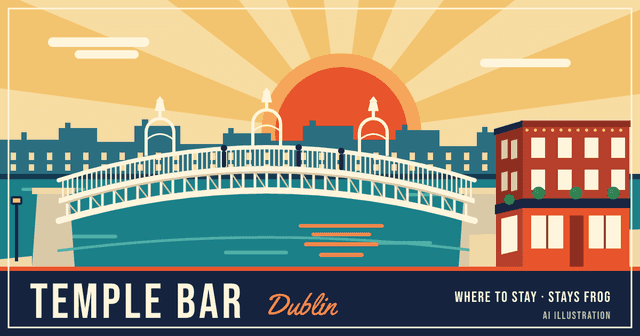
Choose Temple Bar for first-trip energy, trad music and culture on the doorstep, if you can live with weekend noise and higher prices.
Dublin's cobbled riverside quarter on the south bank of the Liffey, full of pubs, buskers and trad sessions. Browse Saturday's Temple Bar Food Market on Meeting House Square, see a film at the Irish Film Institute and cross the Ha'penny Bridge.
How it scores
- Food
- 9/10
Saturday's Temple Bar Food Market, weekend brunch at Elephant and Castle and lobster rolls at the Seafood Café
- Nightlife
- 9/10
Trad at the Auld Dubliner and Oliver St. John Gogarty, gigs at the Button Factory and the Workman's Club
- Shopping
- 8/10
Vintage rails at Lucy's Lounge, Nine Crows and Tola Vintage, plus the Gutter Bookshop on Cow's Lane
- Walkability
- 9/10
All on foot: Trinity College, Grafton Street and Dublin Castle are minutes away, and the Ha'penny Bridge crosses north
- Transit
- 8/10
Luas Green Line at Westmoreland and Trinity, Red Line on Abbey Street; Dublin Express stops at Wellington Quay
- Coolness
- 8/10
The Irish Film Institute, Photo Museum Ireland, Smock Alley Theatre and the mosaic walls of Crampton Court
- Safety
- 7/10
Busy, with a visible Garda presence; weekend stag and hen crowds bring rowdiness and pickpockets, so avoid back lanes late
- Loudness
- 9/10
Music from mid-morning and loud, crowded Friday and Saturday nights; ask for a room away from the street
Each category is scored 1-10 by our editors; the Frog Score is their average. Safety is our editors' judgment of how comfortable it is to walk around, not crime statistics. Loudness runs from library quiet (1) to never sleeps (10) and doesn't count toward the Frog Score. How we score
Our take
Temple Bar is the cobbled riverside quarter on the south bank of the Liffey, running from Westmoreland Street to Fishamble Street between the river and Dame Street, and it is the Dublin most visitors picture: narrow lanes, painted pub fronts, buskers and music spilling out of doorways from mid-morning. It is also the city's cultural quarter, so between the pubs you find an arthouse cinema, a photography museum, theatres, galleries and vintage shops, and at its western end, toward Wood Quay, Christ Church Cathedral and Dublinia are a few steps away. By day it is lively and easy to browse; on Friday and Saturday nights it is loud, crowded and unashamedly touristy.
It suits first-time visitors on a short city break, groups who want to be in the thick of the music, and anyone who wants Trinity College, Grafton Street and Dublin Castle a few minutes' walk away. Light sleepers and families should think twice, or at least ask for a room away from the street, because noise from bars and late venues has long been a local complaint. The hotels cluster on Fleet Street at the eastern end: the Temple Bar Hotel at 13-17 Fleet Street has 136 rooms, from compact pods to suites, and The Morgan Hotel at 10 Fleet Street has 168 rooms and its own restaurant and bar. Expect to pay more for rooms, meals and rounds than in the Liberties or Smithfield.
Start at Meeting House Square, home to Photo Museum Ireland, whose exhibitions change every couple of months, and on Saturdays to the Temple Bar Food Market, with stalls selling oysters, cheese, curries and bread. The Irish Film Institute is one of Dublin's two arthouse cinemas, holds the Irish Film Archive and has a café bar with a courtyard; Project Arts Centre, the New Theatre and Smock Alley Theatre, Dublin's first purpose-built theatre, keep the stages busy, and the 3Olympia Theatre on Dame Street dates from 1879. Music fans can try the Irish Rock 'N' Roll Museum Experience on Curved Street, gigs at the Button Factory and the Workman's Club, or trad sessions at the Auld Dubliner and the Oliver St. John Gogarty; The Temple Bar pub itself, with its red front, fairy lights and hanging baskets, has live music from mid-morning. Hunt out Love Lane, the mosaic-covered walls of Crampton Court, and the Icon Walk panels in the lanes behind Fleet Street, then browse the vintage rails at Lucy's Lounge, Nine Crows and Tola Vintage and the shelves of the Gutter Bookshop on Cow's Lane. For food, Elephant and Castle is a weekend brunch favourite, the Seafood Café does lobster rolls, and Cow's Lane has il Valentino for cannoli and Piglet Wine Bar for a glass at an outdoor table.
Everything here is on foot: Trinity College and Grafton Street are just to the east and south, Dublin Castle sits behind Dame Street, and the Ha'penny Bridge, the white cast-iron footbridge of 1816, crosses the Liffey to the north bank, where the Luas Red Line runs along Abbey Street. Green Line trams stop at Westmoreland (northbound) and Trinity (southbound) on the eastern edge. From the airport, the Dublin Express coach runs through the Port Tunnel and stops at Wellington Quay, Aston Quay and Trinity College, all on the district's doorstep, and TFI buses such as the 16 and 41 also run to the city centre. By day Temple Bar feels safe and is full of people, and at night heavy foot traffic and a visible Garda presence help, but weekend crowds bring rowdy stag and hen groups, drunken behaviour and occasional pickpocketing, so keep phones and wallets secure. Late at night stick to the busy main streets rather than quiet back lanes, use licensed taxis, and be aware that parts of O'Connell Street across the river call for more care after hours.
By Stays Frog AI Desk
A short history
In medieval times this stretch of the Liffey's south bank lay outside the city walls in St Andrew's parish, home from around 1259 to an Augustinian friary, but it fell out of use in the 14th century. In the 17th century it was laid out with gardens for wealthy families and the marshy riverbank was reclaimed; the name, first recorded on Bernard de Gomme's plan of the city in 1673, is usually linked to Sir William Temple, provost of Trinity College from 1609, who built a house and gardens here. After a disreputable 18th century the district declined, and in the 1970s and 1980s CIÉ bought up property for a planned bus terminus, letting buildings cheaply in the meantime to artists, galleries and small businesses. Protests by An Taisce, residents and traders killed the scheme, and in 1991 the government set up Temple Bar Properties to regenerate the area as Dublin's cultural quarter, bringing the Irish Film Institute, the Gallery of Photography and The Ark children's cultural centre, which opened on Meeting House Square in 1996. Its cobbled lanes have since become the city's busiest pub and music district, while at the western end Christ Church Cathedral, founded around 1030, and Dublinia stand over the oldest part of the city.
No places in Temple Bar & Wood Quay scored yet.
Traveller reviews
What people who've been say. One review each; you can update yours.
References(11)
Primary sources used to check this guide and its listings.
- Top 13 Things To Do in Temple Bar With Visit Dublin · Official tourism / municipal source
- Official map: Royal Exchange A, Wood Quay A · Dublin City Council / Smart Dublin, CC BY
- How Safe Is Dublin? A Local Guide for Tourists · DoDublin visitor operator
- Temple Bar, Dublin · Wikipedia
- Ha'penny Bridge · Wikipedia
- Temple Bar Hotel · Fáilte Ireland / Visit Dublin
- The Morgan Hotel · Fáilte Ireland / Visit Dublin
- Dublin Airport: buses to and from the airport · Dublin Airport (daa)
- Dublin Express: airport coach stops · Dublin Express
- Green Line (Luas) · Wikipedia
- Red Line (Luas) · Wikipedia