NeighborhoodsNeighborhood area
Fourvière
Hilltop heritage and city panoramas · Lyon
Choose Fourvière for sweeping views, Roman Lyon and a quiet special-occasion hotel on the hill, if you don't mind riding the funicular home.
A quiet, leafy hilltop above Vieux Lyon crowned by the Notre-Dame de Fourvière basilica, with the Roman theatres, the Lugdunum museum and the city's classic panorama from the esplanade; the funicular links it to the old town.
How it scores
- Food
- 8/10
Têtedoie, Christian Têtedoie's Michelin-starred restaurant with views over Lyon, plus Les Téléphones at Fourvière Hôtel
- Nightlife
- 4/10
The annual Nuits de Fourvière festival at the Roman theatre; for bars, head down the hill to Vieux Lyon
- Shopping
- 4/10
Quiet, almost suburban hilltop of leafy lanes and garden walls with little shopping; the rest of Lyon is a funicular ride away
- Walkability
- 5/10
Steep: the walk up from Vieux Lyon through the Rosaire gardens takes about 25 minutes, and every evening ends with a climb
- Transit
- 5/10
F2 funicular from Vieux Lyon (metro D) to the basilica until about 10pm; F1 to Saint-Just until about midnight; bus 55
- Coolness
- 8/10
Roman theatre and odeon, the Lugdunum museum with the Lyon Tablet, and the mosaic-filled basilica high above the city
- Safety
- 7/10
One of Lyon's calmest areas day and night; mind pickpockets on the esplanade, and take the funicular, not empty stairways, late
- Loudness
- 4/10
Quiet and almost suburban up top; crowds gather on the basilica esplanade by day and for light shows each 8 December
Each category is scored 1-10 by our editors; the Frog Score is their average. Safety is our editors' judgment of how comfortable it is to walk around, not crime statistics. Loudness runs from library quiet (1) to never sleeps (10) and doesn't count toward the Frog Score. How we score
Our take
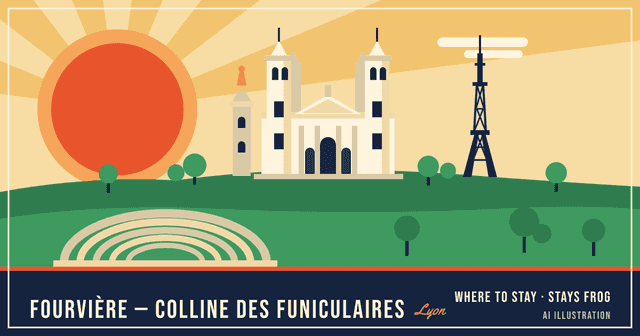
Fourvière is the steep, green hill on the right bank of the Saône that rises above Vieux Lyon, crowned by the white basilica of Notre-Dame de Fourvière and, beside it, the lattice metal tower that looks like a small Eiffel Tower. Lyon calls it "the hill that prays" for the basilica and the many convents and chapels on its slopes, and it is also where the city began, with the theatres of Roman Lugdunum set into the hillside just below the summit. Up top it is quiet and almost suburban, with leafy lanes, garden walls and terraces that look out over the whole city, the Presqu'île, the Rhône and, on a clear day, as far as Mont Blanc.
It suits couples, return visitors and anyone who wants calm, views and a special-occasion hotel rather than nightlife on the doorstep. Two hotels make the case. Fourvière Hôtel on rue Roger Radisson, a four-star with 75 rooms a few steps from the basilica, is arranged around a cloister, with a guest spa and pool and its restaurant Les Téléphones. Villa Maïa on rue du Professeur Pierre Marion, a five-star with 27 rooms and six suites, was designed by Jean-Michel Wilmotte on the former Antiquaille site near the Roman theatres, with gardens by Louis Benech, a spa and a restaurant by chef Christian Têtedoie. The trade-off is the hill: the rest of Lyon is a funicular ride or a steep walk away, and every evening ends with a climb.
Begin at the basilica, built from 1872 with four towers and two churches stacked one above the other, the upper one glowing with mosaics, marble and stained glass; entry to the basilica and the crypt is free, and its esplanade is Lyon's classic viewpoint. The older chapel beside it carries the golden Virgin whose statue gave rise to the Festival of Lights each 8 December, when the hill hosts light projections. A short walk down, the Roman theatre, begun around 15 BC and enlarged to seat some 10,000 people, and the smaller odeon sit beside Lugdunum, the museum of Roman Lyon, whose treasures include the Lyon Tablet with a speech by the emperor Claudius; the theatre still hosts the annual Nuits de Fourvière festival. For a special meal, Têtedoie on rue Pierre Marion is Christian Têtedoie's Michelin-starred restaurant with panoramic views over Lyon, with a bistro and a rooftop alongside; for a wider choice of restaurants and bars, head down to Vieux Lyon at the foot of the hill.
The funiculars are the easy way up. From Vieux Lyon, which is on metro line D, the F2 climbs to the basilica in about two minutes and runs until about 10pm, while the F1 runs via Minimes to Saint-Just until about midnight; bus 55 also stops at Saint-Just, and the walk up from Vieux Lyon through the Rosaire gardens takes about 25 minutes. Part-Dieu station and the Rhônexpress airport tram are on the far side of the city, so allow extra time on departure day. Fourvière is one of Lyon's calmest areas by day and at night. Crowds gather on the esplanade and at the Roman theatres, so keep the usual pickpocket precautions there, the main warning Lyon's tourist office gives visitors. After dark the gardens, stairways and steep lanes down to Vieux Lyon are quiet and empty, so if you are alone late, take the funicular down rather than the stairs.
By Stays Frog AI Desk
A short history
Fourvière is where Lyon began: the Romans founded Lugdunum on the summit in 43 BC, and as capital of Roman Gaul it had a forum, theatres and baths on the hill, whose name comes from the Latin forum vetus, the old forum. In the Middle Ages the hill was largely abandoned for the riverbanks below and its Roman monuments were quarried for stone, and by the 16th century it was vineyards and open land where so many religious orders settled that it became known as "the hill that prays". A shrine to the Virgin had stood here since the 12th century, and in 1852 its chapel gained a bell tower crowned by a gilded statue of Mary, the origin of Lyon's 8 December Festival of Lights. After the Church credited the Virgin with sparing Lyon in the Franco-Prussian War of 1870, Pierre Bossan's basilica rose beside the chapel from 1872, the privately built metal tower followed in 1892–94, and funiculars opened in 1878 and 1900 to link the hill with the old town. The Gallo-Roman museum, now Lugdunum, opened beside the Roman theatres in 1975, and in 1998 the hill became part of Lyon's UNESCO World Heritage site.
No places in Fourvière scored yet.
Traveller reviews
What people who've been say. One review each; you can update yours.
References(15)
Primary sources used to check this guide and its listings.
- Visit - Notre-Dame de Fourvière heart-full heart-full · Official tourism / municipal source
- Official map: Colline des Funiculaires · Ville de Lyon via DataGrandLyon
- Lyon en toute sécurité — updated 27 January 2026 · ONLYLYON Tourism & Conventions
- Basilica of Notre-Dame de Fourvière · Wikipedia
- Fourvière · Wikipedia
- Colline de Fourvière · Wikipédia (fr)
- Ancient Theatre of Fourvière · Wikipedia
- Lugdunum (museum) · Wikipedia
- Lugdunum – Musée & Théâtres romains · Métropole de Lyon
- Metallic tower of Fourvière · Wikipedia
- Funiculars of Lyon · Wikipedia
- Fourvière Hôtel Lyon · Fourvière Hôtel
- Villa Maïa · Villa Maïa
- Têtedoie · Têtedoie
- France travel advice: safety and security · GOV.UK (FCDO)