NeighborhoodsNeighborhood area
Vieux Lyon
Renaissance lanes, courtyards and silk shops · Lyon
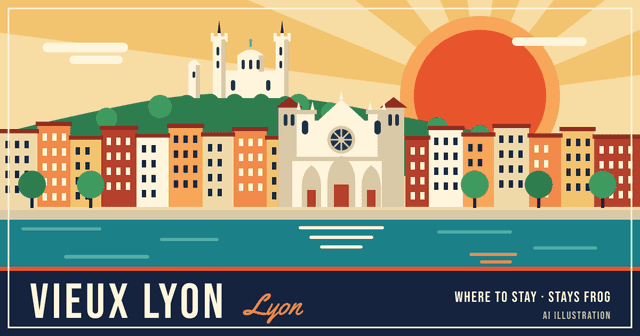
Pick Vieux Lyon for Renaissance lanes, traboules and bouchons on the doorstep, with funiculars up to Fourvière and the Presqu'île just over the river.
Lyon's Renaissance quarter, a ribbon of cobbled lanes between the Saône and Fourvière hill, with the cathedral of Saint-Jean, hidden traboules, traditional bouchons and funiculars up to the basilica.
How it scores
- Food
- 9/10
Bouchon country: quenelles, andouillette and salade lyonnaise, with 'Les Authentiques Bouchons Lyonnais' stickers to look for
- Nightlife
- 7/10
Lanes full of diners through the evening and busy weekend nights; side lanes go dark once restaurants close
- Shopping
- 9/10
Silk shops and small galleries fill the gaps between restaurants along the cobbled lanes of the old town
- Walkability
- 7/10
Cobbled lanes and traboules such as 54 rue Saint-Jean to 27 rue du Bœuf; steep montées and stairs climb the hill
- Transit
- 7/10
Metro D at Vieux Lyon, one stop from Bellecour; funiculars to Fourvière and Saint-Just; tram-trains from Gare Saint-Paul
- Coolness
- 9/10
Saint-Jean cathedral's astronomical clock, the Musées Gadagne puppet museum and one of Europe's largest Renaissance districts
- Safety
- 7/10
Safe by day and through the evening; pickpockets work the crowded lanes, and side lanes and montées are dark and empty late
- Loudness
- 7/10
Main lanes hear diners late into the evening and on weekend nights; ask for a courtyard or upper-floor room
Each category is scored 1-10 by our editors; the Frog Score is their average. Safety is our editors' judgment of how comfortable it is to walk around, not crime statistics. Loudness runs from library quiet (1) to never sleeps (10) and doesn't count toward the Frog Score. How we score
Our take
Vieux Lyon is the city's Renaissance quarter, a ribbon of cobbled lanes squeezed between the Saône and the steep slope of Fourvière, and one of the most extensive Renaissance districts in Europe. It has three distinct parts: Saint-Paul in the north, around its station and church; Saint-Jean in the middle, around the cathedral; and Saint-Georges in the south, the old silk weavers' quarter. Tall old houses hide spiral staircases, galleries and traboules, the passages that run through buildings and their courtyards from one street to the next, and the basilica of Notre-Dame de Fourvière looks down on it all from the hilltop.
Choose Vieux Lyon for atmosphere: it suits couples, history lovers and anyone who wants to step out of the door into the old city, and the Presqu'île and Place Bellecour are a short walk over the Saône. Hotels are fewer than across the river, and rooms in old houses can be compact, with steep stairs. Villa Florentine, a five-star Relais & Châteaux hotel in a 17th-century former convent on montée Saint-Barthélemy, is the splurge, with panoramic views over the city; elsewhere expect small hotels and apartments in historic buildings. Rooms on the main lanes hear diners late into the evening, so ask for one on a courtyard or higher up.
Start at the Gothic cathedral of Saint-Jean-Baptiste, seat of the Archbishop of Lyon, with its astronomical clock inside and the Romanesque Manécanterie, a former choir school, beside it. Walk north along rue Saint-Jean, the pedestrian main street, to the Musées Gadagne in the Hôtel de Gadagne, home to the Lyon history museum and the international puppet museum, and on to the Loge du Change and the church of Saint-Paul. The Museum of Miniatures and Film Sets occupies a 15th-century inn on rue Saint-Jean, and the longest traboule runs from 54 rue Saint-Jean through four houses to 27 rue du Bœuf. The riverside church of Saint-Georges, rebuilt in neo-Gothic style by Pierre Bossan in 1844, anchors the quieter south end. Courtyards are part of lived-in buildings, so use the publicly accessible passages respectfully, follow access notices and keep voices down. This is bouchon country: Lyon's traditional restaurants serve hearty dishes such as quenelles, andouillette, salade lyonnaise and Lyon sausage, and about twenty in the city carry the 'Les Authentiques Bouchons Lyonnais' sticker showing the puppet Gnafron. Silk shops and small galleries fill the gaps between restaurants.
Vieux Lyon station, by the cathedral, is on metro line D, one stop from Bellecour, and it is also the lower station of the two funiculars, one climbing to the basilica of Fourvière and the other to Saint-Just by way of Minimes. Gare Saint-Paul at the north end has tram-trains to the western suburbs. For Part-Dieu station and the Rhônexpress tram to Lyon-Saint Exupéry airport (about 30 minutes, every 15 minutes), take line D to Saxe–Gambetta and change to line B. Vieux Lyon is one of the most visited parts of the city and feels safe by day and through the evening, when the lanes are full of diners. Lyon's tourist office calls the city safe but warns about pickpockets, and the crowded lanes are where to keep bags zipped and phones out of back pockets. Late at night, once the restaurants close, the side lanes and the stepped montées up the hill are dark and empty, so take the funicular or a taxi up to Fourvière rather than climbing alone, and expect some noise on weekend nights.
By Stays Frog AI Desk
A short history
Vieux Lyon grew up on the narrow strip between Fourvière hill and the Saône: rue Saint-Jean, its spine, was laid out at the end of the 3rd century, when people from the Roman town on the hill moved down towards the river. In the Middle Ages the Saint-Jean quarter was the seat of religious and political power, and the cathedral of Saint-Jean-Baptiste rose there between 1180 and 1476 on the ruins of a 6th-century church. In the 15th and 16th centuries, when trade fairs made Lyon rich, Italian banker-merchants filled Saint-Paul with mansions such as the Hôtel de Gadagne, while silk weavers settled in Saint-Georges from the 16th century before moving up to the Croix-Rousse in the 19th. In 1964 Vieux Lyon became the first site in France protected under the Malraux law, safeguarding its Renaissance houses, courtyards and traboules, and in 1998 it was inscribed on the UNESCO World Heritage List with the rest of historic Lyon.
No places in Vieux Lyon scored yet.
Traveller reviews
What people who've been say. One review each; you can update yours.
References(14)
Primary sources used to check this guide and its listings.
- The old Lyon district - Lyon Tourist Office · Official tourism / municipal source
- Official map: Quartiers anciens · Ville de Lyon via DataGrandLyon
- Lyon en toute sécurité — updated 27 January 2026 · ONLYLYON Tourism & Conventions
- Vieux Lyon · Wikipedia (English)
- Lyon Cathedral · Wikipedia (English)
- Rue Saint-Jean (Lyon) · Wikipedia (French)
- Funiculars of Lyon · Wikipedia (English)
- Villa Florentine, Lyon · Beauvallon Collection (hotel owner)
- Bouchon (Lyon restaurant) · Wikipedia (English)
- Lyon Metro Line D · Wikipedia (English)
- Lyon Metro Line B · Wikipedia (English)
- Basilica of Notre-Dame de Fourvière · Wikipedia (English)
- Rhônexpress: Lyon centre to Saint-Exupéry airport and station · Rhônexpress
- France travel advice: safety and security · UK Foreign, Commonwealth & Development Office