NeighborhoodsNeighborhood area
Croix-Rousse plateau & upper slopes
Silk-working history across plateau and slopes · Lyon
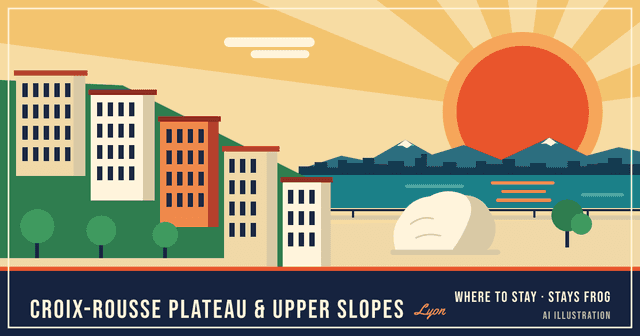
Choose the Croix-Rousse for silk-weaver history, village-like squares and a local apartment stay, if you're happy to climb.
The silk weavers' hill north of the Presqu'île, with steep slopes of traboules, stairways and tall canut buildings below a village-like plateau, where place de la Croix-Rousse has a daily market and the Maison des Canuts tells the silk story.
How it scores
- Food
- 8/10
A small daily market on place de la Croix-Rousse ringed by bistros, plus cafés along the slopes down to the Terreaux
- Nightlife
- 7/10
Shows at the Théâtre de la Croix-Rousse and bistros round the square; the student slopes stay livelier later than the plateau
- Shopping
- 9/10
Small shops and cafés on the slopes, the daily plateau market and French-made fabrics at the Maison des Canuts shop
- Walkability
- 6/10
Steep montées and long stairways like the Montée de la Grande Côte are a workout both ways; walking down to the Terreaux is quick
- Transit
- 7/10
Metro C climbs from Hôtel de Ville to Croix-Paquet, Croix-Rousse and Hénon; change in the centre for Part-Dieu
- Coolness
- 9/10
Canut buildings, traboules like the Cour des Voraces, the 365-window Maison Brunet and the Gros Caillou boulder
- Safety
- 7/10
Safe and neighbourly by day; long stairways on the slopes can be empty late, so stick to main streets, and visit traboules by day
- Loudness
- 6/10
The plateau is quiet at night; the student slopes stay livelier later, and traboules run through homes, so keep voices down
Each category is scored 1-10 by our editors; the Frog Score is their average. Safety is our editors' judgment of how comfortable it is to walk around, not crime statistics. Loudness runs from library quiet (1) to never sleeps (10) and doesn't count toward the Frog Score. How we score
Our take
The Croix-Rousse is the hill that rises north of the Presqu'île between the Rhône and the Saône, and it comes in two parts: the steep slopes, les pentes, in the 1st arrondissement, which climb from place des Terreaux, and the plateau on top, in the 4th. This was the silk weavers' hill and it still looks it, with tall, plain buildings of five or six floors and very high windows made for the canuts' Jacquard looms, linked by stairways, steep "montées" and traboules, the covered passages that cut through buildings and courtyards. The slopes have a student, artistic and alternative streak, while the plateau feels like a village, where locals say they "go down to town" when they head for the centre.
It suits travellers who want to live like a local for a few days: couples, creative types, repeat visitors and anyone happy to trade a big central hotel for a high-ceilinged apartment in a former weavers' building. Stay on the slopes for cafés, small shops and a quick walk down to the Terreaux and the Presqu'île, or on the plateau around place de la Croix-Rousse for its daily market, bistros and quieter nights. Be ready for hills: the slopes are a workout in both directions, and a base near a metro C station saves your legs.
On the plateau, the Maison des Canuts on rue d'Ivry tells the silk story, from silkworms to Jacquard's invention and the revolts of 1831 and 1834, with guided visits that include a demonstration on a 19th-century hand loom, a shop selling French-made fabrics and, on some days, a walk down through the traboules. Place de la Croix-Rousse, with its statue of Jacquard, has a small daily market ringed by bistros, and at the eastern end of the boulevard the Gros Caillou, a 24-tonne boulder carried from the Alps by glaciers, stands on a terrace that looks across the Rhône towards the Alps. On the slopes, climb the Montée de la Grande Côte for the panorama from the top, look for the Maison Brunet, the "house of 365 windows", and cut through the traboules of the Cour des Voraces and the Passage Thiaffait. In the evening, catch a show at the Théâtre de la Croix-Rousse or settle into one of the bistros around the square.
Metro C, which began life as a rack railway up the slope, climbs from Hôtel de Ville–Louis Pradel to Croix-Paquet on the slopes and Croix-Rousse and Hénon on the plateau; walking down the slopes to the Terreaux is often just as quick. For Part-Dieu station and the Rhônexpress airport tram, change in the centre and allow plenty of time. The Croix-Rousse feels safe and neighbourly by day, the plateau is quiet at night, and the slopes, with their student crowd, stay livelier later. Traboules run through people's homes and courtyards, so keep your voice down and visit them in daylight, and the long stairways on the slopes can be empty late at night, so stick to the main streets if you are walking alone. Lyon's tourist office describes the city as safe and mainly warns visitors about pickpockets.
By Stays Frog AI Desk
A short history
The Croix-Rousse takes its name from a reddish stone cross raised on the hill in the 16th century; in 1512 Louis XII's ramparts brought the slopes inside Lyon but left the plateau outside the walls as a faubourg, which became a commune of its own in 1802. Silk workshops moved up from Vieux Lyon from the 18th century, and after Jacquard's loom appeared in 1801 the canuts, Lyon's silk weavers, filled the hill with tall buildings whose high ceilings and big windows were made for the looms and the light. The canuts rose in 1831, one of the first workers' uprisings, and again in 1834 under the motto "live working or die fighting", and both revolts were crushed by the army, giving the "hill that works" its rebellious name opposite Fourvière, "the hill that prays". In 1852 the commune, then home to about 30,000 people, was annexed to Lyon; a funicular nicknamed "la ficelle" climbed the slope from 1862, and the ramparts were pulled down in 1865 to make way for the boulevard de la Croix-Rousse. As the silk industry declined in the 20th century the slopes became a student, artistic and alternative quarter, and since their listing as part of Lyon's UNESCO World Heritage site in 1998 the old weavers' buildings have been renovated into sought-after homes.
No places in Croix-Rousse plateau & upper slopes scored yet.
Traveller reviews
What people who've been say. One review each; you can update yours.
References(11)
Primary sources used to check this guide and its listings.
- The Croix-Rousse district - Lyon Tourist Office · Official tourism / municipal source
- Official map: Ouest Pentes, Haut et Coeur des Pentes, Croix-Rousse Saône, Croix-Rousse Ouest, Croix-Rousse Centre, Croix-Rousse Est et Rhône · Ville de Lyon via DataGrandLyon
- Lyon en toute sécurité — updated 27 January 2026 · ONLYLYON Tourism & Conventions
- La Croix-Rousse · Wikipedia
- Croix-Rousse (Lyon) · Wikipédia (fr)
- Canut revolts · Wikipedia
- Gros Caillou (Lyon) · Wikipédia (fr)
- Maison des Canuts · Maison des Canuts
- Lyon Metro · Wikipedia
- Rhônexpress: Lyon Part-Dieu to Lyon Saint-Exupéry airport · Rhônexpress
- France travel advice: safety and security · GOV.UK (FCDO)