NeighborhoodsNeighborhood area
Central Presqu’île: lower slopes, Bellecour & Carnot
Central shopping and cultural streets · Lyon
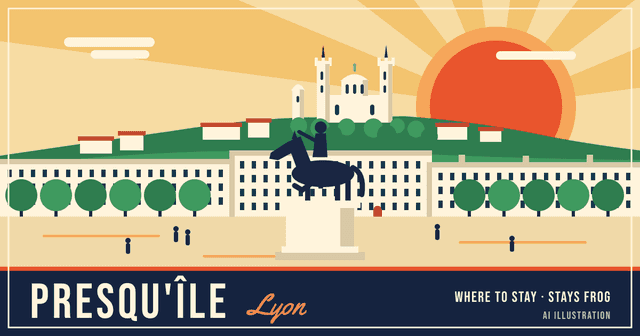
First-timers and short stays: Lyon's grand squares, museums, shops and restaurants on the doorstep, with Vieux Lyon just across the Saône.
Lyon's central peninsula between the Saône and the Rhône, from Place Carnot through Place Bellecour to Place des Terreaux, with grand shopping streets, the Museum of Fine Arts, bouchons and Vieux Lyon just over the river.
How it scores
- Food
- 9/10
La Mère Brazier on rue Royale and traditional bouchons serving quenelles, andouillette and salade lyonnaise
- Nightlife
- 8/10
Le Dôme bar under the InterContinental's dome and lively terraces around Place des Terreaux and the Opéra
- Shopping
- 9/10
Department stores and luxury shops along rue de la République and rue Édouard-Herriot, the grand Second Empire streets
- Walkability
- 8/10
Most sights are a walk away, from Bellecour north to Terreaux, with Vieux Lyon just over the Saône
- Transit
- 8/10
Metro A runs the peninsula from Perrache to Hôtel de Ville; D at Bellecour is one stop from Vieux Lyon; C up to Croix-Rousse
- Coolness
- 8/10
Museum of Fine Arts in the Palais Saint-Pierre, Jean Nouvel's Opéra, the Bartholdi fountain and the Museum of Printing
- Safety
- 7/10
Comfortable on main streets at night; pickpocket teams work the shopping streets and metro, so avoid crossing empty Bellecour late
- Loudness
- 8/10
Weekend nights around Terreaux and the Opéra are loud, so ask for a courtyard room; Ainay and Bellecour streets are calmer
Each category is scored 1-10 by our editors; the Frog Score is their average. Safety is our editors' judgment of how comfortable it is to walk around, not crime statistics. Loudness runs from library quiet (1) to never sleeps (10) and doesn't count toward the Frog Score. How we score
Our take
The Presqu'île is Lyon's centre in every practical sense: a narrow peninsula between the Saône and the Rhône where the city's grand squares, department stores, luxury shops, theatres and many of its best-known restaurants sit within walking distance of one another. Its central stretch runs from Place Carnot and Ainay in the south, through Bellecour and the Cordeliers, to Place des Terreaux and the lower slopes of the Croix-Rousse. Renaissance lanes, 17th-century squares and the wide Second Empire streets of rue de la République and rue Édouard-Herriot sit side by side, and from Place Bellecour you look straight across the Saône to Vieux Lyon, with the basilica of Fourvière on the hill above.
It is the easiest base for first-time visitors, short stays and anyone without a car: most sights are a walk away, and Vieux Lyon is just over the river. Hotels run from small, simple hotels on the side streets to the city's grandest addresses. The InterContinental Lyon – Hotel Dieu, a five-star hotel with 144 rooms and suites inside Soufflot's riverside hospital under its 32-metre dome, is the landmark stay. Ainay and the streets around Bellecour are calmer than the lanes near Terreaux and the Opéra, and prices here are among the highest in the city.
Start on Place Bellecour, one of the largest open squares in Europe, with François-Frédéric Lemot's 1825 equestrian statue of Louis XIV in the middle, a statue of Antoine de Saint-Exupéry and the Little Prince at the west end, and the tourist office in one of its pavilions. Walk north along rue de la République, or rue Édouard-Herriot with its luxury shops, to Place des Terreaux, where the Bartholdi fountain faces the Hôtel de Ville and the Museum of Fine Arts fills the former Benedictine abbey of the Palais Saint-Pierre, whose cloister garden is a quiet escape. On the way, look into the church of Saint-Nizier, the old printers' street of rue Mercière and the Museum of Printing, and the Opéra, rebuilt by Jean Nouvel in 1993; to the south, the Romanesque basilica of Saint-Martin d'Ainay is worth the detour. For food, there are traditional bouchons serving quenelles, andouillette and salade lyonnaise, and La Mère Brazier on rue Royale, the restaurant Eugénie Brazier opened in 1921 and now run by chef Mathieu Viannay. After dark, Le Dôme bar under the InterContinental's cupola and the terraces around Terreaux and the Opéra keep the evening going.
Metro line A runs the length of the peninsula, from Perrache station at its southern tip through Ampère–Victor Hugo, Bellecour and Cordeliers to Hôtel de Ville; line D crosses it at Bellecour, one stop from Vieux Lyon, and line C climbs from Hôtel de Ville to the Croix-Rousse. For Part-Dieu station, take line D from Bellecour to Saxe–Gambetta and change to line B; from Part-Dieu the Rhônexpress tram reaches Lyon-Saint Exupéry airport in about 30 minutes, every 15 minutes. The Presqu'île is busy and well used from morning to late evening and feels comfortable at night on its main streets. Lyon's tourist office calls the city safe but warns about pickpockets, who can work in teams with one person distracting you, so keep bags closed in the crowded shopping streets, at the Bellecour interchange and on the metro. Weekend nights around Terreaux and the Opéra are loud, so light sleepers should ask for a room on a courtyard, and late at night it is better to keep to lit, busy streets than to cut across the empty expanse of Bellecour.
By Stays Frog AI Desk
A short history
The Presqu'île is the tongue of land between the Saône and the Rhône, running from the foot of the Croix-Rousse hill to the rivers' confluence; in Gallo-Roman times the Bellecour area was an alluvial island used by traders and boatmen. In the Middle Ages and the Renaissance it grew into the counterpart of Vieux Lyon across the Saône, with convents, the church of Saint-Nizier, printers and booksellers on rue Mercière and, in the south, the Romanesque abbey church of Saint-Martin d'Ainay. The 17th and early 18th centuries gave it its set pieces: the Hôtel de Ville on Place des Terreaux, built between 1646 and 1655, the Palais Saint-Pierre abbey that now houses the Museum of Fine Arts, and Place Bellecour, created as a royal square in honour of Louis XIV. Jacques-Germain Soufflot later expanded the riverside hospital into the Hôtel-Dieu, and in 1855, under the Second Empire, the prefect Claude-Marius Vaïsse created rue de la République and rue Édouard-Herriot, the peninsula's grand shopping streets. In 1998 the Presqu'île was inscribed on the UNESCO World Heritage List with Lyon's other historic districts, and the closed Hôtel-Dieu has since become shops, offices and a five-star InterContinental hotel.
No places in Central Presqu’île: lower slopes, Bellecour & Carnot scored yet.
Traveller reviews
What people who've been say. One review each; you can update yours.
References(14)
Primary sources used to check this guide and its listings.
- The Presqu’île district - Lyon Tourist Office · Official tourism / municipal source
- Official map: Bas des Pentes - Presqu'île, Bellecour - Cordeliers, Bellecour - Carnot · Ville de Lyon via DataGrandLyon
- Lyon en toute sécurité — updated 27 January 2026 · ONLYLYON Tourism & Conventions
- Presqu'île · Wikipedia (English)
- Place Bellecour · Wikipedia (English)
- InterContinental Lyon – Hotel Dieu · InterContinental Lyon – Hotel Dieu
- La Mère Brazier · La Mère Brazier
- Bouchon (Lyon restaurant) · Wikipedia (English)
- Lyon Metro · Wikipedia (English)
- Lyon Metro Line A · Wikipedia (English)
- Lyon Metro Line D · Wikipedia (English)
- Lyon Metro Line B · Wikipedia (English)
- Rhônexpress: Lyon centre to Saint-Exupéry airport and station · Rhônexpress
- France travel advice: safety and security · UK Foreign, Commonwealth & Development Office