NeighborhoodsNeighborhood area
Centro Histórico and La Merced
Museums, monuments and specialist shops · Málaga
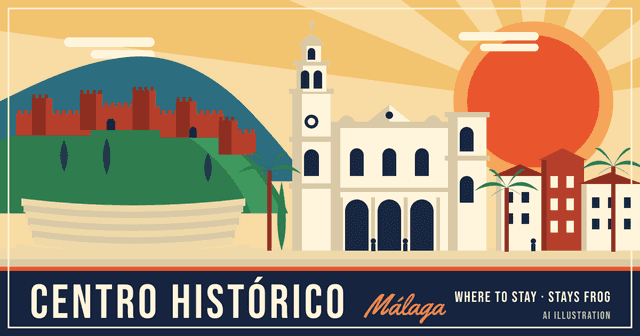
Choose the old town for a first visit or a museum trip: the Picasso, the cathedral and the Alcazaba on your doorstep, at the city's highest prices.
Málaga's compact old town between the Guadalmedina and Gibralfaro, where the Museo Picasso, the cathedral and the Alcazaba sit minutes apart and Calle Larios runs up to Plaza de la Constitución.
How it scores
- Food
- 9/10
Tapas lanes, Balausta at Palacio Solecio, Cortijo de Pepe on Plaza de la Merced and the Atarazanas market
- Nightlife
- 8/10
Terraces stay full well into the evening and the busiest tapas-bar lanes stay lively late
- Shopping
- 9/10
Calle Larios, the city's grand shopping street, plus specialist shops in the lanes and the Atarazanas market
- Walkability
- 9/10
Compact grid: Museo Picasso, cathedral, Alcazaba and central market all a few minutes apart on foot
- Transit
- 8/10
Atarazanas and Guadalmedina metro to María Zambrano; C-1 train from Centro-Alameda to the airport every 20 min or so
- Coolness
- 9/10
Picasso's birthplace, the Roman theatre, the Alcazaba and La Manquita cathedral in 2,000-year-old lanes
- Safety
- 7/10
Comfortable by day and evening; pickpockets work Calle Larios, the cathedral and the market; use lit main streets late
- Loudness
- 8/10
Busiest bar lanes stay noisy late and Calle Larios is crowded; Calle Granada and the Merced lanes are calmer
Each category is scored 1-10 by our editors; the Frog Score is their average. Safety is our editors' judgment of how comfortable it is to walk around, not crime statistics. Loudness runs from library quiet (1) to never sleeps (10) and doesn't count toward the Frog Score. How we score
Our take
Málaga's old town packs more than two thousand years into a compact grid of narrow streets between the Guadalmedina river, the Alameda Principal and the slopes of Gibralfaro. The Alcazaba and the Roman theatre sit at the foot of the hill, the cathedral with its single finished tower rises over the rooftops, and Calle Larios, the city's grand shopping street, runs from the Alameda up to Plaza de la Constitución, the old heart of the Moorish medina. Around them the lanes are full of tapas bars, churches, palaces and specialist shops, and La Merced, at the top end around Plaza de la Merced, is where Picasso was born.
This is the base for first-time visitors and anyone who wants to step out of the door into the museums: the Museo Picasso, the cathedral, the Alcazaba and the central market are all a few minutes apart on foot. Hotels are mostly small and set in old buildings. Palacio Solecio, an 18th-century Andalusian palace on Calle Granada opposite the Iglesia de Santiago, is the stand-out, with its restaurant Balausta. An address on or near Calle Larios puts you on the shopping axis, while Calle Granada and the lanes toward Plaza de la Merced feel a little more residential. It is the priciest part of the city to stay in, and the busiest bar lanes stay noisy late.
Start at the Museo Picasso, in the 16th-century Buenavista Palace on Calle San Agustín, where remains of the Phoenician city wall and a Roman fish-sauce factory can be seen beneath the floor; entry is free on Sundays for the last two hours before closing. A short walk away are the Roman theatre on Calle Alcazabilla, with the Alcazaba's walls and towers climbing the hill behind it, and the cathedral, built over two and a half centuries and still nicknamed La Manquita, the one-armed lady, for its missing tower. Picasso's birthplace is on Plaza de la Merced, where Cortijo de Pepe has served traditional Málaga cooking since 1971. For food shopping, the Mercado Central de Atarazanas, an 1870s iron-framed market entered through a surviving Nasrid marble gate, has a great stained-glass window showing the city's monuments.
Everything in the old town is walkable, and the metro's Atarazanas and Guadalmedina stations, opened in 2023 on its western edge, run to El Perchel for María Zambrano station, where AVE trains leave for Madrid and Barcelona. The C-1 suburban train from Málaga Centro-Alameda and María Zambrano runs every 20 minutes or so to the airport, about 8 km southwest of the centre. The centre is busy and feels comfortable by day and well into the evening, when the terraces stay full. The main risk is pickpocketing: thieves in Spain often work in teams using distraction, so keep bags closed in the crowds on Calle Larios, around the cathedral and in the market, and keep an eye on your drink in bars. After the bars close, the narrow side lanes empty quickly, so walk home along the main, lit streets.
By Stays Frog AI Desk
A short history
Málaga's old town stands on the site of Phoenician Malaka, whose city wall survives beneath the Museo Picasso, and at the foot of the Alcazaba lies a Roman theatre from the early Empire that was rediscovered in 1951. The Hammudid dynasty began the present Alcazaba in the 11th century and the Nasrids largely rebuilt it in the 14th; the main axis of the Nasrid medina ran from the fortress to the square that is now Plaza de la Constitución. After the Catholic Monarchs took the city in 1487, churches and convents filled the walled town, and the cathedral rose from 1528 to 1782 with its south tower never finished, which earned it the nickname La Manquita. The walls came down from the 18th century and in the 19th the centre became a bourgeois district, crowned by Calle Larios, opened in 1891 with façades by Eduardo Strachan. After decades of demolitions and decline, a rehabilitation programme began in 1996, Calle Larios was pedestrianised at the start of the 2000s and the Museo Picasso opened in 2003, turning the old town into the museum quarter visitors find today.
No places in Centro Histórico and La Merced scored yet.
Traveller reviews
What people who've been say. One review each; you can update yours.
References(18)
Primary sources used to check this guide and its listings.
- Tourism in Málaga. What to see | spain.info · Primary city / venue source
- Palacio Solecio - Boutique Hotel - Málaga - Costa del Sol · Primary city / venue source
- Visit — Museo Picasso Málaga · Primary city / venue source
- Málaga municipal neighbourhood polygons — Centro Histórico and La Merced · Ayuntamiento de Málaga — Sistema de Información Cartográfica; CC BY 4.0
- Safety and security - Spain travel advice - GOV.UK · UK Foreign, Commonwealth & Development Office — current visitor-safety guidance
- Centro histórico de Málaga · Wikipedia (Spanish)
- Calle Larios · Wikipedia (English)
- Calle Marqués de Larios · Wikipedia (Spanish)
- Málaga Cathedral · Wikipedia (English)
- Alcazaba of Málaga · Wikipedia (English)
- Teatro romano de Málaga · Wikipedia (Spanish)
- Museo Picasso Málaga · Wikipedia (English)
- Mercado de Atarazanas · Wikipedia (Spanish)
- Cortijo de Pepe — Mesón y restaurante desde 1971 · Cortijo de Pepe (official site)
- Estación de Málaga-María Zambrano · Wikipedia (Spanish)
- Málaga Metro · Wikipedia (English)
- Línea C-1 (Cercanías Málaga) · Wikipedia (Spanish)
- Málaga Airport · Wikipedia (English)