NeighborhoodsNeighborhood area
La Victoria and Monte de Gibralfaro
Neighbourhood streets and a castle hill · Málaga
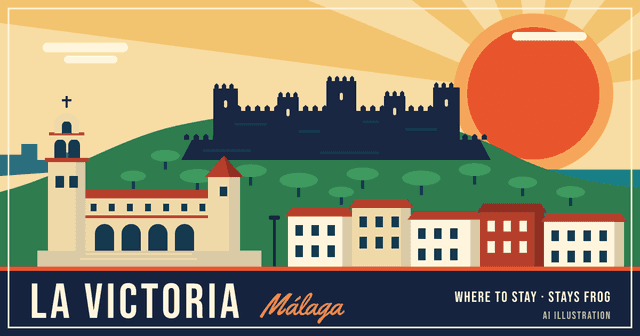
Choose La Victoria for a local, lived-in base below Gibralfaro castle, with the old town downhill and the city's best views uphill.
A traditional residential barrio climbing from Plaza de la Merced along Calle Victoria below Gibralfaro castle, with the Santuario de la Victoria's crypt and the hilltop Parador for views over the bay.
How it scores
- Food
- 6/10
Local bars around Plaza de la Merced; walk downhill into the old town for more choice
- Nightlife
- 4/10
Quieter, local evenings with neighbours out in the squares; the old town's bars are downhill
- Shopping
- 4/10
Local shops and bars along Calle Victoria; little for browsing beyond everyday errands
- Walkability
- 6/10
Steady slopes up Calle Victoria; the path to the castle from Paseo de Don Juan Temboury takes about 20 minutes
- Transit
- 6/10
Several city bus lines and EMT 35 up to the castle; head down to the Alameda for the airport bus or the C-1
- Coolness
- 7/10
Gibralfaro castle walls, the Santuario de la Victoria's skeleton crypt and Holy Week processions
- Safety
- 7/10
Comfortable by day and evening; Gibralfaro's wooded paths are quiet after dark, and pickpockets work the viewpoints
- Loudness
- 5/10
Quieter than the old town and seafront; busy during Holy Week and on 8 September for the patron saint
Each category is scored 1-10 by our editors; the Frog Score is their average. Safety is our editors' judgment of how comfortable it is to walk around, not crime statistics. Loudness runs from library quiet (1) to never sleeps (10) and doesn't count toward the Frog Score. How we score
Our take
La Victoria is the everyday Málaga that begins where the tourist centre ends. From the Plaza de la Merced, Calle Victoria runs north-east along the foot of Monte Gibralfaro, past chapels, schools, local shops and bars, to the Plaza de la Victoria and, just beyond it, the sanctuary of the city's patron saint. Above the rooftops, the pine-covered hill carries the crenellated walls of Gibralfaro castle, which has some of the best views in the city. It is a traditional, devout and unpretentious barrio that comes alive in Holy Week, when several brotherhoods process through its streets, and on 8 September, a local holiday, when the image of Santa María de la Victoria is carried home to her sanctuary.
It suits repeat visitors, walkers and travellers who would rather sleep among locals than among tour groups and who don't mind a slope, since the streets rise steadily towards the hill. Look for a flat or small guesthouse on the lower stretch of Calle Victoria or near the Plaza de la Merced, where the old town is on the doorstep and the walk home is gentler. The stand-out stay is the state-run Parador on the hill beside the castle, for views over the port and the bay. Expect quieter, more local evenings than on the seafront or in the old town.
Gibralfaro castle is the big sight. Built in the 14th century to shelter troops and guard the Alcazaba below, it has a walkway along its walls, an interpretation centre in the old powder magazine and views across the port, the bullring and the bay; the Mirador de Gibralfaro, a lookout on the road up, frames the same panorama. Back down, the Santuario de la Victoria, rebuilt around 1700, keeps the patroness in its tower chamber and a startling black-and-white crypt of skeletons built for the Counts of Buenavista, reopened after restoration in 2024. Along Calle Victoria look out for the small Mudéjar church of San Lázaro, founded in 1491, and the Capilla del Agua. For food and drink, follow the locals to the bars around the Plaza de la Merced, then walk downhill into the old town for Picasso's birthplace museum on the same square and the Roman theatre and Alcazaba at the foot of the hill.
Walking is the way to get about, but expect gradients: the footpath up to the castle from the Paseo de Don Juan Temboury takes about 20 minutes, and EMT bus 35 climbs to the castle from the centre if you would rather ride up and walk down. Several city bus lines serve the barrio, and for the airport or the María Zambrano high-speed station you head down to the Alameda for the airport express bus or the C-1 commuter train. La Victoria is a lived-in residential barrio that feels comfortable by day and in the evening, when neighbours are out in the squares. The wooded paths on Gibralfaro are best walked in daylight, as they are quiet after dark and the castle keeps set opening hours, so come down before dusk unless you are going to an organised night event. As anywhere in Spain, keep bags close in crowds at the viewpoints and during the Holy Week processions, when thieves work in teams with distraction tricks.
By Stays Frog AI Desk
A short history
La Victoria takes its name from the hillside where Ferdinand of Aragon pitched his camp during the siege of Málaga in 1487; a hermitage built on the spot passed in 1493 to the Minim friars, and their church was rebuilt between 1693 and 1700 as today's Santuario de la Victoria, home of the image of the city's patroness. Above it stood Gibralfaro castle, raised in the 14th century under Yusuf I of Granada on a hill used since Phoenician times and joined to the Alcazaba by the walled Coracha, whose starving defenders surrendered to Ferdinand and Isabella after a three-month siege that same year. After the conquest the ground between the old market square, now the Plaza de la Merced, and the sanctuary was gradually built up along Calle Victoria, where the Catholic Monarchs founded a leper hospital in 1491 whose chapel survives as the church of San Lázaro. From the mid-19th century the barrio was home to dressmakers, laundry owners, small traders and clerks, while the castle served as a barracks and prison until 1925, when it passed to the city and opened to the public. Its walls and towers were restored between 1989 and 1999.
No places in La Victoria and Monte de Gibralfaro scored yet.
Traveller reviews
What people who've been say. One review each; you can update yours.
References(10)
Primary sources used to check this guide and its listings.
- Tourism in Málaga. What to see | spain.info · Primary city / venue source
- Málaga municipal neighbourhood polygons — La Victoria and Monte de Gibralfaro · Ayuntamiento de Málaga — Sistema de Información Cartográfica; CC BY 4.0
- Safety and security - Spain travel advice - GOV.UK · UK Foreign, Commonwealth & Development Office — current visitor-safety guidance
- La Victoria (Málaga) · Wikipedia (es)
- Santuario de la Victoria · Wikipedia (es)
- Gibralfaro · Wikipedia
- Castillo de Gibralfaro: historia · Ayuntamiento de Málaga — Alcazaba y Castillo de Gibralfaro
- Alcazaba y Castillo de Gibralfaro: dónde estamos · Ayuntamiento de Málaga — Alcazaba y Castillo de Gibralfaro
- Museo Casa Natal Picasso · Wikipedia
- Cercanías Málaga (line C-1 stations) · Wikipedia