NeighborhoodsNeighborhood area
La Malagueta and La Caleta
Seaside hotels and live flamenco · Málaga
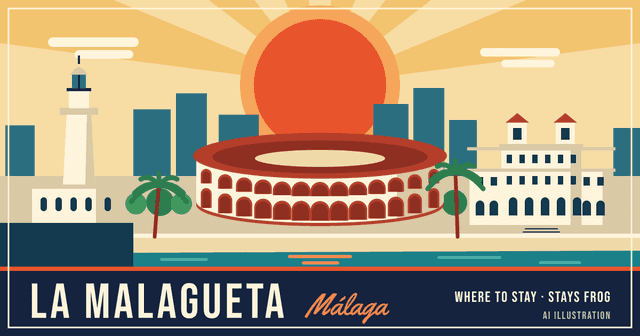
Choose La Malagueta for a city beach on your doorstep, the grand Gran Hotel Miramar and an easy seaside stroll into the old town.
Málaga's own seaside between the port and the Mediterranean, with the 1.2 km Malagueta beach, the Gran Hotel Miramar on the Paseo de Reding and the old town a short stroll west along the harbour.
How it scores
- Food
- 8/10
Fish and seafood on the promenade terraces, Muelle Uno's restaurants and dinner shows at Flamenco Alegría
- Nightlife
- 6/10
Flamenco Alegría's tablao on Calle Vélez-Málaga and evening drinks on the promenade as the port lights up
- Shopping
- 5/10
Mostly apartment blocks; Muelle Uno's harbour shops and the old town are a short walk west
- Walkability
- 8/10
Flat and easy: walk west along the port to Muelle Uno, the Centre Pompidou and the old town
- Transit
- 6/10
Many EMT bus lines including the airport express, about 15 minutes; trains from Centro-Alameda and María Zambrano
- Coolness
- 7/10
La Farola lighthouse, the 1876 bullring, the English Cemetery and the colourful Centre Pompidou cube
- Safety
- 7/10
Safe and relaxed by day and evening; watch bags on the sand and terraces, and stick to the lit promenade late
- Loudness
- 6/10
Busy promenade in the evening and big late crowds at the August fair; streets back by the bullring are calmer
Each category is scored 1-10 by our editors; the Frog Score is their average. Safety is our editors' judgment of how comfortable it is to walk around, not crime statistics. Loudness runs from library quiet (1) to never sleeps (10) and doesn't count toward the Frog Score. How we score
Our take
La Malagueta and La Caleta are Málaga's own seaside: a wedge of apartment towers and old villas squeezed between the port and the Mediterranean, with La Malagueta beach running for about 1.2 km along the front and La Farola, the lighthouse finished in 1817 and a symbol of the city, standing at its tip. Behind the sand, the Paseo de Reding and the Paseo de la Farola keep some of the bourgeois villas of the late 19th century, and the round neo-Mudéjar bullring sits among the 1960s blocks. To the east the mood turns quieter and leafier in La Caleta, the villa quarter around the Paseo de Sancha. This is a place for morning swims, long lunches facing the water and sunset walks, with the historic centre a short stroll away.
It suits beach-first travellers, couples and families who want the sea outside the door and the museums within walking distance, and anyone after a slower, more residential stay than the old town offers. The landmark stay is the Gran Hotel Miramar on the Paseo de Reding, a five-star resort and spa in the palace-like 1926 building with twin towers, a grand staircase and gardens facing the bay. Most of the rest of the housing stock is apartment blocks, so a flat with a sea view is the other classic choice; sea-facing rooms carry a premium, and the streets back towards the bullring are calmer.
Start with the beach, a Blue Flag stretch about 45 m wide with sunbed and umbrella hire, showers, play areas and lifeguards, then follow the front west to Muelle Uno, the harbour promenade of shops and restaurants, and the colourful cube of the Centre Pompidou Málaga. The bullring, opened in 1876 with 9,032 seats, houses the Museo Taurino Antonio Ordóñez and fills up for the August fair. On the Paseo de Reding, the English Cemetery, opened in 1831 at the urging of the British consul William Mark, is a peaceful garden where the writer Gerald Brenan and the poet Jorge Guillén are buried. Evenings mean fish and seafood on the promenade terraces, a drink as the lights come on across the port, or a show at Flamenco Alegría on Calle Vélez-Málaga, a tablao beside the beach where guitar, song and dance can come with an optional Andalusian dinner.
Getting around is easy and flat: the old town is a short walk west along the port, and many EMT city bus lines serve the neighbourhood, including the airport express. The airport is about 8 km from the city, roughly 15 minutes on the express bus; for trains, María Zambrano is the high-speed station, with AVE services to Madrid in under three hours, and the C-1 commuter line runs from Centro-Alameda and María Zambrano to the airport. La Malagueta feels safe and relaxed by day and through the evening, when the promenade is busy with families, runners and diners. Keep phones and bags in sight on the sand and on crowded terraces, because thieves often work in teams with distraction tricks; late at night stick to the lit promenade rather than the empty beach, and expect big crowds and late noise during the August fair.
By Stays Frog AI Desk
A short history
La Malagueta grew on a triangular spit of land between the eastern quay of the port and the open sea, which became municipal property in 1822 and filled through the 19th century with industry: the Heredia family's sugar refinery from 1858, boatyards, wineries and a steelworks, alongside the huts of fishing families. The Hospital Noble and the neo-Mudéjar bullring, designed by Joaquín Rucoba and opened on 11 June 1876, were among its first permanent buildings, and bourgeois villas soon lined the Paseo de la Farola and the Paseo de Reding. Further east, La Caleta became the favourite address of the upper bourgeoisie in the late 19th century, and in 1926 King Alfonso XIII opened Fernando Guerrero Strachan's Hotel Príncipe de Asturias, later renamed the Miramar, on its seafront. In the early 20th century bathhouses such as the Apolo and La Estrella stood over the water on iron piles, while the building boom of the 1960s added the apartment towers that now rise behind the beach. The beach was widened with new sand in 1990, and the Miramar, a hospital in the Civil War and the provincial courthouse from 1987 to 2007, reopened as a hotel in 2017.
No places in La Malagueta and La Caleta scored yet.
Traveller reviews
What people who've been say. One review each; you can update yours.
References(14)
Primary sources used to check this guide and its listings.
- Playas · Primary city / venue source
- Gran Hotel Miramar | Resort & Spa 5* | Web oficial · Primary city / venue source
- El Mejor Tablao de Flamenco en Málaga | Flamenco Alegría · Primary city / venue source
- Málaga municipal neighbourhood polygons — La Malagueta and La Caleta · Ayuntamiento de Málaga — Sistema de Información Cartográfica; CC BY 4.0
- Safety and security - Spain travel advice - GOV.UK · UK Foreign, Commonwealth & Development Office — current visitor-safety guidance
- La Malagueta (barrio de Málaga) · Wikipedia (es)
- La Caleta (Málaga) · Wikipedia (es)
- Plaza de toros de La Malagueta · Wikipedia
- Gran Hotel Miramar (Málaga) · Wikipedia (es)
- English Cemetery, Málaga · Wikipedia
- La Farola de Málaga · Wikipedia (es)
- Playa de La Malagueta · Ayuntamiento de Málaga
- Málaga: what to see and how to get there · Turespaña (spain.info), Spain's official tourism site
- Cercanías Málaga (line C-1 stations) · Wikipedia