NeighborhoodsNeighborhood area
El Palo
Neighbourhood meals and eastern beaches · Málaga
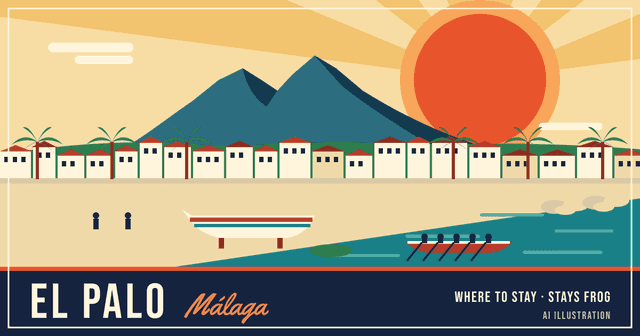
Choose El Palo for a relaxed seaside stay among locals, with espetos on the beach and El Tintero's auction-style fried fish, if you don't mind a bus into the centre.
An old fishing village at Málaga's eastern end, about 8.7 km from the centre, with a dark-sand beach below Monte San Antón, espetos grilled on the sand and El Tintero's menu-free, called-out dishes.
How it scores
- Food
- 8/10
Espetos said to have begun at La Gran Parada, El Tintero's called-out dishes and Cortijo de Pepe on Avenida Pío Baroja
- Nightlife
- 5/10
Beach restaurants keep the seafront promenade lively into summer evenings; otherwise a quiet residential barrio
- Shopping
- 5/10
A residential seaside barrio built around the beach and food; head into the centre for shops
- Walkability
- 8/10
Flat 1,200 m beach promenade and an easy seafront walk to Pedregalejo; streets climb inland to the hills
- Transit
- 5/10
EMT buses 3, 8, 11 and 34 to the Alameda; no metro or train, so a bus plus the C-1 or a taxi for the airport
- Coolness
- 8/10
Working fishing boats, jábega regattas, the Fiestas Marineras and the Virgen del Carmen on 16 July
- Safety
- 7/10
Relaxed by day; don't leave bags on the sand, follow the flags, and taxi back late as back streets go quiet
- Loudness
- 6/10
Promenade lively on summer evenings and during the summer fiestas; streets behind the seafront quiet at night
Each category is scored 1-10 by our editors; the Frog Score is their average. Safety is our editors' judgment of how comfortable it is to walk around, not crime statistics. Loudness runs from library quiet (1) to never sleeps (10) and doesn't count toward the Frog Score. How we score
Our take
El Palo is the old fishing village at Málaga's eastern end, about 8.7 km from the centre, strung along a dark-sand beach beneath Monte San Antón. It still feels like a town of its own: a working-class barrio with a strong identity and busy neighbourhood clubs, with fishing boats still working from the beach and a seafront promenade lined with beach restaurants. Summer brings the Fiestas Marineras, jábega rowing regattas in the evenings and the Virgen del Carmen celebrations on 16 July.
It suits families, return visitors and anyone who would rather wake up by the sea than in the old town, and it is the place to be if fried fish and espetos are the point of the trip. Look for an apartment within a few streets of the promenade, since the neighbourhood climbs inland toward the hills, and don't expect boutique hotels or museums; you come here for the beach and the food, and go into the centre for the sights. Pedregalejo, next door to the west, is an easy walk along the seafront.
The beach, about 1,200 metres of sand with calm water, lifeguards, showers and a promenade, is also called the Playa de los Espetos: sardines skewered on a cane and grilled over charcoal are said to have begun here, at the bar La Gran Parada. Just east along the seafront, El Tintero has no menu at all: waiters walk between the tables calling out dishes, and the first guest to raise a hand gets the plate. On Avenida Pío Baroja at the western edge, Cortijo de Pepe's El Palo branch serves traditional Málaga cooking, as it has done in the city since 1971. On summer evenings, watch the jábega clubs race their long rowing boats off the beach, with the twin peaks of Monte San Antón rising behind the village.
EMT city buses, among them lines 3, 8, 11 and 34, link El Palo with Pedregalejo, the Alameda Principal in the centre, the university and the Hospital Clínico, and interurban buses run east to Rincón de la Victoria, Vélez-Málaga and Nerja. There is no metro or train out here, so allow time for the ride into town and plan on a taxi, or a bus to the centre and then the C-1 suburban train, for the airport. El Palo is a residential neighbourhood that feels relaxed by day, and the promenade stays lively into the evening in summer. Take the usual beach precautions: don't leave bags unattended on the sand, follow the flags (red means no swimming), and cover up when you leave the sand, as local rules in Spain can fine swimwear on the seafront and nearby streets. Late at night the streets behind the promenade are quiet, so take a taxi if you're coming back from the centre after the buses thin out.
By Stays Frog AI Desk
A short history
El Palo grew up between Monte San Antón and the sea, where the Romans salted anchovies and sardines in the first century AD and where, in 1483, a Christian army suffered heavy losses by the Jaboneros stream in a battle remembered in the name Cuesta de la Matanza. For centuries the valley was almost empty, with only 35 people counted there and in Las Cuevas in the late 17th century, until a drought from 1800 brought families from Motril, Almería, Totalán, Olías and Benagalbón, and the population grew from 560 to more than 5,000 in under a century. Fishing became the main living: jábega boats worked the beach and cenacheros carried the catch in baskets to sell in the city. The tram reached El Palo in 1901 and a narrow-gauge railway crossed it in 1908, tying the village to Málaga, and the most widespread story of its name is a tall wooden pole that stood at the tram stop. Today it is a working-class seaside barrio with a strong identity, where jábegas race in summer regattas and the Virgen del Carmen is honoured every 16 July with a blessing of the waters.
No places in El Palo scored yet.
Traveller reviews
What people who've been say. One review each; you can update yours.
References(12)
Primary sources used to check this guide and its listings.
- El Palo · Primary city / venue source
- Especialistas en pescaito frito y su subasta · Primary city / venue source
- Cortijo de Pepe | Meson y Restaurante desde 1971 · Primary city / venue source
- Málaga municipal neighbourhood polygons — El Palo · Ayuntamiento de Málaga — Sistema de Información Cartográfica; CC BY 4.0
- Safety and security - Spain travel advice - GOV.UK · UK Foreign, Commonwealth & Development Office — current visitor-safety guidance
- El Palo (Málaga) · Wikipedia (Spanish)
- Playa de El Palo · Wikipedia (Spanish)
- Monte San Antón (Málaga) · Wikipedia (Spanish)
- Jábega · Wikipedia (Spanish)
- Playas de Málaga · Ayuntamiento de Málaga
- Málaga Airport · Wikipedia (English)
- Línea C-1 (Cercanías Málaga) · Wikipedia (Spanish)