NeighborhoodsNeighborhood area
Alfalfa, Encarnación-Regina and Santa Catalina
Central squares, tapas and the Setas cultural complex · Seville
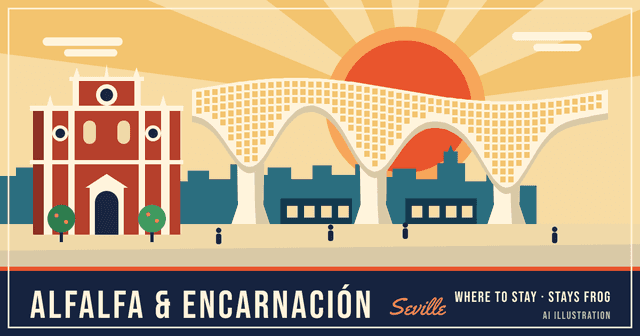
Choose Alfalfa and Encarnación for a central, lively base under the Setas, with tapas bars, a market and the cathedral all within an easy walk.
The lively heart of Seville's old walled town, around the Plaza de la Alfalfa and the giant timber Setas of the Metropol Parasol, with the Encarnación market, the Iglesia del Salvador and the browsing streets of Regina and Pérez Galdós.
How it scores
- Food
- 9/10
Traditional taverns and creative kitchens around Plaza de la Alfalfa and Pérez Galdós, plus the Encarnación market
- Nightlife
- 8/10
Bars around the Plaza de la Alfalfa stay lively until late, especially at weekends, with art markets and events
- Shopping
- 8/10
Designer shops, bookshops and cafés on Calle Regina and Pérez Galdós, with the Sierpes shopping streets next door
- Walkability
- 9/10
Flat, compact lanes; the cathedral, Sierpes and the Macarena are all within walking distance
- Transit
- 7/10
Buses and taxis on the edge streets; MetroCentro trams from Plaza Nueva; airport bus from Plaza de Armas
- Coolness
- 9/10
Rooftop terraces of the Setas, the Roman Antiquarium below, street art on Regina and the Museo del Baile Flamenco
- Safety
- 7/10
Busy and comfortable by day; watch bags at the Setas and drinks in packed bars; Santa Catalina is quiet late
- Loudness
- 8/10
Bar streets around the Alfalfa are loud late, especially at weekends; Santa Catalina's side lanes go quiet
Each category is scored 1-10 by our editors; the Frog Score is their average. Safety is our editors' judgment of how comfortable it is to walk around, not crime statistics. Loudness runs from library quiet (1) to never sleeps (10) and doesn't count toward the Frog Score. How we score
Our take
Alfalfa, Encarnación-Regina and Santa Catalina make up the busy middle of Seville's old walled town, the knot of lanes between the Sierpes shopping streets and the quieter north. The Plaza de la Alfalfa sits where the Roman city's main streets crossed, the Iglesia del Salvador stands on the site of a 9th-century mosque, and the Metropol Parasol, the giant timber "Setas" on Plaza de la Encarnación, gives the area its modern landmark. Calle Regina and Calle Pérez Galdós are the main browsing streets, with designer shops, bookshops, street art and cafés, while the side streets of Santa Catalina, around its parish churches, feel more residential.
It suits first-time visitors, food lovers and anyone who wants to step out of the door into the centre, with the cathedral, the shopping streets and the Macarena all within walking distance. Accommodation is mostly small hotels and apartments in old townhouses around Regina, Santa Catalina and the lanes off the Alfalfa, often better value than the cathedral-side lanes of Santa Cruz. Rooms over the bar streets can be noisy late, so ask for one at the back or on a quieter lane.
Start at the Setas: the Antiquarium in the basement displays the Roman and Moorish remains found on the site, the Encarnación market trades at street level, and the terraces on top look out over the rooftops of the old town. The Iglesia del Salvador, finished in 1712 by Leonardo de Figueroa, keeps the base of the old minaret in its tower, and the Museo del Baile Flamenco is a few lanes away on Calle Manuel Rojas Marcos. The food runs from traditional taverns and Sevillian tapas to newer, creative kitchens, especially around the Plaza de la Alfalfa and Pérez Galdós, and everyday life here mixes with cultural events and art markets.
The area is flat and compact, and most of what visitors come for is on foot; taxis and city buses run along the wider streets at its edges. MetroCentro trams start at Plaza Nueva, just beyond the City Hall, and run to Puerta de Jerez, where metro line 1 stops, and on to San Bernardo, while the airport express bus leaves from the Plaza de Armas bus station on the west side of the old town, calls at Santa Justa station and takes about 40 minutes. By day the streets are busy and comfortable. At night the bars around the Alfalfa stay lively until late, especially at weekends, while Santa Catalina's lanes go quiet, so keep to the main streets if walking alone in the small hours. As anywhere in Spain, thieves use distraction and often work in teams, so watch bags in the crowds around the Setas and on the shopping streets, keep an eye on your drink in packed bars, and in summer save long walks for the cooler mornings and evenings.
By Stays Frog AI Desk
A short history
In Roman times the main north-south and east-west streets of Hispalis crossed around today's Plaza de la Alfalfa, where the forum of the imperial city stood, and nearby the Iglesia del Salvador occupies the site of the mosque of Ibn Adabbas, built in 829 to 830 and the city's main mosque until 1182. After Fernando III took Seville in 1248 the mosque became a church, and the present Baroque building went up between 1679 and 1712, completed by Leonardo de Figueroa. Plaza de la Encarnación is named after an Augustinian convent pulled down early in the 19th century, during the French invasion, and replaced by a market of three covered galleried streets, while in 1852 the city moved an animal market onto the Plaza de la Alfalfa. The Encarnación market was partly demolished in 1948 and the rest in 1973, and when work on a new market and car park began around 1990, Roman and Al-Andalus remains turned up and the project stopped. In 2004 an international competition chose German architect Jürgen Mayer H.'s Metropol Parasol, finished in 2011, whose six timber parasols now shelter the market, a museum of the excavated ruins and a rooftop walkway.
No places in Alfalfa, Encarnación-Regina and Santa Catalina scored yet.
Traveller reviews
What people who've been say. One review each; you can update yours.
References(13)
Primary sources used to check this guide and its listings.
- Barrio de la Alfalfa & Encarnación - Visita Sevilla - EN · Visita Sevilla
- Verified formal map scope — Alfalfa, Encarnación-Regina and Santa Catalina · Ayuntamiento de Sevilla — Gerencia de Urbanismo y Medio Ambiente
- Safety and security - Spain travel advice - GOV.UK · UK Foreign, Commonwealth & Development Office — current visitor-safety guidance
- Metropol Parasol · Wikipedia
- Plaza de la Encarnación (Sevilla) · Wikipedia (Spanish)
- Plaza de la Alfalfa · Wikipedia (Spanish)
- Iglesia del Salvador (Sevilla) · Wikipedia (Spanish)
- Encarnación-Regina · Wikipedia (Spanish)
- Santa Catalina (Sevilla) · Wikipedia (Spanish)
- MetroCentro (Seville) · Wikipedia
- Seville Metro · Wikipedia
- Seville Airport (ground transport) · Wikipedia
- Getting there by bus - Seville Airport · Aena