NeighborhoodsNeighborhood area
Triana Casco Antiguo, Triana Este and Los Remedios
Ceramics streets, river-side meals and west-bank outings · Seville
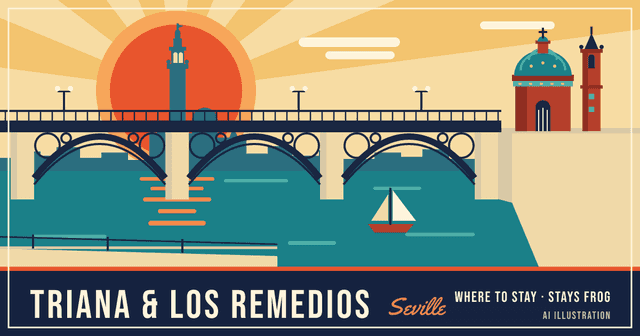
Choose Triana and Los Remedios for tapas, ceramics, flamenco and river views with real local life, a short walk over the bridge from the Cathedral.
Seville's west bank across the Guadalquivir: old Triana's ceramics workshops, the Triana Market and Calle Betis terraces facing the Torre del Oro, plus calmer Los Remedios around Plaza de Cuba and Calle Asunción, a bridge from the Cathedral.
How it scores
- Food
- 9/10
Triana Market's fish, bread and tapas stalls on Plaza del Altozano, corner bars on San Jacinto and Betis terraces
- Nightlife
- 8/10
Riverside bars and terraces on Calle Betis stay busy late, with live flamenco in the barrio's peñas and tablaos
- Shopping
- 7/10
Ceramics shops on San Jorge, Pureza and Antillano Campos; local shops and ice-cream parlours on Calle Asunción
- Walkability
- 8/10
Walk over the Triana or San Telmo bridge to the Arenal and Cathedral; Calle Asunción in Los Remedios is pedestrianised
- Transit
- 8/10
Metro Line 1 at Plaza de Cuba, Parque de los Príncipes and Blas Infante to Puerta Jerez; EA airport bus from the centre
- Coolness
- 9/10
Santa Ana church of 1276, the Centro Cerámica Triana's original kilns, flamenco peñas and July's Velá de Santa Ana
- Safety
- 7/10
Neighbourly by day and evening; watch bags in the market and on the bridge, and avoid dark riverside stretches late
- Loudness
- 7/10
Betis is noisy and crowded on weekend nights and in high season; Los Remedios is calm except during the April Fair
Each category is scored 1-10 by our editors; the Frog Score is their average. Safety is our editors' judgment of how comfortable it is to walk around, not crime statistics. Loudness runs from library quiet (1) to never sleeps (10) and doesn't count toward the Frog Score. How we score
Our take
Across the Guadalquivir from the old town, Triana has always felt like a place of its own: the old arrabal of potters, sailors, bullfighters and flamenco artists, whose trianeros still identify fiercely with the barrio. Its heart runs from the Triana Bridge and Plaza del Altozano along San Jacinto and Pureza, past ceramics workshops and corner bars, to the riverside Calle Betis, whose colourful houses face the Torre del Oro, the Giralda and the Cathedral across the water. To the south, Los Remedios is a different world: a planned 20th-century grid of apartment blocks around Plaza de Cuba and the pedestrianised Calle Asunción, calm, residential and home to the April Fair grounds.
It suits food lovers, repeat visitors, flamenco fans and travellers who want a lived-in neighbourhood with the Cathedral a bridge away. For atmosphere, stay in old Triana near Altozano, San Jacinto or Betis, ideally with a river view; for quieter nights and a metro on the doorstep, look around Plaza de Cuba and Calle Asunción in Los Remedios, which the tourism board counts among the most sought-after residential areas in Seville. Prices are generally gentler than across the river, and you trade monument views from the window for real neighbourhood life. Book well ahead for Feria week, when Asunción becomes the main route to the fairground.
Cross the Triana Bridge, officially the Isabel II Bridge and Seville's first permanent metal bridge, past the little Chapel of El Carmen to the Triana Market on Plaza del Altozano, with stalls of fish, meat, fruit, vegetables and bread alongside tapas bars, all built over the remains of the Castillo de San Jorge; the archaeological site below is closed for now, but its lobby serves as a tourist office. The parish church of Santa Ana, founded by Alfonso X in 1276 and known as the Cathedral of Triana, anchors Calle Pureza, and the Centro Cerámica Triana, in the old Santa Ana pottery factory, keeps its original kilns and explains how Triana tiles came to decorate buildings such as the Plaza de España; ceramics shops still trade on San Jorge, Pureza and Antillano Campos. Evenings belong to the bars and riverside terraces of Calle Betis and to live flamenco in the barrio's peñas and tablaos, and in late July the Velá de Santa Ana fills Betis with sevillanas, roasted sardines and the cucaña, a greasy-pole contest over the river. In Los Remedios, Calle Asunción has local shops, cafés and ice-cream parlours, and Plaza de Cuba has a monument to the Magellan-Elcano expedition, which set sail from this riverbank in 1519.
Metro Line 1 stops at Plaza de Cuba, Parque de los Príncipes and Blas Infante and runs across the river to Puerta Jerez, the Prado de San Sebastián and Nervión, while the Triana and San Telmo bridges make the Arenal and the Cathedral an easy walk. For the airport, cross to the centre for the EA airport bus, which takes about 30 to 35 minutes, or take a taxi. Both halves feel safe and neighbourly by day and in the evening, when families fill Asunción and the terraces of Betis and Altozano stay busy late. Expect noise and crowds on Betis on weekend nights and in high season, and huge crowds in Los Remedios during the April Fair; keep an eye on bags in the market and on the bridge, where thieves use distraction, and late at night stick to the lit streets rather than the darker stretches of the riverside walk.
By Stays Frog AI Desk
A short history
Triana began as an arrabal, a suburb across the Guadalquivir from the walled city, inhabited since Roman times and grown up under Islamic rule around a castle, and in 1171 the caliph Abu Yaqub Yusuf tied it to Seville with a bridge of boats. After the Castilian conquest of 1248 the castle became the Castillo de San Jorge, seat of the Inquisition from 1481 to 1785, and Alfonso X founded the church of Santa Ana in 1276. Potters, sailors, bullfighters and flamenco artists, among them a large Romani community living in courtyard corrales, shaped the barrio's identity, and the iron Isabel II Bridge, inaugurated in 1852, finally gave it a permanent link to the city. Los Remedios, on the orchards and riverside land to the south from which Magellan's expedition sailed in 1519, was planned from the 1920s, linked to the centre by the San Telmo bridge in 1931 and built up with apartment blocks around Plaza de Cuba and Calle Asunción from the 1940s. In 1973 the April Fair moved to its new grounds in Los Remedios, while many of Triana's corrales were lost to redevelopment in the late 20th century, leaving today's mix of old Triana lanes and modern Los Remedios avenues.
No places in Triana Casco Antiguo, Triana Este and Los Remedios scored yet.
Traveller reviews
What people who've been say. One review each; you can update yours.
References(15)
Primary sources used to check this guide and its listings.
- Barrio de Triana y Los Remedios - Visita Sevilla - EN · Visita Sevilla
- Verified formal map scope — Triana Casco Antiguo, Triana Este and Los Remedios · Ayuntamiento de Sevilla — Gerencia de Urbanismo y Medio Ambiente
- Safety and security - Spain travel advice - GOV.UK · UK Foreign, Commonwealth & Development Office — current visitor-safety guidance
- Triana, Seville · Wikipedia
- Los Remedios (Sevilla) · Wikipedia (es)
- Triana Bridge - Visita Sevilla - EN · Visita Sevilla
- Mercado de Triana - Visita Sevilla - EN · Visita Sevilla
- Castillo de San Jorge - Visita Sevilla - EN · Visita Sevilla
- Parroquia de Santa Ana - Visita Sevilla - EN · Visita Sevilla
- Centro Cerámica Triana - Visita Sevilla - EN · Visita Sevilla
- Calle Betis - Visita Sevilla - EN · Visita Sevilla
- Calle Asunción - Visita Sevilla - EN · Visita Sevilla
- Metro de Sevilla (Line 1 stations) · Metro de Sevilla
- Seville Airport: getting there by bus (EA line) · Aena
- Aeropuerto de Sevilla - Visita Sevilla - EN · Visita Sevilla