NeighborhoodsNeighborhood area
Prado and Parque María Luisa
Exhibition-era buildings, gardens and open-air architecture · Seville
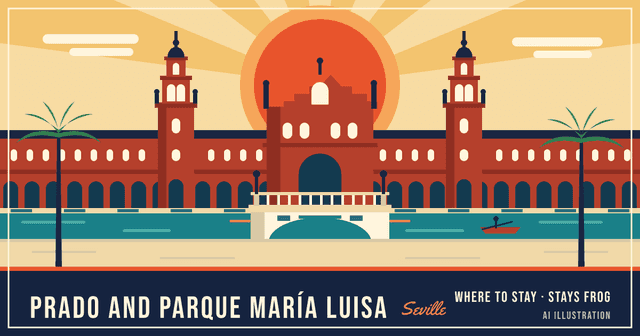
Stay by María Luisa Park for the Plaza de España, quiet garden mornings and easy metro and tram links, not for nightlife.
Seville's 1929 exposition grounds just south of the old town, where María Luisa Park's palms and fountains surround the tiled Plaza de España and the museum pavilions of Plaza de América. Quiet nights, leafy morning walks and the Cathedral a short walk north.
How it scores
- Food
- 6/10
Few restaurants in the park itself; picnic on the lawns, eat at La Raza or walk back into Santa Cruz and the Arenal
- Nightlife
- 4/10
Quiet after dark apart from summer concerts at the Plaza de España; bars and tapas are back in Santa Cruz
- Shopping
- 4/10
Gardens, museums and government offices rather than shops; the old town's streets are minutes away
- Walkability
- 8/10
Park paths link the Plaza de España, Glorieta de Bécquer and Plaza de América; the Cathedral is a short walk north
- Transit
- 8/10
Metro Line 1 and the Metrocentro tram at Prado de San Sebastián and Puerta Jerez, plus the Prado bus station hub
- Coolness
- 7/10
Aníbal González's tiled Plaza de España, seen in Lawrence of Arabia, plus Neo-Mudéjar pavilions and the Costurero de la Reina
- Safety
- 7/10
Relaxed and family-friendly by day; inner park paths are dim at night, and thieves work the Plaza de España crowds
- Loudness
- 5/10
Busy by day around the Plaza de España, with occasional summer concerts; quiet nights on the park's edges
Each category is scored 1-10 by our editors; the Frog Score is their average. Safety is our editors' judgment of how comfortable it is to walk around, not crime statistics. Loudness runs from library quiet (1) to never sleeps (10) and doesn't count toward the Frog Score. How we score
Our take
This is the Seville built to impress the world in 1929: the Prado de San Sebastián and María Luisa Park, where the Ibero-American Exposition left wide avenues, tiled plazas and pavilions in every historical style scattered among palms, orange trees and fountains. The tourism board calls it an open-air museum, and its centrepiece, Aníbal González's vast brick-and-ceramic semicircle of the Plaza de España, is the area's most recognisable image. It is more park than neighbourhood, a place of gardens, museums, university buildings and government offices rather than shops and bars.
It suits families, architecture lovers, garden walkers and runners, and travellers arriving at the Prado de San Sebastián bus station. There is little accommodation inside the park itself, so most visitors stay on its edges, between Puerta de Jerez and the Prado, with the old town minutes away. The landmark choice is the Hotel Alfonso XIII on Calle San Fernando, a short walk north of the park, built in Neo-Mudéjar style for the exposition and opened with a royal banquet in April 1929; it is still run as a luxury hotel. Staying here means quiet nights and leafy morning walks, at the cost of fewer restaurants and bars on the doorstep.
Start at the Plaza de España, built between 1914 and 1928: its curved arcades end in two tall towers, a canal you can explore by rowing boat runs in front under four bridges dedicated to the old kingdoms of Castile, León, Aragon and Navarre, and tiled benches illustrate the Spanish provinces with typical scenes. It is open from 8am to midnight and starred in Lawrence of Arabia and Star Wars: Episode II. Then wander María Luisa Park, past the Glorieta de Bécquer and the Fountain of the Lions, to the Plaza de América, where the Mudéjar Pavilion holds the Museum of Arts and Popular Customs and the former Fine Arts Pavilion the Archaeological Museum, with finds from Italica and Roman mosaics. Children love the white doves of the plaza and the planetarium at the Casa de la Ciencia in the Peru Pavilion. Opposite the park, the octagonal Neo-Mudéjar Costurero de la Reina of 1893 houses a tourist information point, and the Baroque Palacio de San Telmo, seat of the Andalusian regional presidency, opens for free guided tours on selected dates with advance registration. For food, picnic in the park, try the La Raza restaurant in the exposition's old information pavilion, or walk back into Santa Cruz and the Arenal.
Getting here is easy: Metro Line 1 stops at Prado de San Sebastián and Puerta Jerez, the Metrocentro tram stops at both on its run between Plaza Nueva and Nervión, and the Prado de San Sebastián bus station, run by the city transport company TUSSAM, is a hub for urban and regional buses. The Cathedral is a short walk north, and the EA airport bus links the centre with Seville Airport in about 30 to 35 minutes. By day the park and the plaza are busy, relaxed and family-friendly, but they are exposed to the sun, so carry water and go early or near sunset in summer, and check the events calendar, since summer concerts can close the plaza and parts of the park. After dark the park's inner paths are dim and quiet, so walk around them on the lit avenues, and keep an eye on bags in the crowds at the Plaza de España, where, as anywhere busy in Spain, thieves work in teams using distraction.
By Stays Frog AI Desk
A short history
For centuries this was open ground beyond the city walls: the Prado de San Sebastián served as a burning ground of the Inquisition, whose last victim died there in 1781, and from 1847 it hosted the April Fair. Beside it lay the private gardens of the Palace of San Telmo, which the Infanta María Luisa, Duchess of Montpensier, donated to the city in 1893, and from 1911 the French landscape architect Jean-Claude Nicolas Forestier redesigned them as María Luisa Park. The park was chosen for the Ibero-American Exposition, and from 1914 Aníbal González built the Plaza de España, finished in 1928, and the Mudéjar, Renaissance and Royal pavilions of the Plaza de América. The exposition ran from May 1929 to June 1930 and most of its buildings were meant to last: country pavilions became consulates, a flamenco school and a science museum, and the Mudéjar and Fine Arts pavilions now house the Museum of Arts and Popular Customs and the Archaeological Museum. The Prado gained Andalusia's first bus station, designed between 1938 and 1944, and when the fair outgrew its grounds in 1973 and moved to Los Remedios, the area settled into the gardens and monuments visitors walk today.
No places in Prado and Parque María Luisa scored yet.
Traveller reviews
What people who've been say. One review each; you can update yours.
References(18)
Primary sources used to check this guide and its listings.
- Barrio de la Sevilla del 29 - Visita Sevilla - EN · Visita Sevilla
- Verified formal map scope — Prado and Parque María Luisa · Ayuntamiento de Sevilla — Gerencia de Urbanismo y Medio Ambiente
- Safety and security - Spain travel advice - GOV.UK · UK Foreign, Commonwealth & Development Office — current visitor-safety guidance
- Plaza de España - Visita Sevilla - EN · Visita Sevilla
- Plaza de América y museos - Visita Sevilla - EN · Visita Sevilla
- Costurero de la Reina - Visita Sevilla - EN · Visita Sevilla
- Palacio de San Telmo - Visita Sevilla - EN · Visita Sevilla
- Pabellón de Perú, Museo de las Ciencias - Visita Sevilla - EN · Visita Sevilla
- Estación de Autobuses Prado de San Sebastián - Visita Sevilla - EN · Visita Sevilla
- Ibero-American Exposition of 1929 · Wikipedia
- Plaza de España, Seville · Wikipedia
- Parque de María Luisa · Wikipedia
- Prado de San Sebastián · Wikipedia (es)
- Hotel Alfonso XIII · Wikipedia
- Metro de Sevilla (Line 1 stations) · Metro de Sevilla
- MetroCentro (Seville) · Wikipedia
- Seville Airport: getting there by bus (EA line) · Aena
- Aeropuerto de Sevilla - Visita Sevilla - EN · Visita Sevilla