NeighborhoodsNeighborhood area
Santa Cruz and San Bartolomé
Cathedral-side lanes, historic houses and flamenco rooms · Seville
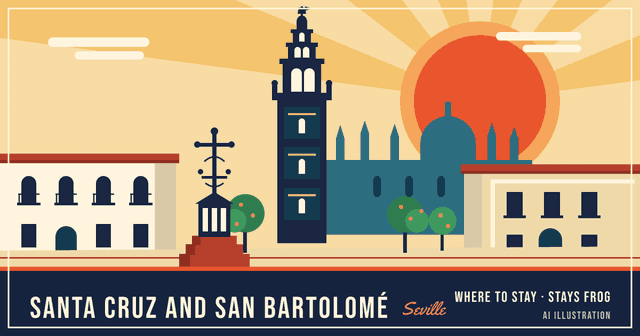
Choose Santa Cruz to wake up beside the Cathedral, Giralda and Alcázar in Seville's most romantic lanes, and accept higher prices and crowds.
Seville's old Jewish quarter of whitewashed lanes and orange-tree squares wrapped around the Cathedral, the Giralda and the Royal Alcázar, with corners such as Callejón del Agua and Plaza de los Venerables to get lost in.
How it scores
- Food
- 9/10
Tapas bars and restaurants fill the squares in the evening, with rooftop terraces looking onto the Cathedral
- Nightlife
- 7/10
Flamenco rooms, tapas bars and rooftop terraces with Cathedral views; book the popular ones ahead
- Shopping
- 8/10
Lanes and squares around the Cathedral and Alcázar to wander; the Arenal is within easy reach on foot
- Walkability
- 9/10
Made for walking: Callejón del Agua, Plaza de Doña Elvira, and the Arenal and Triana Bridge in easy reach
- Transit
- 8/10
Metrocentro tram at Archivo de Indias and Puerta de Jerez, Metro line 1 at Puerta Jerez and the EA airport bus
- Coolness
- 9/10
Three UNESCO-listed monuments, Plaza de Santa Cruz, the Velázquez Center at Los Venerables and Casa Fabiola
- Safety
- 7/10
Safe by day and evening; pickpockets at the Cathedral, Alcázar queues and tram stops; use Mateos Gago late
- Loudness
- 7/10
Squares full of diners into the evening; inner lanes empty quickly late, and patio rooms are quieter
Each category is scored 1-10 by our editors; the Frog Score is their average. Safety is our editors' judgment of how comfortable it is to walk around, not crime statistics. Loudness runs from library quiet (1) to never sleeps (10) and doesn't count toward the Frog Score. How we score
Our take
Santa Cruz is the Seville of the postcards: the old Jewish quarter's tangle of narrow, whitewashed lanes, squares shaded by orange trees and courtyards full of flowers and fountains, wrapped around the Cathedral, the Giralda and the Royal Alcázar. Together with neighbouring San Bartolomé it stretches from the Cathedral and the Archive of the Indies to the Murillo Gardens, so a stay here puts all three of the city's UNESCO-listed monuments on your doorstep. The romantic look was polished in the 1910s and 1920s with brick paving, tiles and fountains, but the winding medieval street plan is real, and corners such as Callejón del Agua, Plaza de Doña Elvira and Plaza de los Venerables still reward getting lost.
It suits first-time visitors, couples and anyone who wants to step out of the door into the monuments early, before the tour groups arrive. Accommodation ranges from small hotels in historic houses to grander addresses facing the Cathedral, and at the southern end, on Calle San Fernando, the Hotel Alfonso XIII, built for the 1929 exposition and opened with a royal banquet in April 1929, is still run as a luxury hotel. Expect to pay more than elsewhere in Seville and to wheel luggage along narrow lanes. The city has declared the quarter saturated with holiday flats and limits new tourist-rental licences, so a hotel is often the simpler choice, and light sleepers should ask for a room on an inner patio rather than over a lane.
Book the Alcázar ahead: begun as a 10th-century Muslim fortress and transformed by Peter I with his 14th-century Mudéjar Palace, it is still used by the royal family, and its gardens cover more than seven hectares. The Cathedral, the largest Gothic cathedral in the world, was begun in 1401 on the site of the Almohad Great Mosque; climb the Giralda's 35 ramps for views over the Patio de los Naranjos. Next door, the Archive of the Indies, founded in 1785, displays documents signed by Columbus, Magellan and Pizarro. Deeper in the quarter, the Hospital de los Venerables, a Baroque priests' residence built between 1676 and 1697, houses the Velázquez Center; Casa Fabiola shows Mariano Bellver's collection of 19th-century Sevillian painting; and Plaza de Santa Cruz, with its wrought-iron Cruz de la Cerrajería, marks the site of the church where Murillo was buried. In the evening, tapas bars, restaurants, flamenco rooms and rooftop terraces with Cathedral views fill up; each sets its own reservations and rules, so book the popular ones.
Santa Cruz is a place to walk, and the Arenal, the river and the Triana Bridge are all within easy reach on foot. The Metrocentro tram stops at Archivo de Indias and Puerta de Jerez on its run between Plaza Nueva and Nervión, Metro Line 1 stops at Puerta Jerez, Santa Justa station for high-speed trains is a short taxi ride away, and the EA airport bus links the centre with Seville Airport in about 30 to 35 minutes. The quarter feels safe by day and in the evening, when its squares are full of diners, but the crowds around the Cathedral, the Alcázar queues and the tram stops are where pickpockets work, often in teams using distraction, so keep bags closed and phones out of back pockets. Late at night the inner lanes empty quickly and can be dim and confusing, so use the wider streets such as Mateos Gago and Santa María la Blanca, and remember this is a residential quarter: the tourism board publishes a good-practice guide asking visitors to respect the people who live here.
By Stays Frog AI Desk
A short history
Santa Cruz grew out of Seville's medieval Jewish quarter: after Ferdinand III of Castile took the city in 1248, its Jewish community, the most important in Spain after Toledo's, settled here and in neighbouring San Bartolomé. After the anti-Jewish riots of 1391 the synagogues were turned into churches, and the expulsion of the Jews in 1492 left the quarter to a long decline. During the French occupation the parish church of Santa Cruz, where the painter Bartolomé Esteban Murillo was buried, was closed and then demolished in 1814, and its site became today's Plaza de Santa Cruz. The romantic barrio visitors know took shape between about 1912 and 1924, when the Marqués de la Vega-Inclán and the architect Juan Talavera remodelled its squares with brick paving, fountains, tiles and gardens, while in 1911 Alfonso XIII gave part of the Alcázar's gardens to the city for what became the Jardines de Murillo. Today it is one of Seville's great tourist draws, so popular that the city has declared it saturated with holiday flats and limits new tourist-rental licences.
No places in Santa Cruz and San Bartolomé scored yet.
Traveller reviews
What people who've been say. One review each; you can update yours.
References(17)
Primary sources used to check this guide and its listings.
- Barrio de Santa Cruz - Visita Sevilla - EN · Visita Sevilla
- Verified formal map scope — Santa Cruz and San Bartolomé · Ayuntamiento de Sevilla — Gerencia de Urbanismo y Medio Ambiente
- Safety and security - Spain travel advice - GOV.UK · UK Foreign, Commonwealth & Development Office — current visitor-safety guidance
- Barrio de Santa Cruz (Sevilla) · Wikipedia (es)
- Santa Cruz, Seville · Wikipedia
- Plaza de Santa Cruz - Visita Sevilla - EN · Visita Sevilla
- Jardines de Murillo - Visita Sevilla - EN · Visita Sevilla
- Hospital de los Venerables - Visita Sevilla - EN · Visita Sevilla
- Real Alcázar de Sevilla - Visita Sevilla - EN · Visita Sevilla
- Catedral de Sevilla y Giralda - Visita Sevilla - EN · Visita Sevilla
- Archivo de Indias - Visita Sevilla - EN · Visita Sevilla
- Casa Fabiola - Visita Sevilla - EN · Visita Sevilla
- Hotel Alfonso XIII · Wikipedia
- Metro de Sevilla (Line 1 stations) · Metro de Sevilla
- MetroCentro (Seville) · Wikipedia
- Seville Airport: getting there by bus (EA line) · Aena
- Aeropuerto de Sevilla - Visita Sevilla - EN · Visita Sevilla