NeighborhoodsNeighborhood area
Museo and San Vicente
Fine art, civic architecture and central shopping · Seville
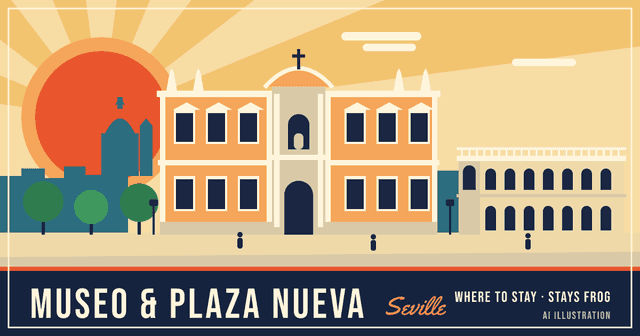
Stay here for the Museo de Bellas Artes, the main shopping streets and the airport bus at Plaza de Armas, in a central base calmer than the cathedral quarter.
The calmer western side of Seville's old town, around the Museo de Bellas Artes and its Murillo paintings, with the Sierpes and Tetuán shopping streets, Plaza Nueva and the airport bus at Plaza de Armas close by.
How it scores
- Food
- 8/10
Cafés and bars around the Museo and the shopping streets, with El Arenal's tapas streets just to the south
- Nightlife
- 7/10
Bars around the shopping district and El Arenal next door; San Vicente goes very quiet at night
- Shopping
- 9/10
Historic shops and family businesses from Plaza del Duque down Sierpes, Tetuán and Velázquez to Plaza Nueva
- Walkability
- 9/10
Flat and central: Murillo's paintings, Plaza Nueva, the river and Triana are all a few minutes on foot
- Transit
- 8/10
Airport express from Plaza de Armas via Santa Justa in about 40 minutes; MetroCentro trams at Plaza Nueva
- Coolness
- 8/10
Museo de Bellas Artes in a three-cloister convent, the Sunday painters' market and the Magdalena's frescoes
- Safety
- 7/10
Cheerful crowds by day; watch bags at the bus station and on shopping streets; keep to lit streets late
- Loudness
- 7/10
Busy shopping streets by day; San Vicente and the Torneo riverside road grow very quiet after closing
Each category is scored 1-10 by our editors; the Frog Score is their average. Safety is our editors' judgment of how comfortable it is to walk around, not crime statistics. Loudness runs from library quiet (1) to never sleeps (10) and doesn't count toward the Frog Score. How we score
Our take
Museo and San Vicente are the quieter western side of Seville's old town, a web of residential streets, convents and chapels around the Museo de Bellas Artes that stretches west to the river, with the city's main shopping streets and Plaza Nueva on its eastern edge. The tourism board groups it with the civic and commercial heart of the city, from Plaza del Duque down Sierpes, Tetuán and Velázquez to the City Hall, so in one short walk you pass from Murillo's paintings to historic shop windows and family businesses.
It suits art lovers, shoppers and travellers arriving by bus or heading to the airport, since the Plaza de Armas bus station is on its western side. Hotels range from those facing Plaza Nueva, such as the long-established Hotel Inglaterra, to hotels nearer Calle Reyes Católicos and apartments in the quieter streets around San Vicente. You give up the postcard lanes of Santa Cruz, but gain a calmer base a few minutes from the shops, the river and Triana.
The Museo de Bellas Artes, in a former convent with three cloisters, is one of Spain's leading museums of Spanish painting, with works by Murillo, Zurbarán, Valdés Leal and Velázquez, and on Sunday mornings painters sell their work in the open-air market on the Plaza del Museo, under the statue of Murillo. The Baroque church of the Magdalena, with frescoes by Lucas Valdés, two canvases by Zurbarán and an exterior picked out in blue and red, is a short walk away. Shopping fills the streets from Plaza del Duque to Plaza Nueva, and cafés and bars in the surrounding streets make easy stops between visits; the tapas streets of El Arenal are just to the south.
The area is flat and central. The airport express bus starts at Plaza de Armas and calls at Santa Justa station, reaching the airport in about 40 minutes. MetroCentro trams leave Plaza Nueva for Archivo de Indias by the cathedral, Puerta de Jerez, where metro line 1 stops, and San Bernardo. By day the shopping streets are crowded and cheerful; after the shops close the residential streets around San Vicente and the riverside road along the Torneo grow very quiet, so keep to lit main streets late at night. Thieves use distraction and work in teams, especially around luggage, so keep an eye on bags at the bus station and in the shopping crowds, and in summer plan museum time for the hottest part of the day.
By Stays Frog AI Desk
A short history
This western side of the walled city was long a district of religious houses: the Mercedarian convent on today's Plaza del Museo was built in 1594 and remodelled early in the 17th century by the architect Juan de Oviedo, and the Dominicans' church of the Magdalena was rebuilt between 1691 and 1709 to designs by Leonardo de Figueroa. When Spain's monasteries were closed in the 19th century, the convent became the Museo de Bellas Artes, established on 16 September 1835 to hold the paintings taken from secularised convents and monasteries, and the Magdalena became a parish church. Just to the east, the Franciscans' great medieval friary, the Casa Grande de San Francisco, was wrecked by French troops in 1811 and demolished in 1840, and its ground became Plaza Nueva, where the City Hall received its neoclassical façade and the monument to San Fernando, the king who took Seville in 1248, was unveiled in 1924. In October 2007 the square became the terminus of the new MetroCentro tram, whose first works there had been paused in 2006 when remains of the Franciscan friary came to light.
No places in Museo and San Vicente scored yet.
Traveller reviews
What people who've been say. One review each; you can update yours.
References(12)
Primary sources used to check this guide and its listings.
- Barrio del Museo y Plaza Nueva - Visita Sevilla - EN · Visita Sevilla
- Verified formal map scope — Museo and San Vicente · Ayuntamiento de Sevilla — Gerencia de Urbanismo y Medio Ambiente
- Safety and security - Spain travel advice - GOV.UK · UK Foreign, Commonwealth & Development Office — current visitor-safety guidance
- Museum of Fine Arts of Seville · Wikipedia
- Santa María Magdalena, Seville · Wikipedia
- Plaza Nueva (Sevilla) · Wikipedia (Spanish)
- San Vicente (Sevilla) · Wikipedia (Spanish)
- Hotel Inglaterra - official website · Hotel Inglaterra
- MetroCentro (Seville) · Wikipedia
- Seville Metro · Wikipedia
- Seville Airport (ground transport) · Wikipedia
- Getting there by bus - Seville Airport · Aena